
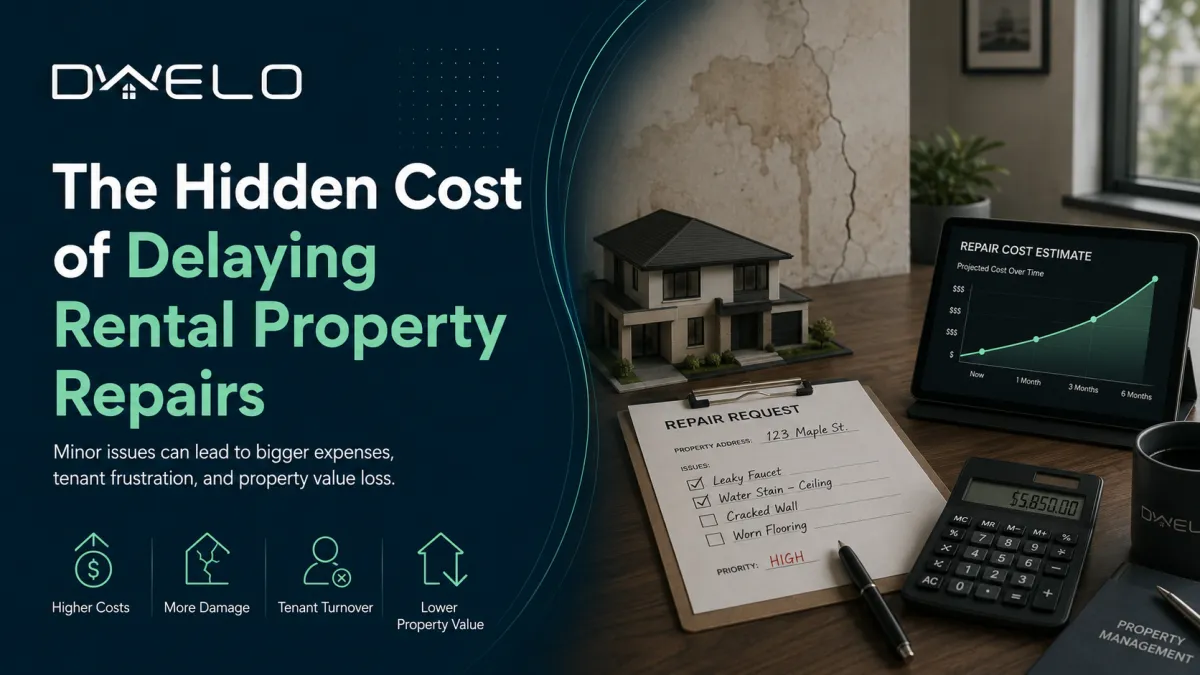
The Hidden Cost of Delaying Rental Property Repairs
Delayed repairs cost South Carolina rental property owners far more than the original fix. Discover the hidden financial, legal, and tenant costs of putting off property maintenance.
This is how deferred maintenance begins. Not with a decision to neglect a property, but with a series of small, individually justifiable delays that accumulate into something far more expensive than any single repair would have been.
The cost of delaying rental property repairs is almost always higher than the cost of making them, and the gap widens with every week that passes. For property owners across South Carolina, understanding what that gap actually contains, the financial exposure, the legal liability, the tenant relationship damage, and the property value erosion, is what separates owners who manage their investments proactively from those who are perpetually managing the consequences of not doing so.
This blog maps the full cost of delayed repairs, category by category, so owners can see exactly what is at stake when maintenance gets pushed to the back of the queue.
The Compounding Nature of Property Damage
The most direct and quantifiable cost of deferred maintenance is the compounding of physical damage over time. This is not a theoretical risk; it is the documented, predictable behavior of construction materials, mechanical systems, and building components when problems are left unaddressed.
A roof leak that is reported in spring and not addressed before summer storm season doesn't stay a roof leak. Water intrusion into a wall cavity over several months saturates insulation, compromises framing, and creates the warm, humid conditions that support mold colonization. What began as a $400 roofing repair becomes a $4,000 remediation project, and that estimate assumes the mold hasn't penetrated deeply enough to require wall demolition.
A slow drain that a tenant reports and a landlord defers doesn't stay slow. Partial blockages in older South Carolina plumbing systems, particularly in the coastal markets where saltwater corrosion accelerates pipe deterioration, can progress to full blockages, pipe stress fractures, or sewage backflow. A $150 drain clearing becomes a $2,500 pipe repair or replacement.
A minor crack in exterior caulking around a window frame, unreported by the tenant and undetected without an inspection, allows moisture infiltration that softens the window frame, damages the interior wall, and eventually compromises the window's operability. A $50 caulking job becomes a $1,200 window replacement.
The pattern is consistent across every category of repair: delay multiplies cost. The multiplier varies by the type of issue and the time elapsed, but the direction is always the same, upward, and usually steeply.
The Legal Exposure That Builds in Silence
Beyond the physical damage, deferred maintenance creates legal exposure that many property owners don't recognize until they are already in the middle of a dispute.
South Carolina's Residential Landlord and Tenant Act requires landlords to maintain rental properties in a habitable condition. This obligation is not contingent on tenant reminders, budget cycles, or a landlord's assessment of urgency. It is a continuous legal duty. When a documented maintenance request goes unaddressed for an unreasonable period of time, the property owner has created a record of potential habitability failure, a record that a tenant, or a tenant's attorney, can use as the foundation of a legal claim.
The remedies available to tenants under South Carolina law in habitability cases include the right to terminate the lease, seek damages for diminished enjoyment of the property, and, in some circumstances, withhold rent pending repair. Each of these outcomes is worse for the owner than the cost of the original repair would have been.
There is also the liability dimension that operates independently of tenant action. If a delayed repair results in an injury — a tenant trips on a broken step that was reported weeks earlier, or a ceiling fixture fails because a known water intrusion issue was never addressed, the owner's documented knowledge of the problem and failure to act creates a negligence exposure that goes well beyond a maintenance invoice.
Dwelo's lease administration and legal compliance approach is built on the understanding that documented maintenance requests are legal records, not just operational tickets. Every request acknowledged, every response timeline, every repair completion, all of it contributes to the owner's compliance posture under South Carolina law. Our property maintenance and repair services ensure that requests move through a systematic process that protects owners legally while resolving issues efficiently.
The Tenant Relationship Damage That Precedes Vacancy
The financial and legal costs of deferred maintenance are measurable. But there is a third category of cost that is harder to see on a spreadsheet and equally damaging: the erosion of the tenant relationship.
Tenants who submit maintenance requests and receive no response, or slow, reluctant responses, don't typically confront the landlord directly. They absorb the frustration quietly. They stop reporting non-urgent issues. They begin evaluating their options for the next lease term. And when renewal time arrives, they decline, not with an angry letter citing the unaddressed repairs, but with a simple notice to vacate that the owner may not immediately connect to the maintenance pattern that caused it.
This is why the cost of delayed repairs extends beyond the repair itself and into vacancy. A tenant who leaves because they felt their home wasn't being cared for takes with them the equivalent of months of rental income, the vacancy period, the turnover costs, the re-leasing expenses, and the carrying costs during the gap. None of that shows up on an invoice, but all of it traces back to the maintenance delays that made the tenant feel invisible.
The inverse is equally true and equally important. Tenants whose maintenance requests are handled promptly, professionally, and with clear communication develop trust in their property manager. That trust is the foundation of lease renewals, positive word-of-mouth, and the kind of stable long-term occupancy that makes a rental property genuinely perform. Dwelo's routine property inspections proactively surface issues before tenants need to report them, a practice that signals attentiveness and builds the tenant confidence that drives retention.
The Property Value Erosion That Accumulates Over Years
There is a longer arc to deferred maintenance that extends beyond any single tenancy or repair event: the cumulative effect on property value.
A well-maintained rental property in Charleston, Mount Pleasant, or Columbia holds and appreciates its value in line with the market. It attracts strong rental applicants because it presents well. It commands competitive rental rates because its systems and finishes are in good condition. When the owner decides to sell, it passes inspection without surprises and commands a price that reflects its care.
A property with a pattern of deferred maintenance tells a different story, one that prospective tenants read through photos and showings, and that buyers read through inspection reports. Deferred exterior maintenance signals moisture risk. Aging mechanical systems that haven't been serviced signal imminent capital expenditure. Cosmetic deterioration that accumulated through years of minimal upkeep investment signals an owner who treated the property as a cash extraction vehicle rather than an asset worth maintaining.
The discount a neglected property incurs at sale, relative to what it would have achieved with consistent maintenance, is often far larger than the cumulative cost of all deferred repairs. Buyers and their agents price risk, and a property with visible deferred maintenance is a property where the buyer is pricing in every unknown behind the walls.
Real-World Scenarios: When Delay Became the Expensive Decision
Scenario 1: The Leak That Became a Renovation
A property owner in Columbia received a tenant report of minor water staining on a bathroom ceiling. The owner assessed the repair as low priority, attributed it to a previous plumbing event, and deferred it for investigation. Six months later, the staining had spread, the ceiling drywall had softened, and a plumber's inspection revealed a slow leak in a supply line above the ceiling that had been running the entire time. The resulting repair, ceiling removal, pipe repair, mold treatment, drywall replacement, and repainting, cost significantly more than a same-week response to the original report would have. The tenant, who had followed up twice in the intervening months, did not renew.
Scenario 2: The Step That Became a Liability
A Charleston landlord was notified by a tenant that a wooden step on the rear exterior staircase had developed a soft spot and felt unstable. The repair was placed on a deferred list as the owner sought contractor estimates. Three weeks later, the step partially gave way as the tenant descended with groceries. No serious injury occurred, but the tenant documented the incident and the prior report. Given the clear evidence of a known hazard and the owner's failure to act, the owner resolved the situation by granting a lease concession that far exceeded the cost of a prompt stair repair and absorbed the associated legal consultation fees.
Scenario 3: The Portfolio That Lost Its Edge
A Greenville investor owned three properties and had managed them with a reactive, cost-minimizing maintenance philosophy for several years. When two units came up for re-marketing simultaneously, the properties photographed poorly, showed signs of accumulated wear, and took significantly longer to lease than comparable properties in the same submarkets. The owner's own contractor, brought in to prepare the units, identified a list of deferred items across both properties that collectively cost more to address as a pre-vacancy project than they would have cost managed incrementally over the prior three years. After transitioning to Dwelo's full-service property management in South Carolina, the properties were placed on a proactive maintenance schedule, and subsequent re-marketing timelines improved markedly.
Key Costs of Deferred Maintenance — Summarized
Compounding Repair Costs: Small repairs become large ones. The longer a known issue goes unaddressed, the more expensive the eventual resolution, often by a factor of five to ten or more, depending on the category of damage.
Legal and Habitability Liability: Documented maintenance requests that go unaddressed create a legal record of potential habitability failure. The owner's exposure in a tenant dispute, injury claim, or regulatory action grows with every week the repair is deferred.
Tenant Attrition and Vacancy: Tenants who feel neglected don't announce their departure; they simply leave at renewal. The vacancy, turnover, and re-leasing costs that follow trace directly back to a maintenance culture that communicated indifference.
Property Value Depreciation: Deferred maintenance visibly compounds over the years. The discount a neglected property takes at sale, versus what consistent maintenance would have produced, represents a real, measurable financial loss that exceeds any short-term savings from repairs deferred.
Owner Stress and Reactive Management: Deferred maintenance creates an operational environment defined by crisis response rather than proactive control. Owners spend more time, money, and emotional energy managing consequences than they would have spent simply managing the property.
Stop Paying the Hidden Tax on Delayed Repairs
Every deferred repair is a down payment on a larger, more disruptive, more expensive problem. The math is consistent, the legal exposure is real, and the tenant and property value consequences are measurable. There is no category of deferred maintenance that saves money over a complete investment horizon, only categories where the cost of delay is paid faster or slower.
Dwelo's approach to property maintenance and repair services in South Carolina is built on the discipline of addressing repairs promptly, documenting everything, and giving property owners the visibility to understand what is being done and what it costs, so nothing accumulates in the dark.
Real estate agents with South Carolina investor clients who are unknowingly carrying the hidden costs of deferred maintenance can learn more about how Dwelo's management approach changes the equation through our agent referral program, a straightforward way to deliver lasting value to the clients who need it most.
Ready to stop paying the compounding cost of delayed repairs? Schedule a free consultation with Dwelo, and let's build a maintenance management approach that protects your investment from the inside out.
Dwelo Property Management provides comprehensive, full-service rental property management across South Carolina, including Charleston, Mount Pleasant, Isle of Palms, Columbia, Greenville, Spartanburg, and surrounding communities.


