
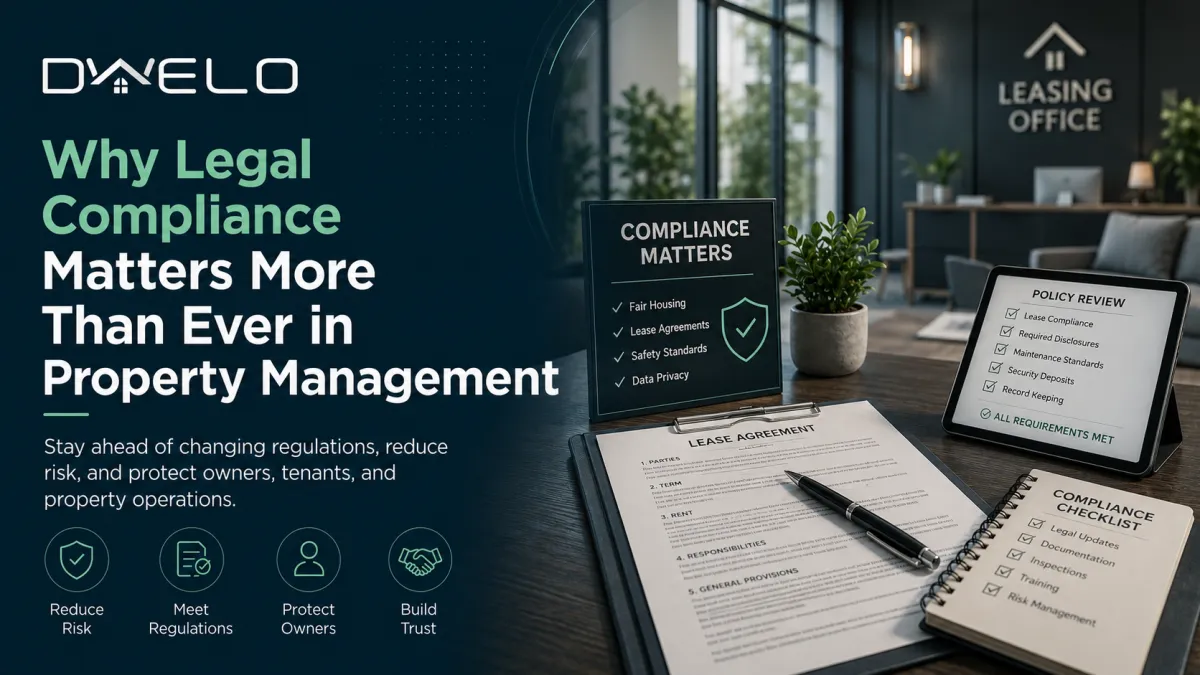
Why Legal Compliance Matters More Than Ever in Property Management
Most rental property owners don't set out to break the law. They set out to earn a return on their investment, provide a decent home for a tenant, and manage the process as efficiently as possible. And yet, legal disputes involving landlords and tenants are among the most common civil litigation matters in South Carolina, and in the majority of cases, the owner's liability traces back not to malicious intent, but to a compliance gap they didn't know existed.
A lease clause that seemed reasonable but contradicts the South Carolina statute. A security deposit was returned two days past the legally required deadline. A maintenance request not addressed within a timeframe that the law considers a habitability issue. A screening decision, made with legitimate business intent, that an applicant characterizes as a fair housing violation. Each of these situations can generate a legal claim, regardless of the owner's intentions, and the cost of defending or resolving them can far exceed the value of the original transaction.
Legal compliance in property management has always been important. But the regulatory environment governing landlord-tenant relationships has grown steadily more complex, and the consequences of non-compliance have grown proportionally more serious. For property owners in South Carolina, understanding what compliance actually requires and having a partner equipped to execute it consistently has never mattered more.
The Legal Landscape South Carolina Landlords Must Navigate
Legal compliance in rental property management isn't a single checkbox. It's an overlapping framework of federal law, South Carolina state law, and local ordinances, each with its own requirements, timelines, and enforcement mechanisms.
The South Carolina Residential Landlord and Tenant Act
The foundation of landlord-tenant law in South Carolina is the Residential Landlord and Tenant Act, which governs the rights and responsibilities of both parties throughout the life of a tenancy. It specifies everything from how security deposits must be handled and returned, to the notice requirements for entry into an occupied unit, to the conditions under which a lease can be terminated, to the habitability standards a rental property must meet.
Many owners. particularly those who are self-managing or who drafted their own lease documents, are operating with practices that don't fully align with the current requirements of this Act. The gap may be minor in many cases, but it creates exposure that a tenant, or a tenant's attorney, can exploit if the relationship deteriorates.
Federal Fair Housing Law
The Fair Housing Act prohibits discrimination in the rental of housing based on race, color, national origin, religion, sex, familial status, and disability. In practice, compliance requires that every stage of the rental process, marketing, screening, application review, lease terms, renewal decisions, and eviction, be conducted in a way that is demonstrably consistent and non-discriminatory.
Fair housing violations can arise from practices that seem entirely neutral to the owner. An advertising description that inadvertently signals a preference for a particular type of tenant. A screening criterion, income threshold, credit score minimum, and rental history requirement were applied inconsistently across applicants. A refusal to make a reasonable accommodation for a tenant with a disability. None of these requires intent to discriminate to generate a complaint, an investigation, or a claim.
The financial consequences of a fair housing violation can be severe: civil penalties, compensatory damages, and legal fees that accumulate regardless of whether the case ultimately resolves in the owner's favor.
Local Ordinances and Short-Term Rental Regulations
In addition to state and federal law, South Carolina's cities and counties have increasingly enacted local ordinances that affect rental property operations. Charleston, for example, has specific regulations governing short-term rentals, licensing requirements, and noise ordinances that affect how properties can be marketed and operated. Columbia and other municipalities have their own evolving local frameworks.
Owners who manage properties without close attention to the local regulatory environment risk inadvertent violations that carry fines, permit revocations, or operational restrictions, consequences that are entirely preventable with proper professional oversight.
Where Non-Compliance Most Commonly Occurs
Understanding where compliance failures happen most frequently helps owners recognize the areas that require the most careful attention.
Security Deposit Handling
South Carolina law is specific about how security deposits must be managed: how they must be held, what written documentation must be provided at collection, the conditions under which deductions can be made, and the deadline for returning the deposit after a tenancy ends. Missing the return deadline, even by a small number of days, can forfeit the owner's right to retain any portion of the deposit, regardless of actual damages. This is one of the most common and most preventable compliance failures in self-managed properties.
Entry and Notice Requirements
South Carolina law requires landlords to provide reasonable notice before entering an occupied rental unit for non-emergency purposes. Entering without proper notice, even to perform routine maintenance or conduct an inspection, is a violation of the tenant's legal rights. An owner who enters routinely without notice is building a pattern of conduct that a tenant can document and use as the basis for a legal claim.
Screening Consistency
Tenant screening decisions must be applied consistently across all applicants using the same published criteria. An owner who approves one applicant with a particular credit profile and declines another with a similar profile, without a documented, neutral explanation for the difference, has created a situation where the declined applicant can assert discriminatory treatment. Without consistent application of written screening standards, that assertion is difficult to disprove.
Dwelo's tenant placement and screening process is built around documented, uniform criteria applied consistently across every applicant, creating a defensible record of every screening decision made.
Lease Terms and Enforceability
A lease that contains provisions that conflict with South Carolina law is not simply unenforceable on those specific points; it can undermine the owner's position in a broader dispute by demonstrating that the lease was drafted without adequate legal knowledge. Provisions that attempt to waive tenant rights guaranteed by the Residential Landlord and Tenant Act, for example, are void under South Carolina law regardless of whether the tenant signed them.
Dwelo's lease administration and legal compliance services ensure that every lease we draft is legally current, SC-specific, and built to protect the owner's interests within the bounds of applicable law, not around them.
Maintenance and Habitability Standards
South Carolina law requires landlords to maintain rental properties in a habitable condition, which includes functional plumbing, adequate heating and cooling, structural integrity, and freedom from conditions that constitute a health or safety hazard. A failure to address a documented maintenance issue within a reasonable timeframe can constitute a violation of the implied warranty of habitability, giving the tenant legal remedies that may include rent withholding, lease termination, or a damages claim.
This is one of the reasons that Dwelo's property maintenance and repairs process emphasizes prompt, documented response to every maintenance request, not just as a service quality matter, but as a legal compliance practice.
The Eviction Process
If a tenancy needs to be terminated due to non-payment, lease violation, or the expiration of the lease term, the eviction process in South Carolina must follow a strict statutory sequence: proper notice, correct notice content, appropriate delivery method, and a waiting period before legal action can be filed. Any procedural error in this sequence, an incorrect notice form, delivery to the wrong address, or failure to wait the required number of days can result in the eviction action being dismissed, requiring the owner to restart the entire process from the beginning.
Eviction proceedings that are delayed by procedural errors are not just frustrating. They are costly, extending the period during which an owner cannot regain possession of their property while continuing to absorb carrying costs.
Real-World Scenarios: The Cost of Compliance Gaps
Scenario 1: The Security Deposit That Became a Liability
A self-managing landlord in Greenville conducted a thorough move-out inspection, identified legitimate damages, and prepared an itemized deduction list. But between the inspection, the repairs, and the accounting, the deposit was returned three days past South Carolina's statutory deadline. The tenant, advised by a tenant-rights organization, filed a small claims action. The landlord forfeited the right to any deduction and was required to return the full deposit. The damages he was entitled to recover became an uncollectible loss.
Scenario 2: The Screening Decision That Became a Fair Housing Complaint
A Columbia property owner declined an applicant based on income, a legitimate screening criterion, but had not documented the income threshold in writing before the application process. A second applicant with a similar income was subsequently approved. The declined applicant filed a fair housing complaint alleging differential treatment. Without written screening criteria showing the standard was applied uniformly, the owner's position in the investigation was weakened significantly. The resolution involved legal fees, time, and stress that a documented screening process would have prevented entirely.
Scenario 3: The Lease Clause That Couldn't Be Enforced
A Charleston landlord included a clause in his self-drafted lease specifying that the tenant waived the right to advance notice before property entry. When a dispute arose and the tenant documented multiple instances of unannounced entry, the clause was unenforceable under South Carolina law, and the documented pattern of entry without notice was cited as a factor in the tenant's favor during the dispute resolution process. The clause the owner believed protected him had, in practice, no legal standing.
How Dwelo Keeps South Carolina Property Owners Legally Protected
Legal compliance is not a one-time event. It is an ongoing practice that touches every stage of property management, marketing, screening, leasing, maintenance, rent collection, and lease termination. Maintaining compliance requires current knowledge of applicable law, disciplined operational systems, and consistent documentation.
This is precisely where professional property management earns its value. Dwelo's team brings knowledge of South Carolina landlord-tenant law, fair housing requirements, local ordinances, and the operational discipline to execute every process in compliance with applicable requirements.
For property owners in South Carolina, partnering with Dwelo through our full-service property management in South Carolina means every management decision is made with legal compliance built in, not retrofitted after a problem emerges. Screening is consistent and documented. Leases are legally current and property-specific. Notices are served correctly and on time. Maintenance is responded to promptly and recorded. Security deposits are handled, documented, and returned within required timeframes. Eviction proceedings, when necessary, follow the precise statutory sequence.
The owners who face the most legal exposure are not, in most cases, bad landlords. They are owners who are managing complex legal obligations without the systems, knowledge, or bandwidth to execute them consistently. That gap is what professional management closes.
Legal Compliance Is an Investment, Not an Expense
The cost of professional property management, measured against the potential cost of a single significant compliance failure, is not a difficult calculation. One security deposit dispute resolved in a tenant's favor, one fair housing investigation requiring legal representation, one eviction restarted because of a procedural error: any one of these outcomes can exceed the annual cost of professional management fees many times over.
Legal compliance in property management is not the most visible benefit of working with a professional firm. It doesn't generate a line item on a monthly statement the way rental income does. But it is one of the most financially consequential protections a property owner can have and one of the most compelling reasons that experienced investors in South Carolina choose professional management over self-management as their portfolios grow.
Real estate agents with investor clients navigating these complexities can learn more about how Dwelo supports South Carolina property owners through our agent referral program, a straightforward way to connect clients with the compliance expertise and operational systems their investments deserve.
Ready to ensure your rental property is fully protected? Schedule a free consultation with Dwelo, and let's talk about how we keep your investment compliant, documented, and defended at every stage.
Dwelo Property Management provides comprehensive, full-service rental property management across South Carolina, including Charleston, Mount Pleasant, Isle of Palms, Columbia, Greenville, Spartanburg, and surrounding communities.


