
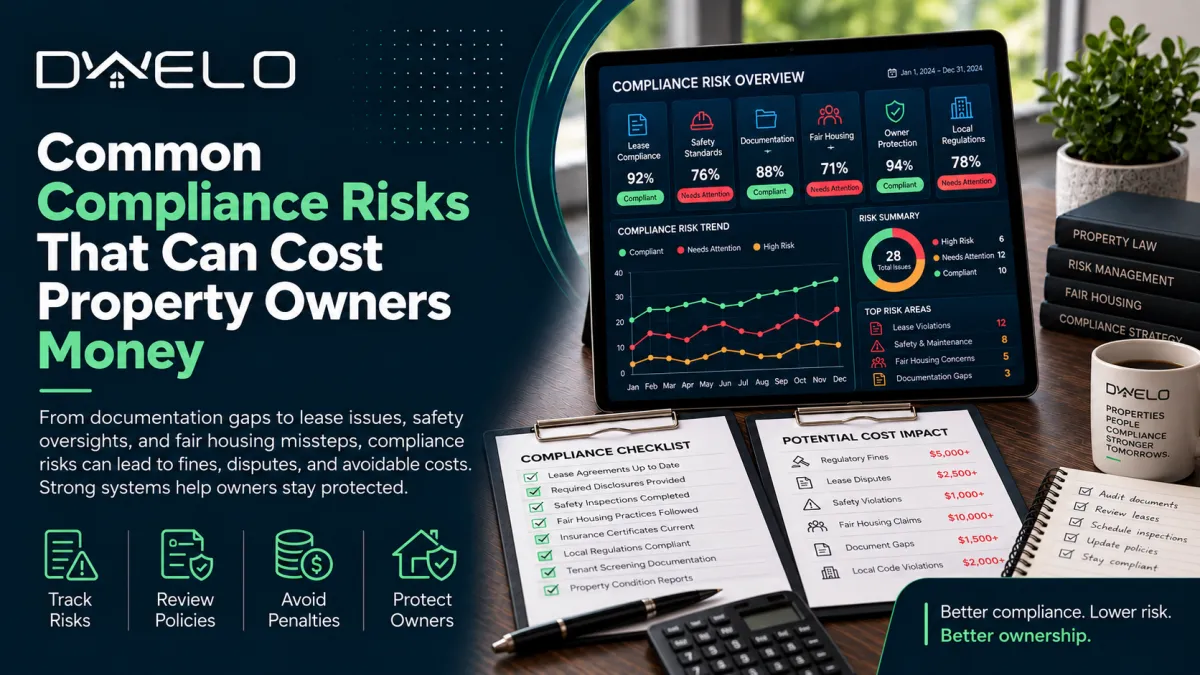
Common Compliance Risks That Can Cost Property Owners Money
Non-compliance in rental property management comes with real financial consequences. Learn about the most costly compliance risks South Carolina owners face and how to avoid them.
Property ownership in South Carolina comes with a regulatory framework that most owners understand only in outline. They know leases need to be signed. They know security deposits need to be returned. They know they cannot discriminate in tenant selection. But the specific requirements that live beneath these general principles the timelines, the documentation standards, the procedural steps, the disclosure obligations are where most compliance failures actually occur.
And compliance failures in rental property management are not abstract. They carry direct, measurable financial consequences: forfeited deposit rights, civil penalties, legal defense costs, settlement payments, dismissed eviction filings, and fines from municipal licensing programs. None of these costs require intent to cause harm. They require only that an owner failed to execute a specific process correctly, often a process they didn’t know was required in the form it needed to take.
Understanding the compliance risks that cost rental property owners money is the first step toward eliminating them. For South Carolina property owners managing rentals in any market from Charleston to Columbia to Greenville, this is not a theoretical exercise; these are the specific situations that generate real financial losses for owners who encounter them without professional management support in place.
Risk 1: Security Deposit Non-Compliance
Security deposit handling is the single most common source of compliance-related financial loss for South Carolina rental property owners not because the rules are obscure, but because they are specific in ways that owners frequently underestimate.
South Carolina law requires that security deposits be returned or that a written itemized accounting of deductions be provided within 30 days of the tenancy ending. Missing this deadline does not merely expose the owner to a dispute. Under South Carolina’s Residential Landlord and Tenant Act, an owner who fails to return the deposit or provide the required written accounting within the statutory period forfeits the right to retain any portion of the deposit, regardless of the actual damage caused by the tenant.
The financial consequence is direct: an owner who was legitimately entitled to withhold $1,200 for documented damage, but who missed the 30-day return window by a week, may be required to return the entire deposit with no offset for damages. Depending on the circumstances, the tenant may also be entitled to additional damages.
The most common causes of this failure are: an owner who was waiting on final contractor invoices before calculating deductions, an owner who lost track of the exact move-out date, or an owner who sent the accounting by first-class mail on day 29 and didn’t account for delivery time. Each of these is an entirely preventable process failure.
Dwelo’s legal compliance support services include systematic tracking of move-out dates and deposit return deadlines, so the 30-day clock is never missed because someone forgot to start it.
Risk 2: Fair Housing Violations
Fair housing compliance is the compliance risk with the highest potential financial exposure for rental property owners because the penalties for violations are not capped at the value of the transaction, and because violations can arise from practices that appear entirely routine to the owner committing them.
The federal Fair Housing Act prohibits discrimination in the rental of housing based on race, color, national origin, religion, sex, familial status, and disability. South Carolina adds additional state-level protections. A violation does not require a written policy of exclusion or a stated discriminatory intent. It can arise from advertising language that signals a preference for a particular type of household, screening criteria applied inconsistently across applicants, a refusal to grant a reasonable accommodation request, or a lease term that effectively treats protected-class tenants differently from others.
The financial exposure in a fair housing complaint can include: civil penalties up to $21,663 for a first violation at the federal level, compensatory damages paid to the complainant, punitive damages in cases involving aggravated conduct, and attorney’s fees, all of which can accumulate regardless of how the underlying case is ultimately resolved. Legal defense costs alone for a fair housing complaint that proceeds through investigation and conciliation can reach tens of thousands of dollars before any penalty is assessed.
The most effective prevention is structural: screening criteria that are written, consistent, and applied uniformly to every applicant, and an advertising and communication process that avoids the language patterns that fair housing guidance identifies as problematic. Dwelo’s tenant placement and screening process is built around documented, uniform criteria, creating the consistent application record that is the primary defense against a fair housing complaint.
Risk 3: Improper Eviction Procedures
An eviction that is procedurally incorrect does not simply fail; it resets. South Carolina’s eviction process requires a specific sequence of steps executed in a specific way: the correct written notice, the correct content within that notice, the correct delivery method, and the correct waiting period before a court filing can be made. An error in any one of these elements gives the tenant grounds to have the filing dismissed, and the owner must begin the entire sequence again from the first notice.
The financial consequence of a dismissed eviction is not merely the court filing fee lost. It is the additional weeks or months of carrying costs incurred while the property remains occupied by a non-paying tenant during the restarted process: mortgage payments, taxes, insurance, and utilities all continue while rental income does not. In South Carolina, a dismissed eviction due to procedural error can extend a non-payment situation by four to six additional weeks minimum, which at $1,800 per month represents $2,700 to $4,500 in additional carrying costs that a correctly executed first filing would have avoided.
The most common procedural errors include: serving a Pay or Quit notice with an incorrect notice period, delivering the notice by a method the statute doesn’t recognize, or filing before the full statutory waiting period has elapsed. None of these errors are substantive disagreements about whether eviction is warranted; they are procedural failures that invalidate an otherwise legitimate action.
Risk 4: Habitability Violations and Tenant Remedies
South Carolina law imposes a continuous obligation on landlords to maintain rental properties in a habitable condition. This obligation encompasses functional plumbing, adequate heating and cooling, structural integrity, and freedom from conditions that constitute a health or safety hazard. When a documented maintenance request remains unaddressed for an unreasonable period, the owner is at risk of a habitability claim, and the tenant’s available remedies can include rent withholding, lease termination, and a claim for damages related to the reduced enjoyment of the property.
The financial exposure has two components. The first is direct: if a tenant successfully withholds rent based on a habitability claim, the owner has lost that income and may have limited ability to collect it retroactively. The second is indirect: a habitability dispute that escalates to legal proceedings involves attorney’s fees, court costs, and time, all of which represent costs the owner absorbs regardless of the outcome.
The most effective prevention is the same as the most effective maintenance practice: prompt, documented response to every reported maintenance issue. An owner who can demonstrate through maintenance records that every tenant report was acknowledged within a defined timeframe and addressed promptly has a strong defense against a habitability claim. An owner whose maintenance records show a weeks-long gap between a reported issue and a response does not. Dwelo’s legal compliance support services and maintenance documentation work together to create exactly this kind of defensible record.
Risk 5: Local Licensing and Registration Non-Compliance
South Carolina municipalities have increasingly implemented rental property registration, licensing, and inspection programs, and the owners most likely to be unaware of these requirements are those who self-manage without active engagement in local regulatory developments.
Charleston has specific licensing requirements for certain rental property categories. Several other South Carolina municipalities have implemented or are in the process of implementing similar programs. Operating a rental property in a jurisdiction that requires registration or licensure without obtaining the required permit can result in fines, required inspections, retroactive fee assessments, and, in some cases, the issuance of a notice that affects the lease’s enforceability while the property is in non-compliant status.
The financial exposure varies by municipality but is consistently avoidable because the requirement, once known, is straightforward to satisfy. The cost is the registration fee and compliance with any inspection or documentation requirements. The cost of non-compliance discovered retroactively is typically multiples of the compliance cost, with the addition of administrative burden and, in some jurisdictions, per-day fine accrual from the date of identified non-compliance.
Risk 6: Lease Non-Compliance and Unenforceable Provisions
A lease that contains provisions contradicting South Carolina law does not simply include an unenforceable clause it creates a document with internal inconsistencies that can undermine the owner’s position across multiple dispute scenarios simultaneously.
South Carolina’s Residential Landlord and Tenant Act specifies that certain tenant rights cannot be waived by lease agreement. An owner who includes a clause requiring the tenant to waive the right to advance notice before entry, for example, has included an unenforceable provision, but the presence of that provision in the lease, and the owner’s evident reliance on it, can complicate the owner’s position in a dispute involving entry practices. Similarly, a lease that specifies a security deposit return period longer than the statutory 30 days does not extend the legal deadline — it simply demonstrates that the lease was not drafted against current South Carolina law.
The financial exposure from non-compliant lease provisions typically surfaces when a dispute arises, and the owner’s position depends on a clause that cannot be enforced. The remedy at that point is reactive rather than preventive: dispute resolution, potential legal representation, and possible settlement, all of which carry costs that a properly drafted lease would have prevented.
Dwelo’s lease administration services ensure that every lease is drafted against current South Carolina statute, not a national template or an outdated prior version so the owner’s foundational document is one they can actually rely on when it matters.
Real-World Scenarios: Compliance Costs in Practice
Scenario 1: The 30-Day Deadline That Cost More Than the Damage
A Charleston property owner conducted a thorough move-out inspection on the day a tenant vacated and identified $1,400 in damage beyond normal wear and tear. Collecting contractor quotes, scheduling the repairs, and receiving the final invoices took 34 days, at which point the owner sent the itemized accounting and retained the deposit. The tenant, aware of the 30-day statutory requirement, disputed the retention. Because the written accounting arrived four days past the deadline, South Carolina law required the owner to return the full deposit. The $1,400 in legitimate damages became an uncollectible loss, and the $1,400 deposit was returned in full. The four-day delay cost more than any single maintenance expense that month.
Scenario 2: The Eviction That Had to Start Over
A Columbia property owner filed for eviction after a tenant failed to pay rent for two consecutive months. The owner had sent a notice to vacate by text message, a delivery method that South Carolina’s eviction statute does not recognize as proper service. The magistrate dismissed the filing on procedural grounds. The owner had to re-serve the correct notice by the correct method, wait the full statutory period again, and refile a process that extended the non-payment period by approximately five weeks and cost the owner an additional $2,250 in lost rental income beyond what the initial non-payment had already produced. The correct notice method was knowable in advance and would have cost nothing to apply correctly.
Scenario 3: The Screening Decision That Generated a Fair Housing Inquiry
A Mount Pleasant property owner declined an applicant who had adequate income but a credit score slightly below the owner’s stated threshold. A second applicant with a similar credit score was approved two weeks later. The declined applicant, who was a member of a protected class, filed a fair housing inquiry noting the apparent inconsistency. Because the owner’s screening criteria had not been documented in writing before either application was received, and because the credit score threshold had been applied differently across the two applications, the owner had no clean documentary record to demonstrate consistent application of objective criteria. Legal consultation to respond to the inquiry cost over $3,000 before the matter was resolved a cost entirely preventable with a written screening policy applied uniformly from the outset. With Dwelo’s full-service property management in South Carolina, documented and consistent screening criteria are applied to every applicant as a standard practice — never as an afterthought.
Key Compliance Risks and Their Financial Consequences — Summary
Compliance Risk | Potential Financial Consequence |
|---|---|
Security deposit deadline missed | Full deposit forfeited regardless of damages |
Fair housing violation | Civil penalties, compensatory and punitive damages, legal fees |
Improper eviction procedure | Dismissed filing, 4–6 additional weeks of carrying costs |
Habitability non-compliance | Rent withholding, lease termination, damages claim |
Local licensing non-compliance | Fines, retroactive fees, per-day penalty accrual |
Non-compliant lease provisions | Unenforceable clauses, weakened dispute position, settlement costs |
Compliance Is Not Optional — But Managing It Doesn’t Have to Be Your Job
Every compliance risk on this list is preventable. None of them require legal expertise from the owner; they require that the management processes governing each area are executed correctly, consistently, and with proper documentation. That is precisely what professional property management provides.
When compliance is embedded in the operational processes that execute every day lease drafting, tenant screening, maintenance response, deposit handling, and eviction procedures, owners are protected not because they tracked every requirement themselves, but because the management system tracks it for them.
Dwelo Property Management — your partners in real estate success.
Real estate agents whose South Carolina investor clients are carrying compliance exposure they may not be aware of can connect them with a management approach that closes those gaps systematically through our agent referral program.
Ready to eliminate the compliance risks that could cost you far more than professional management fees? Schedule a free consultation with Dwelo and let’s talk about how we keep your investment protected on every dimension.
Dwelo Property Management provides comprehensive, full-service rental property management across Charleston, Mount Pleasant, North Charleston, Summerville, Goose Creek, Daniel Island, Johns Island, James Island, West Ashley, Isle of Palms, and the South Carolina Lowcountry.


