
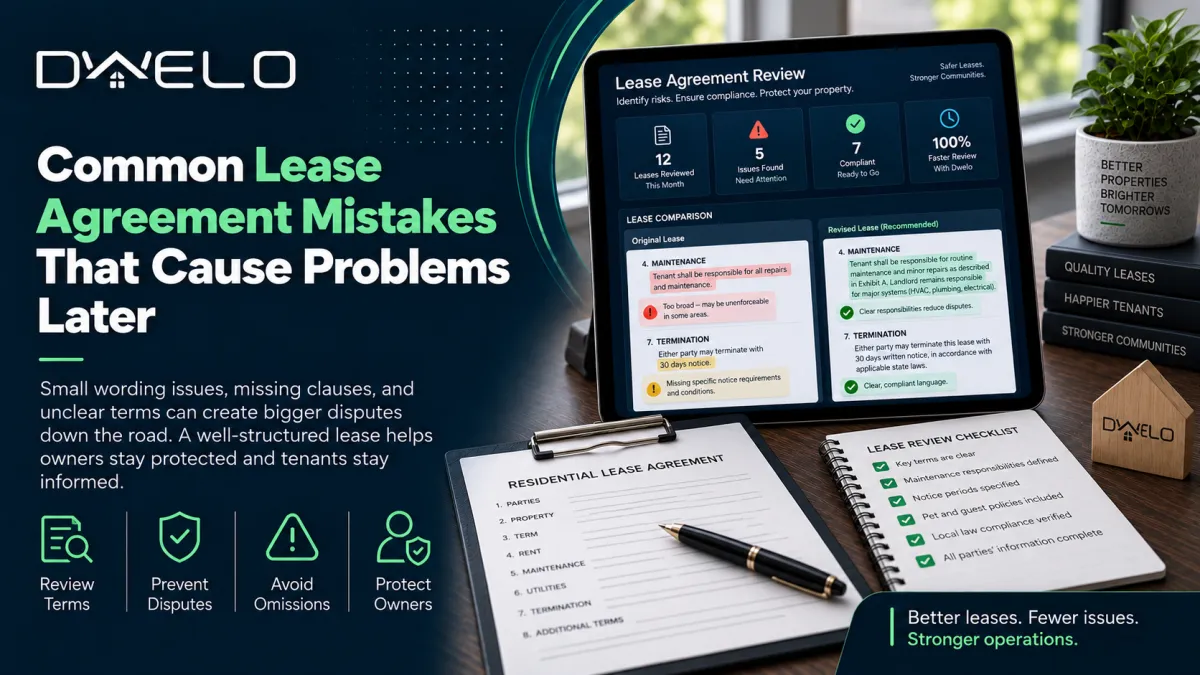
Common Lease Agreement Mistakes That Cause Problems Later
Generic lease templates and overlooked clauses put South Carolina rental owners at risk. Learn the most common lease agreement mistakes and how Dwelo prevents them.
The lease agreement is the single document that governs everything that can go wrong between a landlord and a tenant. It defines what is expected, what is permitted, what happens when obligations aren't met, and how disputes are resolved. A lease drafted well is a framework that prevents problems. A lease drafted poorly is a set of unresolved questions waiting for a conflict to expose them.
The frustrating reality for South Carolina rental property owners is that most common lease agreement mistakes are not made out of carelessness. They are made by owners who believe they have covered the basics, who downloaded a template, filled in the rent amount and move-in date, and had both parties sign. That document may look like a lease. It may even function like one for the duration of an uneventful tenancy. But the moment a dispute arises, a tenant stops paying, or a security deposit becomes contested, the gaps in a poorly drafted lease become very expensive problems to manage.
This blog identifies the most common lease agreement mistakes that South Carolina property owners make, explains exactly how each one creates downstream problems, and shows what a professionally managed lease does differently to close those gaps before they open.
Mistake 1: Using a Generic Online Template Without SC-Specific Review
This is the most widespread and most consequential lease mistake in self-managed rental properties. Generic lease templates are readily available online, and most of them are produced for a general national audience, written to satisfy the lowest common denominator across all fifty states, and periodically updated on no reliable schedule.
South Carolina's Residential Landlord and Tenant Act has specific requirements that a generic template may not reflect: particular disclosures that must be included at lease signing, notice periods that differ from other states' defaults, security deposit handling rules specific to South Carolina law, and habitability standards that define the owner's legal obligations throughout the tenancy.
A clause that is standard in a Georgia lease template may be unenforceable under South Carolina law. A disclosure required under South Carolina statute may be absent from a template written for a national audience. An owner who relies on a generic document is operating with a lease whose SC-law compliance is unknown, and discovering those gaps during a dispute is always more expensive than addressing them in advance.
Dwelo's lease administration services use templates that are specific to South Carolina, reviewed against current statute, and updated when legislative changes require it. Every clause reflects applicable law, not a national average.
Mistake 2: Omitting a Clear Pet Policy
Pet policy is one of the most common sources of mid-tenancy disputes in residential rentals, and the disputes are almost always avoidable with clear, specific lease language drafted before move-in.
The problem usually arises in one of two forms. The first is a lease that says nothing about pets, leaving the owner with no enforceable position when a tenant acquires an animal mid-tenancy. The second is a lease that says "no pets" without specifying what happens when a tenant requests to add a pet, what the consequences of an unauthorized pet are, or how assistance animals under fair housing law are distinguished from pets subject to the policy.
A lease that simply prohibits pets without addressing these adjacent questions creates enforcement gaps that become very difficult to resolve once a tenant is already in the unit with an animal they've become attached to. A lease that includes a clear pet policy, permitted or prohibited, and if permitted: what types, weight or breed restrictions if any, pet deposit or monthly pet fee, and what constitutes a violation, provides the owner with an enforceable framework for every pet-related situation that arises.
The fair housing dimension adds additional complexity. Assistance animals and emotional support animals are not pets under federal fair housing law; they are accommodations that must be evaluated through a separate process regardless of the lease's pet policy. A lease that conflates pets and assistance animals creates legal exposure that a properly drafted document avoids entirely. Dwelo's tenant placement and screening process includes guidance on accommodation requests from the moment of application, ensuring that this distinction is handled correctly well before lease execution.
Mistake 3: Vague Maintenance Responsibility Language
Every lease should be explicit about what the tenant is responsible for maintaining and what the owner handles. When this language is vague or absent, maintenance disputes become almost inevitable, because each party has a different understanding of who is responsible for what.
The most common areas of ambiguity include: lawn and landscaping maintenance, changing of HVAC filters, pest control for routine infestations versus structural pest issues, minor repairs below a certain dollar threshold, and the tenant's responsibility to report developing maintenance issues promptly.
An owner who believes their tenant is responsible for routine lawn care but whose lease says only that the tenant must "maintain the premises in good condition" has no enforceable basis for that expectation when the tenant argues that lawn care is the owner's obligation. The dispute is not resolvable by negotiation at that point; it requires either a lease amendment or an acceptance that the original language doesn't support the owner's position.
Specific, enumerated maintenance responsibilities in the lease, "Tenant is responsible for: replacing HVAC filters every 60 days, maintaining lawn and landscaping in the condition present at move-in, and promptly reporting any developing maintenance issue to the management team," create enforceable expectations that prevent ambiguity-based disputes before they begin. Dwelo's property maintenance and repairs process is built on lease language that clearly defines both parties' maintenance obligations, ensuring that every managed property has a documented baseline from which maintenance accountability is measured.
Mistake 4: Missing or Insufficient Late Fee Provisions
A late fee clause that is vague, improperly structured, or absent entirely creates two problems simultaneously: it fails to deter late payment, and it fails to provide an enforceable remedy when late payment occurs.
South Carolina law does not cap residential late fees, but the fee must be specified in the lease to be enforceable. A lease that says "late fees may apply" without specifying the amount, the grace period after which they apply, and how they are calculated is a lease that cannot support a legitimate late fee claim if the tenant disputes one.
The other common error in this area is grace period ambiguity. Many self-drafted leases include a grace period, "rent is due on the first, with a five-day grace period", without clarifying whether the late fee applies on day six or at the end of day five, and whether the grace period resets if the first falls on a weekend or holiday. These are the details that generate disputes when a tenant pays on day five, and the owner charges a late fee because they calculate day five differently.
Precisely drafted late fee language, amount, grace period, calculation basis, and the automatic nature of the fee's application remove every variable from this calculation and create a consistent, enforceable, and dispute-resistant collection structure.
Mistake 5: No Clear Early Termination Provision
Leases end early. Tenants relocate for work, experience life changes, or simply decide they need to leave before the lease term is complete. How the lease handles that situation, and what financial consequences attach to early departure, determines whether the owner has a protected position or an unresolvable negotiation.
A lease that is silent on early termination leaves the owner in a legally ambiguous position. They may be entitled to pursue the remaining rent owed under the lease, but the process for doing so in South Carolina requires navigating landlord-tenant law without the guidance of a lease provision that addresses the situation directly. The owner may also be expected to mitigate damages by attempting to re-lease the property, a requirement that exists regardless of lease language, but that should be explicitly addressed in the lease to set clear expectations.
A well-drafted early termination clause specifies: the notice period required, any early termination fee, the owner's obligation to re-market and the tenant's continued liability during the re-marketing period, and the conditions under which an early termination may be mutually agreed without penalty. These provisions don't prevent early departures, but they give the owner a clear, documented framework for managing them when they occur.
Mistake 6: Failing to Update the Lease at Renewal
A lease renewal that is handled verbally, or that simply carries the original document forward without a signed renewal addendum, creates a legal ambiguity that affects everything from the enforceability of any rent adjustment to the notice period required for the next termination.
Equally problematic is the owner who renews a lease without reviewing the original document first. A lease signed two or three years ago may contain provisions that no longer reflect South Carolina law, rental terms that are no longer accurate, or clauses that the owner now wishes were different. Renewal is the moment to review, update, and re-execute, not the moment to simply extend the expiration date and move on.
Every renewal should produce a signed, dated document that clearly establishes the new term, the rent for that term, and any modifications to the original lease terms. Dwelo's lease administration services treat renewal not as a formality but as an active management function, reviewing terms, updating where appropriate, executing documentation properly, and creating a clean legal record for the new tenancy period.
Mistake 7: Inadequate Move-In Condition Documentation
The lease itself is not the only document that matters at the start of a tenancy. The move-in condition report, completed and signed by both parties at the time of possession, is the document that makes the lease's security deposit provisions defensible at move-out.
A security deposit clause in the lease gives the owner the right to withhold for damages beyond normal wear and tear. Without a documented baseline of the property's condition at move-in, the owner cannot substantiate which damage occurred during the tenancy and which predated it. South Carolina courts and magistrates generally require contemporaneous documentation to support deposit deductions, and without it, the owner's position is difficult to defend even when the damage is genuine.
The move-in condition report is not technically part of the lease agreement, but it is the document that gives the lease's deposit provisions their practical force. A professionally executed lease package, lease, disclosure addenda, and signed move-in condition report with photographic documentation is a complete legal record that protects the owner from the start of the tenancy to its conclusion.
Real-World Scenarios: Lease Mistakes and Their Consequences
Scenario 1: The Pet Clause That Wasn't There
A Greenville landlord had a lease that prohibited pets in a single vague sentence: "no animals permitted on the premises." When a tenant acquired a dog mid-tenancy, the tenant produced documentation for an emotional support animal and argued the prohibition didn't apply. Because the lease contained no pet policy beyond the bare prohibition, and no process for evaluating accommodation requests, the owner had no documented framework for responding. The situation was resolved through a lease amendment negotiation that would have been unnecessary had the original lease addressed both the no-pet policy and the accommodation process separately and specifically. Dwelo's full-service property management in South Carolina ensures every lease provision anticipates the situations it will eventually need to govern, before those situations arise.
Scenario 2: The Generic Template That Was Missing a Required Disclosure
A Charleston property owner had been using the same lease template for five years, a document downloaded from a national real estate website at the start of their first tenancy. At the start of a new tenancy, a tenant's attorney reviewing the lease identified a South Carolina-required disclosure that was absent from the template. Because the disclosure was missing, the lease's enforceability of certain provisions was questioned. The owner faced a lease amendment process at the start of a tenancy that should have been fully documented and executed. The disclosure had been a South Carolina statutory requirement when the owner first downloaded the template; it had simply never been included because the national template didn't reflect state-specific requirements.
Scenario 3: The Early Termination That Cost More Than It Should Have
A Columbia property owner's tenant departed six months before the lease end date, citing a job relocation. Because the lease contained no early termination provision, the owner and tenant entered an informal negotiation that resulted in the tenant paying two months of additional rent in exchange for release from the remaining four months. The owner accepted because they had no clear lease provision to enforce, and the negotiation produced a result that was better than nothing but worse than what a clearly drafted early termination clause would have provided. The difference between that outcome and what a proper clause would have supported was several months of rental income the owner was entitled to but couldn't enforce.
Key Takeaways: What Every South Carolina Lease Should Include
SC-Specific, Current Language
Generic templates are not substitutes for state-specific documents reviewed against current South Carolina statute. Lease drafting should reflect current law, not a national average.
A Complete Pet Policy
Specific, detailed pet provisions, including the assistance animal accommodation process, eliminate the most common source of mid-tenancy lease disputes.
Explicit Maintenance Responsibilities
Enumerate what the tenant is responsible for. Ambiguity is always resolved in the direction the owner didn't intend.
Precise Late Fee Language
Amount, grace period, and automatic application, all specified clearly and consistently with South Carolina law.
Early Termination Terms
Notice requirements, termination fees, re-marketing obligations, and continuing liability should all be addressed before a tenant ever needs to invoke them.
Executed Renewal Documentation
Every renewal is a new legal period that deserves its own signed document, not a verbal extension of an original that may now be outdated.
Move-In Condition Report
The document that makes the deposit clause enforceable. Never execute a lease without a signed, photographed move-in baseline.
The Lease Is Only as Strong as What It Contains
A lease agreement that looks complete on the surface but contains the mistakes outlined above is not a neutral document; it is a liability waiting to be activated. Every gap, every vague clause, every missing provision is a gap in the owner's protection that a future dispute will find and exploit.
Professional lease administration is the systematic practice of closing those gaps before tenancy begins, so that the document protecting the owner's investment is actually equal to the task of protecting it. Dwelo's lease administration services bring the drafting precision, legal currency, and documentation discipline that South Carolina rental property owners need to enter every tenancy with a lease that holds up when it matters most.
Dwelo Property Management, your partners in real estate success.
Real estate agents whose South Carolina investor clients are relying on self-drafted or outdated lease documents can connect those clients with a management team that takes lease quality seriously through our agent referral program.
Ready to replace a risky lease with one that actually protects your investment? Schedule a free consultation with Dwelo and let's talk about what professional lease administration looks like for your property.
Dwelo Property Management provides comprehensive, full-service rental property management across Charleston, Mount Pleasant, North Charleston, Summerville, Goose Creek, Daniel Island, Johns Island, James Island, West Ashley, Isle of Palms, and the South Carolina Lowcountry.


