
How Faster Issue Resolution Builds Better Tenant Relationships
Tenants remember how long problems stay open. Learn how faster issue resolution builds trust, improves renewals, and strengthens South Carolina rental relationships.
How Faster Issue Resolution Builds Better Tenant Relationships
A tenant reports a problem on Monday. By Tuesday morning, someone from management has acknowledged it, apologized for the inconvenience, and promised to look into it. Then nothing visible happens. Wednesday passes. Then Friday. By the following week, the tenant is still living with the same problem, and the polite acknowledgment they received feels less like service and more like a way of being put off.
From the owner’s side, this sequence may look like a responsive process. The message was answered quickly. The request was logged. The matter is in progress. But from the tenant’s side, the only thing that matters is whether the problem is still there. And if it is, the quick reply has done almost nothing to protect the relationship.
This gap between being responsive and actually resolving is where tenant relationships are quietly won or lost. Faster issue resolution builds better tenant relationships because resolution is the moment a tenant sees whether management’s words match its actions. For South Carolina rental property owners, treating resolution speed as a core part of the tenant relationship, rather than a maintenance statistic, is one of the most practical ways to keep good tenants longer and protect rental income over time.
This blog looks at resolution as its own discipline: why it matters more than most owners realize, what it looks like in practice, and how professional management delivers it consistently.
Response Is Not Resolution
Our earlier post on responsive communication focused on how quickly and clearly a management team replies to a tenant. That matters, and it is the first step. But there is a second, separate question that tenants care about even more: how long did the problem actually stay open?
Response and resolution are different clocks. Response measures the time from the tenant’s message to management’s first reply. Resolution measures the time from the tenant’s message to the moment the problem is genuinely fixed. A property manager can be excellent at the first and poor at the second, and tenants will still experience the property as poorly managed, because they live with the unresolved issue every day.
A dripping faucet, a door that won’t latch, a recurring pest problem, an appliance that has stopped working, a billing error on a statement, a noise concern involving a neighbor: each of these stays real to the tenant until it is closed. Every additional day it remains open adds to the tenant’s picture of how much management cares. Resolution is where that picture is finalized.
Three measures separate strong resolution from merely adequate handling:
Time to resolve. How many days pass from the initial report to the completed fix, not just to the first reply.
First-visit resolution. Whether the problem is solved on the first attempt, or whether the vendor has to come back because the original repair didn’t fully address it.
Recurrence. Whether the same issue returns within weeks or months, indicating that the symptom was treated but the cause was not.
Owners who understand these three measures can evaluate their own management process, or a prospective management company’s, far more accurately than by asking how quickly messages get answered.
Why Speed of Resolution Shapes the Whole Relationship
The connection between resolution speed and tenant satisfaction is not just intuitive. It follows from how people actually experience a home.
Open Problems Feel Like Indifference
A tenant can tolerate a repair that takes several days if they know the plan and the date. What they struggle to tolerate is an open problem with no end in sight. When an issue sits unresolved without explanation, tenants rarely conclude that the delay has a reasonable cause. They conclude that management doesn’t prioritize their home. That conclusion is hard to reverse, even after the issue is eventually fixed.
Small Issues Grow Into Big Grievances
Most tenant complaints start small. A slow drain, a flickering light, a sticking window. Left open for weeks, these become the story the tenant tells themselves, and later tells others, about how the property is managed. By the time the tenant is deciding whether to renew, the individual issues may have been resolved, but the accumulated sense of having had to wait and chase them remains.
Each Fast Fix Builds Credibility for the Next
Resolution speed compounds. A tenant whose first request is handled quickly develops confidence that the next one will be too, and that confidence changes how they behave. They report problems earlier. They communicate more openly. They give management the benefit of the doubt when something takes longer than usual. A tenant whose first request dragged on does the opposite. They assume the worst, report less, and escalate faster.
Repeat Visits Cost More Than One Good Visit
Resolution done quickly but incorrectly is not actually fast. A repair that fails within three weeks means a second contractor trip, a second scheduling window for the tenant, a second round of disruption, and a second invoice for the owner. The truly fastest path to resolution is usually the one that fixes the root cause the first time, even if that takes a day longer than a quick patch.
What Fast, Real Resolution Looks Like in Practice
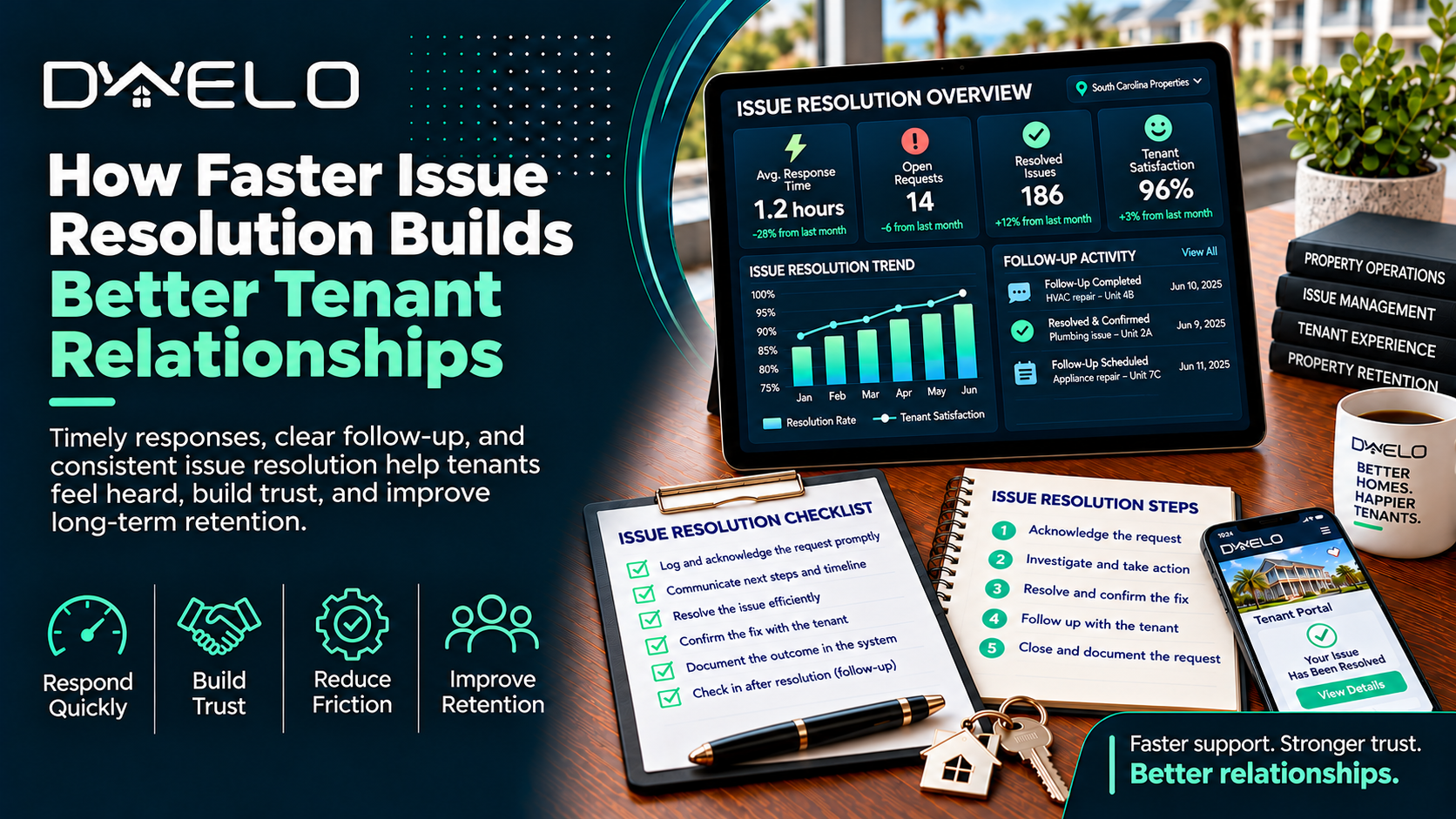
Resolving issues quickly and correctly is not about urgency alone. It is about a process that moves each issue from report to confirmed closure without stalling. Here is what that process looks like when it is working.
Step 1: Triage by Impact
Not every issue deserves the same response speed, and treating them all identically slows everything down. A professional process sorts requests by impact: emergencies that threaten safety or cause damage, loss of essential services like water, heat, or cooling, and routine items that affect comfort but not safety. Urgent issues move immediately. Routine issues still receive firm dates, so nothing disappears behind more dramatic problems.
Dwelo’s property maintenance and repairs team works in exactly this way, which means a minor request is never left waiting indefinitely just because bigger issues arrived first.
Step 2: Diagnose the Cause, Not Just the Symptom
The most common source of recurring issues is a repair that addressed what the tenant could see rather than what was actually wrong. A clogged drain cleared at the surface returns when the blockage deeper in the line remains. A patched leak returns when the failing connection is left untouched.
Asking vendors to identify and document the root cause, and expecting more than a surface fix, prevents the repeat call that tenants find most frustrating. It also reduces the owner’s total repair costs over time.
Step 3: Give a Date, Then Keep It
“We’ll get to it soon” erodes trust. “A technician will be there Thursday between 9 and 11” builds it. A specific commitment tells the tenant that their issue is on a calendar, not in a pile.
When circumstances change, a contractor is delayed or a part is back-ordered, the tenant should hear about it from management before they have to ask. A delay communicated early is tolerated. A delay discovered by the tenant after the window passes is remembered.
Step 4: Confirm With the Tenant That It Is Fixed
A work order marked complete is not the same as a problem solved. A short follow-up message to the tenant, asking whether the issue is resolved to their satisfaction, accomplishes two things at once. It catches repairs that were incomplete, and it tells the tenant that management cares about the outcome, not just the paperwork.
Step 5: Treat Non-Maintenance Issues With the Same Discipline
Resolution is not only about repairs. Noise concerns, portal login problems, questions about charges on a statement, lease clarifications, and parking disagreements all create the same kind of open loop for the tenant. Each one needs a named owner, a timeline, and a closing message.
Dwelo’s tenant relations services apply the same resolution standard to these everyday issues, because a tenant experiences an unanswered billing question with the same frustration as an unrepaired faucet.
Why Self-Managing Owners Struggle to Resolve Issues Quickly
Most owners understand that faster resolution is better. The challenge is capacity. A self-managing owner handling a tenant issue has to identify the right trade, find an available vendor, coordinate access with the tenant, verify the work, and follow up, usually around a full-time job and other responsibilities.
Each step introduces delay. The vendor can’t come until next week. The owner is traveling and can’t confirm the work. The follow-up message slips through. None of this reflects carelessness. It reflects the reality that one person cannot match the response capacity of a team with systems and established relationships.
This is where professional management changes the outcome. Under Dwelo’s full-service property management in South Carolina, issues move from report to assignment to completion to follow-up without depending on any single person’s calendar. A trusted vendor network means faster scheduling, and a documented process means nothing gets lost between steps.
Clear lease administration services support resolution as well. When the lease clearly defines which issues are the owner’s responsibility and which belong to the tenant, there is less delay spent debating who should handle a problem before anyone starts fixing it.
Real-World Scenarios: Faster Resolution in Practice
Scenario 1: The Recurring Drain That Finally Stayed Fixed
A Charleston tenant reported a slow kitchen drain, and a quick service visit cleared it. Two weeks later, it slowed again. The tenant, understandably frustrated, reported it a second time and mentioned that they were beginning to wonder whether the issue would ever be handled properly. This time, the management team asked the plumber to inspect the full line rather than clear the surface blockage. The vendor identified a partial obstruction further down and cleared it completely. The tenant received a follow-up message the next day asking whether the drain was running normally. It was, and it stayed that way. The tenant’s later comment was that the second response was what changed their view: the problem was fixed because someone looked for the cause.
Scenario 2: The Billing Question Answered Before It Became a Dispute
A Summerville tenant noticed a charge on their statement they didn’t recognize and sent a short message asking about it. Under many management arrangements, a question like this sits in an inbox for days while the tenant wonders whether they’re being overcharged. Here, the message was reviewed the same business day, the charge was identified as a prorated item from the lease start date, and the tenant received a clear written explanation with the calculation attached. The tenant replied with a brief thank-you. A situation that could have grown into a dispute never developed, because the question was resolved before it had time to harden into suspicion.
Scenario 3: The Slipped Appointment That Didn’t Damage Trust
A Mount Pleasant tenant had a repair scheduled for Thursday morning. That morning, the contractor called to say he’d been delayed on an earlier job. Dwelo’s team contacted the tenant right away, explained the delay, offered a new window that afternoon, and confirmed with the tenant after the work was done. The repair was completed a few hours later than planned, but the tenant wasn’t left waiting at home wondering what had happened. They noted afterward that being told early made the delay feel like part of a managed process rather than a failure. Delays happen in every property. How they are handled is what the tenant remembers.
Key Benefits of Faster Issue Resolution
Higher Renewal Rates
Tenants who see problems closed quickly and correctly are more likely to stay. Every renewal avoids vacancy loss, turnover preparation costs, and re-leasing expense.
Fewer Repeat Repairs
Root-cause fixes reduce return visits and total repair costs. Doing it right once is cheaper than doing it quickly twice.
Fewer Escalations and Disputes
Issues closed early rarely become formal complaints, rent disputes, or legal questions. The cost of avoiding a conflict is almost always lower than the cost of resolving one.
Earlier Problem Reporting
Tenants who trust that issues get fixed are more willing to report small problems early, giving the management team a chance to address them while they are still inexpensive.
A Stronger Reputation in the Local Market
In South Carolina’s rental communities, tenants talk to neighbors, coworkers, and friends. A property known for handling issues well attracts better applicants and fills faster when vacancies arise.
Resolution Is the Moment Tenants Remember
Tenants rarely remember the months when nothing went wrong. They remember the time something did, and how long it took to make it right. That memory is what they carry into the renewal decision.
Owners who treat resolution speed as part of the tenant relationship, not simply as a maintenance metric, put themselves in a stronger position to keep good tenants and protect their income. The properties that renew year after year are rarely the ones that never have problems. They are the ones where problems are closed quickly, fully, and without the tenant having to chase.
Dwelo Property Management — your partners in real estate success.
Real estate agents whose South Carolina investor clients are losing tenants over unresolved issues can connect them with a team that closes problems quickly and follows through through our agent referral program.
Ready to make problem-solving a reason your tenants stay? Schedule a free consultation with Dwelo and let’s talk about how professional issue resolution can strengthen your tenant relationships and protect your investment.
Dwelo Property Management provides comprehensive, full-service rental property management across Charleston, Mount Pleasant, North Charleston, Summerville, Goose Creek, Daniel Island, Johns Island, James Island, West Ashley, Isle of Palms, and the South Carolina Lowcountry.


