
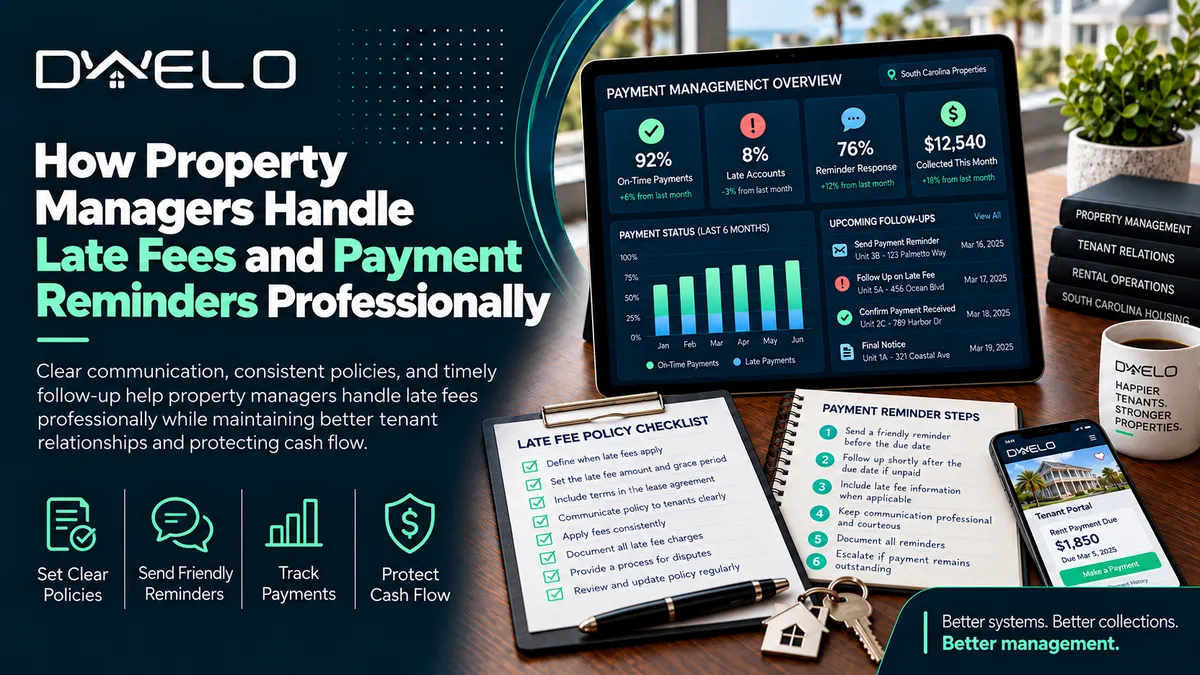
How Property Managers Handle Late Fees and Payment Reminders Professionally
Late fees and reminders don’t have to be awkward. See how professional property managers handle late rent in South Carolina with clear, consistent systems.
How Property Managers Handle Late Fees and Payment Reminders Professionally
Few parts of owning a rental feel as uncomfortable as asking a tenant for money that is already late. Owners put off the text message, soften the fee, or decide to “give it a few more days.” Each choice feels kind in the moment. Together they produce a collection pattern that is inconsistent, hard to defend, and slow to correct.
Professional managers approach it differently. They take the personal judgment out of the process and replace it with a sequence that runs the same way every month. This post shows how property managers handle late fees and payment reminders professionally, step by step, for South Carolina rentals.
Why Professional Handling Starts With Removing the Awkwardness
The discomfort comes from making each late payment a one-off decision. Should I charge the fee this time? Is a text too harsh? Should I wait?
A professional process settles those questions in advance. The reminder schedule, the grace period, the fee amount, and the escalation steps are all set before anyone is late. When rent is late, nobody is making a call. The system is carrying out terms both parties already agreed to. Tenants tend to accept that more easily than a landlord’s mood-dependent enforcement, because it is predictable.
This builds on the process fixes covered in our earlier post on why late rent is often a process problem. Here the focus is the communication and fee mechanics.
The Professional Reminder Sequence
Exact timing depends on the lease, but a well-run sequence usually looks like this:
1. A friendly pre-due-date reminder. A few days before rent is due, tenants get an automated message with the amount and a payment link. Many “late” payments are really forgotten ones, and this step catches them.
2. A simple due-date path to pay. Tenants have one portal, one account, and the option to schedule automatic payments. Dwelo’s rent collection services run through a single online channel, so every payment is timestamped and recorded.
3. A grace period with no accusation. If the lease includes a grace period, nothing happens during it. No fee and no warning tone, because the tenant is still within their terms.
4. A neutral notice after the grace period. When the grace period ends and rent is unpaid, the fee posts as the lease specifies, and the tenant gets a short, factual message: what is owed, what the fee is, and how to pay.
5. A formal written notice if nonpayment continues. At this stage, the process moves from reminders to legal notice. South Carolina has specific notice requirements before an eviction can proceed, and errors in form, delivery, or timing can invalidate the notice. Dwelo’s legal compliance support keeps this step procedurally clean.
How Late Fees Are Set Up to Hold Up
A late fee is only as strong as the lease language behind it. Professionals build it on four points:
It is written in the lease. The amount, grace period, and the trigger for applying it are stated plainly. Vague language like “late fees may apply” invites disputes.
It is reasonable. Fees that look like penalties rather than a fair charge for late payment are easier to challenge. Confirm your amount with a South Carolina attorney.
It is applied automatically. The system posts the fee on the same day, the same way, for every tenant.
Exceptions follow policy. Waivers do happen, for example after a bank error or a documented emergency, but they follow a written standard and are recorded. They are never favors handed out informally.
Drafting fee language precisely is part of Dwelo’s lease administration services, so enforcement later doesn’t depend on interpretation.
What Professional Tone Sounds Like
Tone is where most owners go wrong, in one of two directions: too apologetic to enforce anything, or too sharp to preserve the relationship.
Professional messages are short, factual, and free of judgment. A good late notice states the balance, the fee, the payment method, and a contact for questions. It does not speculate about why the tenant is late or lecture them. If the tenant replies with a real problem, the manager can respond with options that fit policy, such as a payment arrangement documented in writing.
The aim is to keep a good tenant paying on time without making them feel accused.
Documentation: The Quiet Part That Matters Most
Every reminder, fee, payment, and notice is logged with a date and time. That record does three jobs:
It resolves “I paid on time” disputes with a system timestamp instead of competing memories.
It supports a legal notice or filing if nonpayment escalates.
It feeds clean income records into owner statements.
Illustrative Scenarios
These are representative examples of how the process plays out, not specific client case studies.
Summerville: The Forgotten Payment. A tenant who pays a few days late most months starts receiving a pre-due-date reminder and sets up autopay. The pattern ends without a single awkward conversation.
Charleston: The Fee That Wasn’t Negotiated. A tenant pays one day after the grace period. The fee posts automatically, the notice is neutral, and the tenant pays the same day. Because the fee is applied the same way it would for anyone, there is nothing to argue about.
Mount Pleasant: The Documented Hardship. A tenant explains a delayed paycheck before the due date. The manager follows the written waiver policy, records the agreement, and confirms the new payment date in writing. The tenant stays current, and the owner has a clean record.
Key Benefits of a Professional Reminder and Fee Process
Fewer Late Payments
Pre-due-date reminders and autopay options catch most accidental lateness.
Consistent Enforcement
Every tenant is treated the same way, which supports fair housing compliance and reduces disputes.
Less Owner Stress
No chasing, no guessing, and no uncomfortable messages to write.
Stronger Legal Position
Dated records and correctly served notices protect you if a situation escalates.
Healthier Tenant Relationships
Predictable, respectful communication keeps good tenants renewing.
Professional Collection Is Mostly Consistency
Handling late rent well takes no special toughness. It takes a system that treats every tenant the same, communicates clearly, and records everything. That is what Dwelo builds into each managed property.
Dwelo Property Management — your partners in real estate success.
Real estate agents whose South Carolina investor clients are handling late rent case by case can connect them with a team that runs it systematically through our agent referral program.
Ready to stop chasing rent and start collecting it on a schedule? Schedule a free consultation with Dwelo and let’s talk about how we’d handle collection for your property.
Dwelo Property Management provides comprehensive, full-service rental property management across Charleston, Mount Pleasant, North Charleston, Summerville, Goose Creek, Daniel Island, Johns Island, James Island, West Ashley, Isle of Palms, and the South Carolina Lowcountry.


