
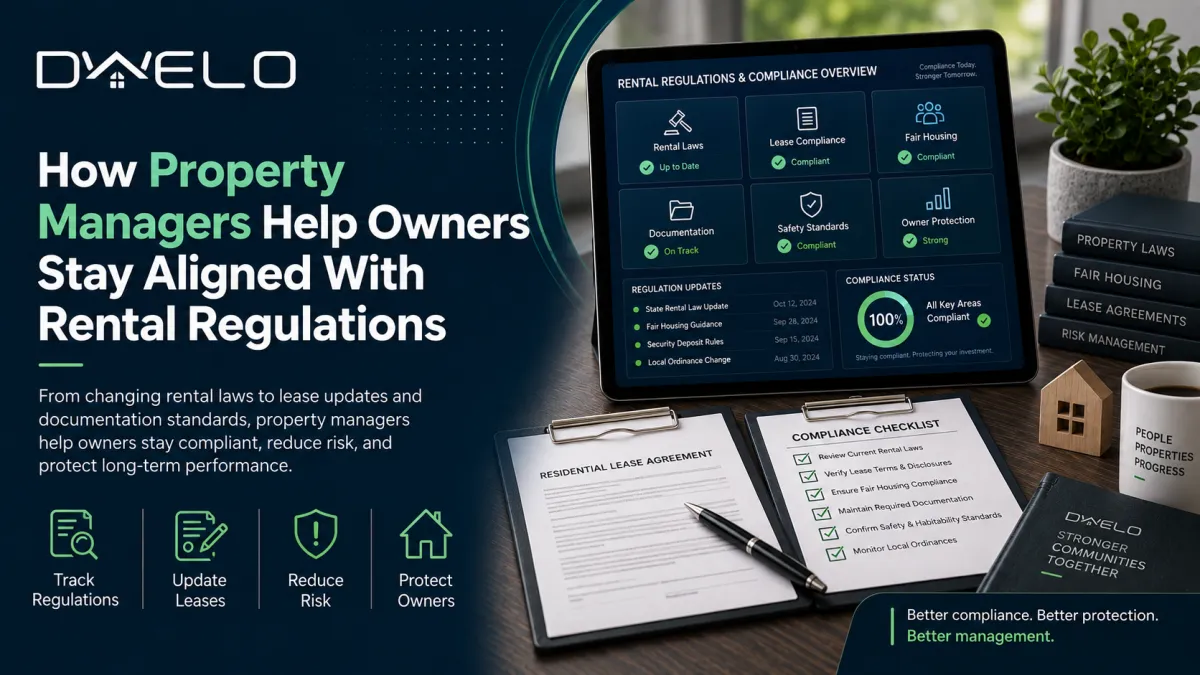
How Property Managers Help Owners Stay Aligned With Rental Regulations
Rental regulations change constantly, and owners who miss updates pay the price. Learn how professional property managers keep South Carolina landlords in compliance year-round.
Rental property regulations in South Carolina are not static. They evolve through state legislative sessions that amend the Residential Landlord and Tenant Act, through local ordinance updates enacted by Charleston, Columbia, Greenville, and other municipalities, through federal fair housing guidance that periodically clarifies or expands what compliance requires, and through court decisions that reinterpret how existing statutes apply to specific situations.
For most property owners, tracking this evolution is not realistic. They are not attorneys. They are not lobbyists. They are investors who own one, two, or several rental properties and whose primary competency is recognizing good real estate opportunities, not monitoring the legislative calendars of multiple municipal governments while simultaneously managing tenants, maintenance, and cash flow.
The gap between what regulation requires and what an owner actually knows it requires is one of the most persistent sources of legal exposure in rental property ownership. And it is almost entirely avoidable, because property managers help owners stay aligned with rental regulations in exactly the ongoing, proactive way that individual owners cannot reliably manage on their own.
This blog examines how that alignment actually works: the specific functions a professional property manager performs to ensure that every managed property remains compliant with applicable law, not just at the moment of initial setup but throughout the full ownership and tenancy lifecycle.
The Compliance Challenge Owners Face Alone
To appreciate what professional property management provides on the compliance front, it helps to understand the full scope of what individual owners are expected to know and track on their own.
Federal Fair Housing Law
The Fair Housing Act and its implementing regulations are federal in scope but have local implications in every market. HUD periodically issues guidance letters, updates to protected class interpretations, and clarifications of what constitutes a discriminatory practice in marketing, screening, or lease administration. None of this guidance is automatically delivered to rental property owners. It is published in the Federal Register, distributed through industry associations, and communicated through fair housing organizations, all channels that most individual owners are not monitoring.
A property owner who last reviewed their screening criteria three years ago may be applying standards that have since been clarified as potentially discriminatory in ways they don't recognize. Not because they intend to discriminate, but because the interpretation of what constitutes discriminatory screening has evolved and they weren't in the room when it did.
South Carolina Residential Landlord and Tenant Act
South Carolina's landlord-tenant statute is the primary framework governing the owner-tenant relationship within the state. Like all state legislation, it is subject to amendment through the General Assembly's regular sessions. Amendments can affect security deposit requirements, notice periods, eviction procedures, habitability standards, and the owner's rights and obligations across dozens of specific situations.
An owner who learned South Carolina landlord-tenant law five years ago and has not revisited it since is operating on a legal map that may no longer match the territory, with no awareness of where the discrepancies lie.
Local Ordinances and Municipal Regulations
Beyond state and federal law, South Carolina's cities and counties have increasing regulatory activity affecting rental properties. Short-term rental ordinances, rental registration and licensing requirements, occupancy standards, habitability inspection programs, and noise and nuisance regulations vary by municipality and are subject to change through local government processes that individual property owners have essentially no practical mechanism to monitor systematically.
A property owner in Charleston who is aware of the city's short-term rental regulations as of two years ago may not know that those regulations were subsequently amended, or that a new licensing requirement was enacted that applies to their property category.
The cumulative picture is one of regulatory complexity that is genuinely difficult for an individual owner to track, particularly across multiple properties in multiple jurisdictions. Professional property management resolves this by making compliance monitoring a core operational function rather than an individual owner's personal responsibility.
How Professional Property Managers Maintain Compliance Alignment
The compliance function of professional property management operates across several distinct dimensions, each addressing a different layer of the regulatory environment.
Staying Current With Legislative and Regulatory Change
A professional property management company operates continuously in the regulatory environment that individual owners navigate occasionally. This means tracking legislative updates through industry associations, legal resources, and professional networks, and translating those updates into operational practice before they create compliance exposure.
When South Carolina's General Assembly amends a landlord-tenant provision, Dwelo's lease administration and compliance services incorporate the change into the lease templates, notice procedures, and deposit handling practices that apply to all managed properties. The owner does not need to identify the change, interpret its implications, or determine what operational adjustment it requires. That translation from legislative update to management practice happens within the professional infrastructure, silently and systematically, without requiring owner attention.
The same applies to local ordinance changes. When a municipality enacts or amends a rental regulation that affects managed properties, the management team identifies the change, assesses its operational implications, and adjusts practice accordingly. Property owners are notified when a change affects their specific property or requires their direct action, but the monitoring function that surfaces the change in the first place belongs to the management company, not the owner.
Building Compliance Into Every Operational Process
Regulatory alignment is not primarily achieved through periodic compliance reviews; it is built into the daily operational processes that property management executes on behalf of owners. Each process is designed to comply with applicable law as a matter of standard practice, not as an exceptional exercise.
Screening and placement: Dwelo's tenant placement and screening process applies uniform, documented criteria to every applicant, establishing the consistent application that fair housing compliance requires. Screening standards are reviewed against current fair housing guidance periodically and updated when clarification or change warrants it. The compliance is structural: it is built into how the process works, not layered on afterward.
Lease drafting: Every lease is drafted against current South Carolina law and includes the provisions, disclosures, and notice requirements that applicable statutes mandate. Lease templates are reviewed and updated when legislative changes require it. An owner whose lease was last updated several years ago, and who continues to use the same document, is operating with a template that may contain outdated provisions or missing disclosures. Professional lease management ensures currency is maintained without owner involvement.
Notice procedures: The notice requirements under South Carolina landlord-tenant law are specific about form, content, delivery method, and timing, and they apply across multiple situations: entry notices, lease violation notices, non-payment notices, and termination notices each have their own regulatory requirements. Professional management applies the correct notice procedure to every situation, creating the documented compliance record that protects the owner if any notice is subsequently challenged.
Security deposit handling: South Carolina's security deposit statutes specify how deposits must be held, what documentation must accompany their collection, and the precise process, including deadlines, for their return or partial withholding at the end of a tenancy. Professional management executes this process correctly by design, not by coincidence or memory.
Habitability maintenance: The legal requirement that rental properties be maintained in a habitable condition is ongoing and continuous. Dwelo's property maintenance and repairs process is structured to address maintenance requests promptly and document the response, creating the operational record that demonstrates habitability compliance throughout a tenancy, not just at move-in.
Providing Compliance-Informed Guidance at Decision Points
Beyond the ongoing operational processes, owners periodically face specific decision points where regulatory alignment requires guidance: a tenant's request for a reasonable accommodation related to a disability, a situation involving a tenant with minor children and a lease provision that may interact with familial status protections, a maintenance situation that has habitability implications, or an eviction scenario that must navigate the precise procedural requirements of South Carolina law.
At each of these decision points, the owner needs more than general awareness that regulations exist; they need guidance on exactly what those regulations require in the specific situation at hand, and how to proceed in a way that is both legally compliant and consistent with their interests as a property owner.
Professional property management provides this guidance as a function of the ongoing management relationship. The owner does not need to consult an attorney for every regulatory question that arises in the course of property management, because the management team brings the regulatory knowledge and operational experience to navigate most situations correctly within the existing management relationship, escalating to legal counsel only when a situation genuinely requires it.
What Regulation-Related Compliance Failures Actually Look Like
Understanding how property managers provide compliance protection is clearer when set against the specific ways that compliance failures occur in practice, because the pattern reveals exactly where the management function closes the gap.
The outdated lease disclosure: South Carolina's landlord-tenant statute requires specific disclosures at lease signing, about lead-based paint in pre-1978 housing, about the identity and address of the property owner and management company, and about the conditions governing the security deposit. An owner using a lease template that was last updated before a disclosure requirement was added or amended is providing an incomplete disclosure and has no way to know it unless someone has told them the requirement changed.
The missed local registration requirement: Several South Carolina municipalities have implemented rental registration or licensing programs that require property owners to register their rental units, pay a fee, and in some cases pass an inspection. An owner unaware of a new registration requirement in their property's jurisdiction is potentially operating an unregistered rental, a violation that can carry fines and, in some cases, affect the enforceability of the lease itself.
The reasonable accommodation request handled incorrectly: When a tenant with a disability requests a reasonable accommodation, a parking space closer to the entrance, permission to keep an assistance animal in a no-pet property, or a modification to an interior fixture, the owner's obligation and the correct process for evaluating the request are defined by fair housing law. An owner who denies a request that should have been granted, or who fails to engage in the required interactive process, has created a fair housing exposure regardless of intent.
The eviction was procedurally flawed: South Carolina's eviction process requires strict adherence to notice requirements before a filing can be made. An owner who proceeds to file without completing the correct notice sequence, or who served notice by a method the statute doesn't recognize, may find the filing dismissed on procedural grounds, requiring the entire process to restart from the beginning with additional carrying costs accumulated in the interim.
Each of these failure modes is addressed through professional property management, not because the management company tracks every possible regulatory pitfall simultaneously as a special project, but because compliant practice is embedded in the operational processes that execute every day.
Real-World Scenarios: Compliance Alignment in Practice
Scenario 1: The Lease Update That Protected a Charleston Owner
A self-managing Charleston property owner had been using the same lease template for four years. After transitioning to Dwelo's full-service property management in South Carolina, the first lease executed under management reflected several updates to South Carolina disclosure requirements that the owner's prior template had not incorporated. The owner was not aware these requirements had changed, and would not have been, absent the professional management relationship that maintains current lease templates as a standard practice. Had a tenancy dispute arisen under the outdated lease, the disclosure gaps could have complicated the owner's legal position materially.
Scenario 2: The Reasonable Accommodation That Was Handled Correctly
A Columbia property owner managing a no-pets rental received a request from a tenant to keep an emotional support animal. Under self-management, the owner's instinct was to apply the no-pets lease provision uniformly. After transitioning to Dwelo, a similar request was received and correctly identified as a reasonable accommodation inquiry requiring a different response process than a standard pet request, including a review of documentation, an interactive process with the tenant, and a decision framework grounded in fair housing requirements. The accommodation was granted correctly and documented appropriately. The owner was protected from a fair housing complaint that an uninformed denial would have risked.
Scenario 3: The Local Ordinance the Owner Didn't Know Existed
A property owner with a rental in a South Carolina municipality that had recently implemented a short-term rental licensing requirement was unaware the ordinance had been enacted; their property had not historically been used for short-term rental, but an adjacent owner's activity had put the entire street of rental properties on the municipality's radar for compliance review. Dwelo's monitoring of local regulatory activity surfaced the ordinance and the applicability question, allowing the owner to review their situation proactively and confirm their property's compliance posture, rather than discovering the requirement through a municipal notice of violation.
Key Ways Property Managers Maintain Owner Compliance Alignment
Active Regulatory Monitoring
Professional management companies track state legislative changes, local ordinance updates, and federal fair housing guidance as an ongoing operational function, surfacing relevant changes before they create owner exposure.
Current Lease Templates and Disclosures
Lease documents are reviewed and updated when applicable law changes, ensuring that every executed lease reflects current requirements rather than outdated templates.
Compliant Operational Processes
Screening, notice procedures, deposit handling, maintenance response, and eviction processes are all structured to comply with applicable law as a matter of standard practice, not a special review.
Decision-Point Guidance
When owners face specific situations with regulatory implications, professional managers provide guidance grounded in current law and operational experience, reducing the owner's need for attorney consultation on routine management situations.
Documentation That Demonstrates Compliance
Every management action creates a record. That record of notices served, maintenance completed, screening criteria applied, and deposits handled is the documentation that protects the owner if any compliance question is ever raised.
Compliance Is a Partnership, Not a One-Time Checklist
Staying aligned with rental regulations is not something that can be accomplished through a single compliance review at the start of a tenancy and then set aside. The regulatory environment changes. Tenancy situations evolve in ways that trigger new regulatory considerations. New local requirements emerge without advance notice to owners who aren't actively monitoring municipal government activity.
Professional property management provides the ongoing partnership that makes continuous compliance alignment possible, not through the owner's individual monitoring effort, but through the management company's professional infrastructure, regulatory knowledge, and operational discipline. For South Carolina property owners who recognize that the cost of a single significant compliance failure can exceed years of management fees, that partnership is one of the most financially rational aspects of professional management.
Real estate agents with South Carolina investor clients who are carrying regulatory exposure they may not fully recognize can help those clients address it through our agent referral program, connecting them with a management partner whose compliance expertise protects their investment from the regulatory risks that self-management cannot reliably address.
Ready to stop wondering whether your rental property is fully aligned with current South Carolina regulations? Schedule a free consultation with Dwelo, and let's talk about how professional management keeps your investment protected every day, not just on the day you sign a lease.
Dwelo Property Management provides comprehensive, full-service rental property management across South Carolina, including Charleston, Mount Pleasant, Isle of Palms, Columbia, Greenville, Spartanburg, and surrounding communities.


