
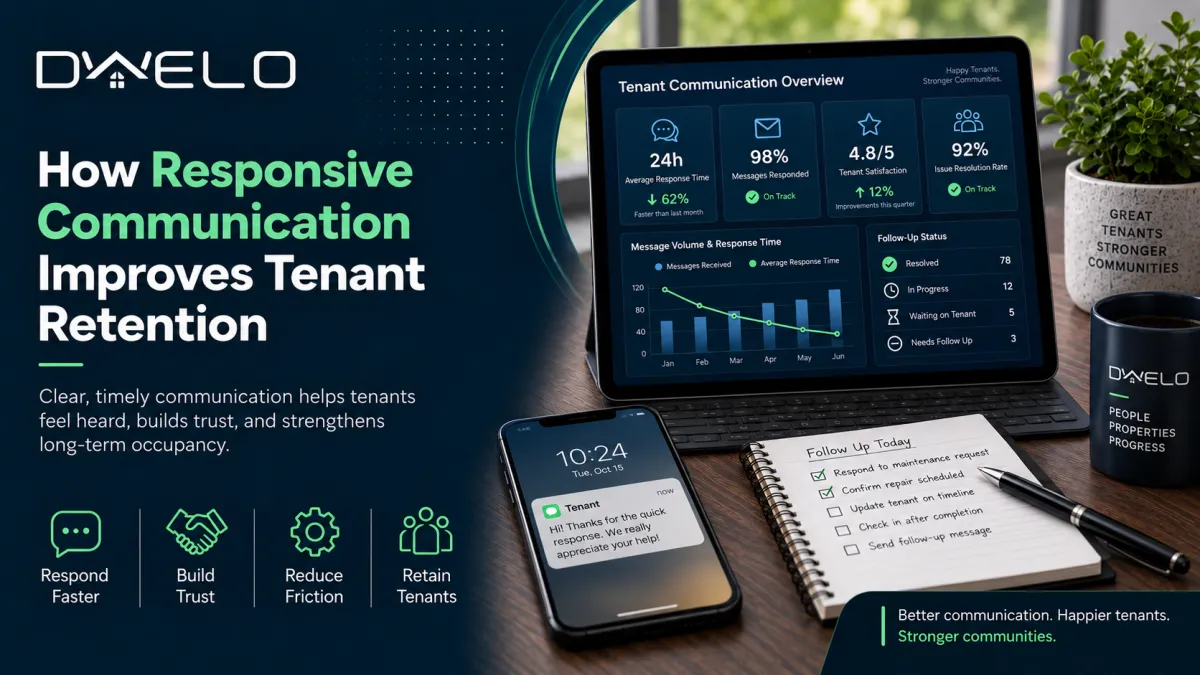
How Responsive Communication Improves Tenant Retention
Slow responses drive tenants away. Discover how responsive communication from a professional property manager builds trust and improves retention across South Carolina rentals.
Most property owners understand, at least in principle, that tenant experience affects retention. What they often underestimate is how much of that experience is shaped not by the property itself, its size, its finishes, its location, but by something entirely within the control of the management team: how quickly and how well they respond when a tenant reaches out.
A tenant who submits a maintenance request at 9 PM and receives a message by 9 AM acknowledging it, confirming next steps, and providing a timeline for resolution has had a fundamentally different experience than a tenant who submitted the same request and heard nothing for four days. The property is identical. The management team's responsiveness is not. And that difference, experienced not once, but repeatedly across the length of a tenancy, is one of the primary drivers of whether a tenant renews or begins looking for somewhere else to live.
Responsive communication improves tenant retention through a mechanism that is both psychological and practical: it builds the trust and confidence that make a tenant feel settled in their home rather than uncertain about whether their needs will be met. For South Carolina property owners, this trust is not a soft metric; it is directly and measurably connected to vacancy rates, turnover costs, and the long-term financial performance of the investment.
This blog examines how responsive communication works as a retention strategy: what it looks like across the stages of a tenancy, why it matters more than most owners recognize, and how professional property management delivers it with the consistency that self-managing owners typically cannot sustain.
What Responsive Communication Actually Means
Before examining the impact, it is worth defining what responsive communication in property management actually entails, because the concept is broader than simply returning phone calls quickly.
Responsive communication has three dimensions that together determine its quality and its effect on the tenant relationship.
Speed is the dimension most owners think of first, and it matters significantly. A tenant who reaches out with a question, concern, or maintenance report needs to know that their message has been received and that action is being taken. Silence, even silence that precedes a thorough and professional response two days later, generates anxiety in proportion to how long it lasts. The first response, even if it is only an acknowledgment that the matter has been received and is being handled, is the one that most reliably prevents the frustration that silence produces.
Clarity is the dimension that determines whether a response, however fast, actually serves the tenant. A response that confirms receipt but provides no information about what will happen next, when it will happen, or what the tenant should expect creates a different kind of uncertainty, one where the tenant knows they were heard but doesn't know what hearing them will produce. Responsive communication answers the questions behind the question: not just "I received your maintenance request" but "I received your maintenance request, a technician is scheduled for Thursday between 10 AM and noon, and you'll receive a confirmation when the work is complete."
Consistency is the dimension that determines whether responsiveness is experienced as a reliable feature of the management relationship or as an occasional pleasant surprise. A management team that responds quickly to some requests and slowly to others, that communicates well about some types of situations and poorly about others, creates an unpredictable experience that erodes tenant confidence even when the individual responses are adequate. Tenants who can rely on consistent responsiveness, who know from experience that reaching out will produce a prompt, clear, and professional response, develop a relationship with the management team that is fundamentally different from those who are never quite sure what to expect.
The Psychological Mechanism: Why Responsiveness Builds Trust
The connection between communication responsiveness and tenant retention is not primarily rational — it is psychological. Understanding the psychological mechanism makes it possible to see why responsiveness has such a disproportionate impact on how tenants experience a tenancy and whether they choose to remain in it.
Tenants live in their rental property every day. It is not an abstraction to them; it is the environment in which they wake up, cook meals, sleep, and spend their leisure time. When something in that environment needs attention, a repair, a question about the lease, a concern about a neighbor, the request they submit to management is, at some level, an expression of vulnerability. They are acknowledging that something in their home is not as it should be, and they are depending on someone else to address it.
How management responds to that vulnerability determines how the tenant feels about the relationship. A fast, clear, professional response communicates: your home matters, your concern is legitimate, and we are on it. A slow or absent response communicates the opposite: that the tenant's comfort is not a priority, that their concern has been noted but not acted upon, and that future requests may receive the same treatment.
That second experience, felt once, dismissed as an exception; felt twice, noted as a pattern; felt three times, accepted as a defining characteristic of the management relationship, is what drives tenants to conclude, usually quietly and well in advance of their lease expiration, that they would be better served living somewhere else.
Where Communication Responsiveness Matters Most Across the Tenancy
Responsive communication is not uniformly critical across all interactions. There are specific touchpoints in a tenancy where responsiveness has a disproportionate impact on the tenant's experience and their assessment of the management relationship.
Move-In Communication
The tenant's first experience of how management communicates sets the expectation that frames everything that follows. A move-in process that is well-organized, proactively communicated, and responsive to questions, utility setup instructions, key handover logistics, and contact information for maintenance and management creates an immediately positive first impression that carries forward.
Conversely, a move-in process marked by unclear instructions, delayed responses to pre-move-in questions, and a sense that the tenant is navigating the transition without adequate support creates an early negative impression that is difficult to reverse and that colors subsequent interactions.
Dwelo's lease administration services encompass the move-in communication process, from executed lease through documented move-in inspection and clear orientation of the tenant to the communication channels and expectations of the management relationship. That structured, professional onboarding experience is the first demonstration of the responsiveness standard the tenant can expect throughout their tenancy.
Maintenance Request Communication
This is the highest-stakes communication category in ongoing property management, not just for completion of the repair, but for the communication that surrounds it. Dwelo's property maintenance and repairs process is built around three communication beats that together constitute a complete maintenance interaction: acknowledgment of the request, confirmation of the scheduled response, and follow-up confirming completion and tenant satisfaction.
Each of these beats serves a specific function. Acknowledgment stops the tenant's uncertainty about whether their request was received. Scheduling confirmation gives the tenant the practical information they need to plan around the repair. Follow-up demonstrates that the management team cares not just that the repair was completed but that it was completed to the tenant's satisfaction, a distinction that communicates attentiveness beyond mere operational compliance.
Tenants who receive all three beats consistently, across every maintenance interaction, develop a high level of confidence in the management relationship. Tenants who receive only the repair, without the surrounding communication, have a transactionally adequate but relationally thin experience that doesn't build the trust that drives renewal.
Lease Renewal Communication
The timing and quality of communication at lease renewal is one of the most directly impactful communication interactions in the entire tenancy, and one of the most frequently mishandled by self-managing owners.
Reaching out to a tenant 90 days before lease expiration, rather than 30 days before or, worse, after the expiration date has passed, communicates that the tenant's continued residency is valued and that the management team is attentive to the calendar. The renewal offer itself should be specific, professional, and accompanied by a clear explanation of any changes in terms. If the tenant has questions, those questions should receive prompt, complete responses.
A tenant who receives a thoughtful, well-timed renewal communication from a management team they trust, because that team has been consistently responsive throughout the tenancy, is a tenant who approaches the renewal decision from a position of confidence and goodwill. A tenant who receives a last-minute renewal notice from a management team whose responsiveness has been inconsistent is a tenant whose renewal decision is already colored by accumulated doubt.
Responding to Concerns and Complaints
How a management team handles a tenant concern, particularly a complaint about something the management team has done or failed to do, is one of the most revealing tests of communication quality in the landlord-tenant relationship.
Defensive, dismissive, or delayed responses to legitimate complaints don't just fail to resolve the underlying issue; they transform the complaint from a singular event into evidence of a pattern. A tenant who raised a concern and was treated dismissively remembers it. That memory influences how they evaluate the management relationship at renewal time, how they communicate future concerns, and, ultimately, whether they feel settled enough in the tenancy to stay.
Prompt, professional, non-defensive engagement with tenant concerns, even when the concern is not fully within the owner's control to resolve, demonstrates respect for the tenant's experience and a genuine commitment to addressing it. That demonstration, particularly when a situation is difficult, builds more trust than a hundred uneventful interactions.
Why Self-Managing Owners Struggle to Sustain Responsiveness
The case for responsive communication is straightforward. The challenge for self-managing owners is not understanding why it matters; it is sustaining it consistently across the full length of a tenancy, across multiple properties, alongside every other responsibility in their lives.
A self-managing owner receives a maintenance request at 11 PM on a Tuesday when they are traveling for work. They intend to respond in the morning. By morning, two other things have demanded attention, and the message is still unread. By Thursday, the tenant has not received a response and is beginning to wonder whether the message was received at all. By the time the owner responds on Friday, four days have passed, and the tenant has formed an impression that will be very difficult to reverse over the remaining ten months of the tenancy.
This is not a failure of intention. It is a structural failure: the self-managing owner is one person with finite time and attention, managing a relationship that requires consistent availability across seven days a week, through travel, illness, competing priorities, and every other demand on their life.
Professional property management resolves this structurally. Dwelo's tenant relations services provide tenants with consistent access to a professional team, not a single individual whose availability fluctuates with life's demands. Communication is handled through established channels with defined response standards, ensuring that the consistency tenants need is delivered by a system rather than dependent on any individual's availability in any given moment.
Real-World Scenarios: Responsiveness as a Retention Tool
Scenario 1: The Acknowledgment That Prevented a Decision to Leave
A Mount Pleasant tenant had submitted a maintenance request for a persistent issue, a window seal that was allowing drafts, and had not received a response after two business days. She had begun researching available rentals in the area, not because she was certain she wanted to leave, but because the silence had produced enough uncertainty about management responsiveness to make her wonder whether the tenancy would continue to serve her well. When she transitioned to a property managed by Dwelo, the same category of request was acknowledged within hours, scheduled within three days, and completed with a follow-up the same day the technician visited. She renewed her lease at the end of the term without seriously considering alternatives, not because the property had changed, but because the management relationship had.
Scenario 2: The Renewal Communication That Landed Differently
A Columbia tenant whose prior management experience had included a last-minute lease renewal notice, offered two weeks before expiration, with no preceding communication, received her first renewal outreach from Dwelo 90 days before her lease expiration date. The offer was specific, accompanied by a brief market context note explaining the modest rent adjustment being proposed, and included a clear invitation to discuss any questions. The tenant responded within a week with a signed renewal. She later noted, in a follow-up conversation, that the advance notice and professional framing of the offer made the decision feel straightforward, a reflection of a management relationship she trusted rather than a transaction she was navigating under time pressure.
Scenario 3: The Complaint That Strengthened the Relationship
A Charleston tenant raised a concern that a repair completed by a contractor had not fully resolved the underlying issue, a recurring drain problem had returned within three weeks of the original service visit. Rather than defending the prior work or delaying acknowledgment, Dwelo's team responded within the same business day, acknowledged the tenant's frustration directly, arranged a follow-up visit from the contractor at no additional scheduling inconvenience to the tenant, and followed up after the second visit to confirm the issue was resolved. The tenant's response to this experience, captured in a note to the management team, indicated that how the complaint had been handled had actually increased their confidence in the management relationship. They renewed their lease six months later. Dwelo's full-service property management in South Carolina treats tenant complaint responses as retention opportunities, not administrative obligations.
Key Benefits of Responsive Communication for Property Owners
Higher Renewal Rates
Tenants who trust that their management team will respond promptly and professionally to their needs are significantly more likely to renew than those who feel their concerns are deprioritized. Higher renewal rates mean lower vacancy, lower turnover costs, and more stable annual income.
Earlier Problem Identification
Tenants who trust the communication relationship are more likely to report developing issues promptly rather than tolerating them until they become urgent. Early reporting enables early intervention, which reduces repair costs and prevents the kind of habitability issues that generate legal exposure.
Reduced Conflict Escalation
Communication-responsive management prevents the kind of accumulated grievance that turns minor disputes into significant conflicts. Tenants who feel heard don't typically escalate, because the management relationship gives them a functional channel for raising concerns before they reach the point of formal dispute.
Stronger Owner Reputation
In South Carolina's rental markets, word of mouth matters. Tenants who have a positive management experience are more likely to recommend a property, or a management company, to others in their network. That organic referral value reduces future marketing effort and improves applicant quality.
Owner Operational Relief
An owner who never receives frantic tenant calls because professional management is handling communication consistently is an owner whose personal time and attention are protected. The operational relief that comes from knowing communication is being handled professionally is itself a meaningful quality-of-ownership benefit.
Communication Is the Invisible Infrastructure of Tenant Retention
Every aspect of a well-managed property the quality of the maintenance, the clarity of the lease, the reliability of the rent collection system depends on communication to be experienced as the value it represents. Maintenance done well but communicated poorly still generates frustration. A lease that is fair and clear still creates uncertainty if the tenant has no confidence that questions will be answered promptly. Communication is not a supplement to property management; it is the medium through which the tenant experiences every other management function.
Professional property management, done well, delivers communication as a structural feature of the management system, not as a variable dependent on an individual owner's bandwidth on any given day. That structural reliability is what transforms a transactional landlord-tenant relationship into the settled, trusting tenancy that renews year after year.
Real estate agents with South Carolina investor clients whose tenants are leaving at the end of each lease term can connect their clients with a management approach that addresses the root cause through our agent referral program.
Ready to build a management relationship that keeps your best tenants in place? Schedule a free consultation with Dwelo and let's talk about how responsive communication changes the retention equation for your rental investment.
Dwelo Property Management provides comprehensive, full-service rental property management across South Carolina, including Charleston, Mount Pleasant, Isle of Palms, Columbia, Greenville, Spartanburg, and surrounding communities.


