
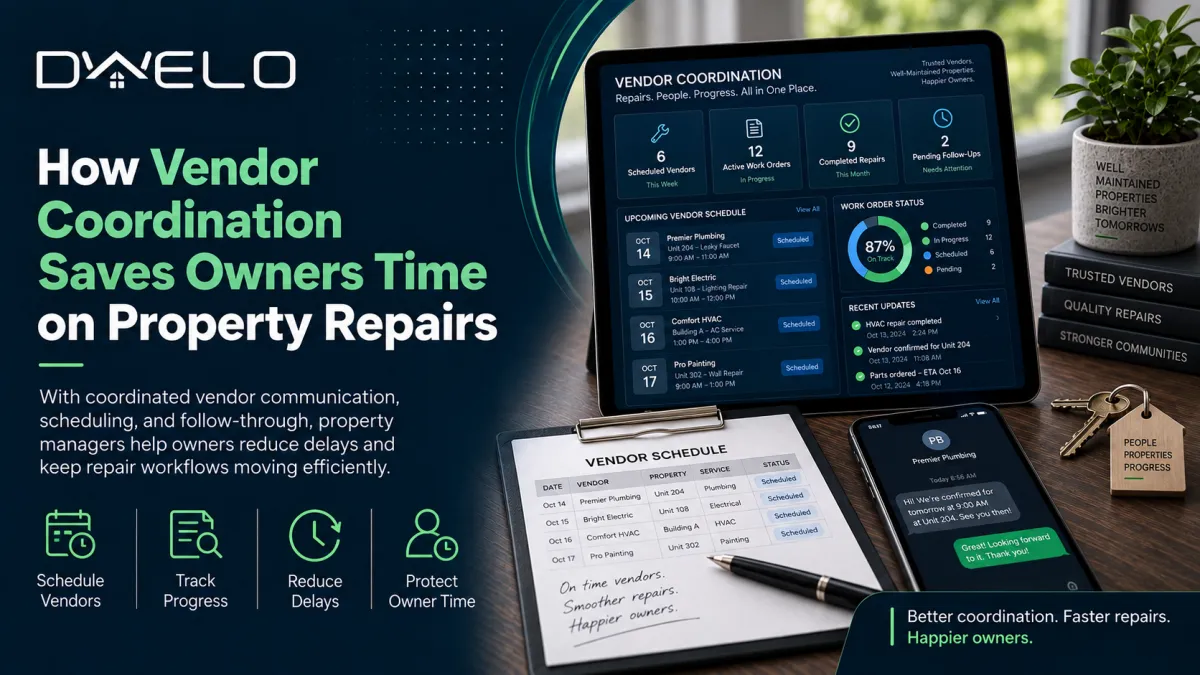
How Vendor Coordination Saves Owners Time on Property Repairs
Coordinating contractors for rental property repairs is time-consuming and stressful. Learn how Dwelo's vendor relationships save South Carolina owners time, money, and frustration.
Ask a self-managing landlord what takes the most time out of property ownership the part they didn't anticipate when they bought their first rental and the answer is rarely lease administration or rent collection. It is almost always maintenance: specifically, the time spent finding contractors, getting estimates, scheduling work around tenant availability, following up when contractors don't show, and verifying that the completed work actually solved the problem.
This is the part of property management that is invisible from the outside and exhausting from the inside. It requires availability during business hours to make phone calls. It requires the judgment to evaluate whether a contractor's estimate is reasonable. It requires the organizational discipline to track multiple open work orders across multiple properties simultaneously. And it requires a network of trusted, responsive contractors that takes years to build and that most individual owners are building from scratch, under pressure, every time something breaks.
Vendor coordination saves owners time on property repairs in ways that compound across every repair event over the full life of a property ownership. For South Carolina property owners who have experienced the operational weight of managing repairs independently, understanding how professional vendor coordination changes the equation is one of the most practically compelling arguments for professional property management. This blog examines exactly what vendor coordination involves, why it is so time-intensive when managed individually, and how Dwelo's established vendor relationships transform it from a burden into a system.
What Vendor Coordination Actually Involves
The term sounds administrative. The reality is more demanding. Effective vendor coordination across a rental property portfolio involves a sequence of distinct activities, each requiring time and judgment, and each creating an opportunity for delay, error, or additional cost if handled poorly.
Identifying the Right Trade for the Problem
Not every maintenance issue calls for the same type of contractor. A plumbing issue requires a licensed plumber. An electrical fault requires a licensed electrician. An HVAC problem requires an HVAC technician with the appropriate refrigerant handling certification. A roof leak may require a roofer, a general contractor, or both depending on whether the failure is at the roofing surface or in the underlying structure. A mold issue following water intrusion requires a remediation specialist, not a general handyman with a mop.
Calling the wrong trade wastes time and sometimes money, as a contractor who arrives and determines the work is outside their scope has still consumed a scheduling slot and may still charge a service call fee. Correctly identifying which trade a given problem requires is a function of maintenance knowledge and experience the same knowledge that a professional property management company applies automatically and that most individual owners are developing on the fly.
Sourcing and Evaluating Contractors
Once the correct trade is identified, the owner without an established vendor network faces a sourcing challenge. Online searches and referral requests produce a list of options with limited basis for distinguishing between them. Licensing can be verified through state databases. Insurance certificates can be requested. Reviews can be read. But none of these substitute for the firsthand experience of having worked with a contractor across multiple jobs — knowing whether they show up on time, communicate clearly, charge what they quoted, and complete work to a standard that holds up.
An owner who is sourcing a contractor under pressure, with a tenant waiting on a repair, is sourcing from a position of urgency that disadvantages them in every dimension. They are less likely to take time to vet thoroughly, more likely to accept the first available option, and more likely to pay a premium because they have no established relationship to draw on.
Dwelo's property maintenance and repair services are supported by an established network of licensed, insured, and vetted contractors across every relevant trade in South Carolina's markets: plumbing, electrical, HVAC, roofing, general carpentry, pest control, landscaping, and more. These relationships were built over years of working together across dozens of properties, producing a firsthand performance record that no online review can replicate.
Scheduling Around Tenant Availability
A repair that requires access to an occupied unit requires coordination between the contractor's availability and the tenant's schedule. This sounds simple. In practice, it involves phone or message exchanges with the tenant to identify available windows, communication with the contractor to confirm those windows work against their schedule, and follow-up if either party needs to adjust. If the first scheduling attempt falls through, which happens regularly in contractor scheduling, the entire sequence repeats.
For an owner managing one property, this is manageable but time-consuming. For an owner managing three or five properties with multiple open work orders simultaneously, the scheduling coordination alone becomes a meaningful part-time administrative function.
Professional property management absorbs this coordination entirely. Tenants communicate with the management team through established channels. The management team coordinates with contractors through established relationships. The owner receives notification that a repair has been scheduled and subsequently completed, without participating in any of the scheduling communication that produced that outcome.
Supervising Work Quality and Completion
Scheduling a contractor and having them complete the work is not the same as having the work completed correctly. Inadequate repairs, addressing the surface symptom without the underlying cause, using materials that don't meet the quality standard the property requires, or completing work that fails again within weeks, generate additional repair events that consume additional time and cost.
Evaluating the adequacy of completed work requires either the owner's presence during or immediately after the job, or a reliable assessment from the property management team. An owner who relies on the contractor's own report that the work is complete has no independent verification, and the first indication of inadequate work is often a repeat maintenance request from the tenant.
Dwelo's vendor relationships include an expectation of work quality that comes from the ongoing relationship. Contractors who work with Dwelo across many properties understand that inadequate work reflects on the relationship, not just the individual job. This accountability, which only exists within an ongoing vendor relationship, produces a higher standard of work quality than a one-time owner-contractor interaction typically achieves.
Invoice Review and Payment Processing
Once work is completed, the invoice needs to be reviewed, verified against the scope of work performed, and processed for payment. For an owner with a simple payment arrangement, this may be straightforward. For an owner managing multiple properties with multiple active vendors, invoice management becomes its own administrative workload, tracking what is outstanding, verifying amounts, processing payments, and maintaining the records that support accurate financial reporting.
Professional property management absorbs invoice review and payment processing as part of the vendor coordination function. Invoices are verified against the documented scope of work, processed through the management accounting system, and reflected directly in owner financial reporting. Dwelo's financial reporting for property owners provides complete, itemized maintenance expense documentation as a standard feature of monthly owner statements, so every vendor payment flows directly into the owner's financial record without requiring any separate tracking effort.
The Network Advantage: What Established Vendor Relationships Produce
The most significant difference between an individual owner's approach to vendor coordination and a professional property management company's approach is not organizational; it is relational. The established vendor network that a professional management company maintains is an asset that individual owners cannot replicate without years of experience and sustained volume.
Priority Scheduling
Contractors who work with a property management company across a portfolio of properties have a meaningful business relationship to protect. They prioritize the management company's calls, not because of favoritism, but because the relationship represents a reliable, recurring source of work that individual property owner calls do not. When scheduling is tight and multiple clients are requesting the same window, the management company's call moves to the front of the line in ways that a one-off owner request typically does not.
This priority access has particularly high value during peak demand periods. In South Carolina's summer months, HVAC technicians are at maximum demand. Roofing contractors are backlogged after storm events. Plumbers become harder to reach during periods of widespread weather-related damage. An individual owner calling without an established relationship is competing with everyone else for available appointment slots. Dwelo's vendor relationships provide access that individual owners cannot match.
Established Pricing
Contractors who work with Dwelo across multiple properties offer pricing that reflects the volume and consistency of the relationship. This is not a formal discount arrangement; it is the natural result of a business relationship where the contractor knows the work is managed professionally, invoices are paid promptly, and the work environment is organized rather than chaotic. The aggregate effect is pricing that is more favorable than what most individual owners achieve when hiring on a one-off basis.
For owners reviewing maintenance costs in their monthly financial statements, this pricing advantage translates into lower per-repair costs across the full portfolio, a benefit that compounds over the life of a property ownership.
Known Quality Standards
When Dwelo dispatches a vendor from the established network, the management team already knows what to expect. The plumber has completed dozens of jobs across managed properties. The HVAC technician has a track record of thorough diagnostic work rather than symptom-only repairs. The roofer uses materials and techniques that the team has observed performing well over time in South Carolina's climate. This foreknowledge eliminates the uncertainty that characterizes every owner-sourced contractor call and dramatically reduces the incidence of inadequate work that generates repeat repair events.
What Vendor Coordination Looks Like for Different Property Profiles
The value of professional vendor coordination manifests differently depending on the owner's situation, but it produces meaningful time and cost savings across every profile.
The Single-Property Owner Who Self-Manages
For an owner managing one property independently, vendor coordination is an occasional but disproportionately time-consuming activity. A single significant repair event a water heater replacement, an HVAC issue, a plumbing problem can consume several hours of phone calls, scheduling, and follow-up. The time cost is real even if the owner doesn't think of it as such. Under professional management, that same repair event consumes zero hours of the owner's time: it is identified, coordinated, completed, invoiced, and reported without owner involvement in any step of the process.
The Multi-Property Owner Whose Portfolio Has Grown Beyond Self-Management Capacity
This is the profile where vendor coordination burden becomes most acute. An owner managing four or five properties independently often reaches a point where maintenance coordination alone is consuming 10 to 15 hours per month, time that is both personally costly and strategically misallocated, since it is time spent on reactive administration rather than on the investment decisions and portfolio management that actually grow the owner's wealth.
Professional management absorbs this workload entirely and restores the owner's time for higher-value activity. Dwelo's full-service property management in South Carolina is particularly well-suited for owners at this inflection point, the moment when portfolio scale has made self-management both unsustainable and counterproductive.
The Out-of-State Owner Who Cannot Be Present
For property owners who live outside South Carolina and cannot be physically present to coordinate or oversee repairs, vendor coordination is not just time-consuming; it is structurally impossible to manage well from a distance. Finding a contractor in a market where you have no local knowledge, coordinating access with a tenant you cannot visit, and verifying work quality without being on site all represent genuine operational challenges that distance makes dramatically harder.
Dwelo's established local vendor network and on-the-ground management presence resolve this entirely. Out-of-state owners receive the same quality of maintenance coordination as owners who live around the corner from their property, because the professional team that manages the coordination is local, experienced, and operating through established relationships, regardless of where the owner is located.
Real-World Scenarios: Vendor Coordination in Practice
Scenario 1: The HVAC Repair That Would Have Taken Two Weeks Alone
A self-managing Columbia property owner with no established HVAC vendor relationship spent three days calling contractors during a July heat wave before finding one who could schedule a visit, and that visit came with a premium emergency rate reflecting both the timing and the absence of a prior relationship. After transitioning to Dwelo's management, an equivalent HVAC issue at another property was resolved through a same-day call to an established vendor who scheduled the repair for the following morning, at a standard rate reflecting the ongoing relationship. The difference in resolution timeline, three days versus one, and in cost was attributable entirely to the vendor relationship, not the nature of the repair.
Scenario 2: The Multi-Vendor Coordination That Required No Owner Involvement
A water intrusion event at a Charleston property required three separate vendors: a plumber to identify and repair the source, a water damage restoration company to extract moisture and deploy drying equipment, and a drywall contractor to repair and repaint the affected ceiling section once drying was complete. Coordinating three vendors in the correct sequence, around tenant availability, with appropriate gap time between each trade, while managing invoicing across all three is a project management exercise that the property owner had zero involvement in. Dwelo's management team handled the full coordination sequence. The owner received a single summary communication with all three vendors' work described, all three invoices itemized, and the total cost reflected in that month's financial statement.
Scenario 3: The Out-of-State Owner Whose Repair Was Handled Entirely Locally
A property owner based outside South Carolina received a tenant maintenance report about a failing garbage disposal and a slow-draining kitchen sink. Under self-management, addressing this would have required finding a local plumber from out of state, arranging access with the tenant, and verifying completion without being present. Under Dwelo's tenant relations services and vendor coordination, the tenant's report was received, a plumber from the established network was dispatched within two business days, both issues were resolved in a single visit, and the owner received a completion notification and invoice documentation the same day, without making a single phone call or sending a single text message.
Key Benefits of Professional Vendor Coordination for Owners
Time Recovery
Every hour spent sourcing contractors, scheduling repairs, and following up on work orders is an hour the owner cannot spend on higher-value activities. Professional vendor coordination returns that time entirely, across every repair event, over the full life of property ownership.
Access to Established Relationships
Priority scheduling, known quality standards, and relationship-based pricing are only available through vendor networks built over time. Individual owners cannot replicate these advantages without the same volume and history of work that a professional management company provides.
Lower Per-Repair Costs
Relationship-based pricing consistently produces lower per-repair costs than one-off owner sourcing, particularly during high-demand periods when individual owners have the least negotiating leverage.
Higher Repair Quality and Lower Repeat Rates
Known contractors working within an ongoing management relationship deliver higher quality work and generate fewer repeat repair events, reducing both the direct cost of rework and the tenant satisfaction impact of recurring maintenance issues.
Complete Documentation Without Owner Effort
Every repair coordinated through professional management produces documented records of work completed, vendor, cost, and date that flow directly into financial reporting without requiring owner-managed invoice tracking.
The Vendor Network Is the Infrastructure That Makes Maintenance Management Possible
A property management company's vendor network is not a peripheral operational detail. It is foundational infrastructure, the relationships, experience, and access that make it possible to respond to maintenance needs promptly, execute repairs correctly, and manage costs effectively across a portfolio of properties.
Building that network takes years of consistent work volume, professional relationship management, and the kind of firsthand experience that tells a management team which vendor to call for which problem in which market. Individual owners cannot replicate it overnight. But by working with a management company that has built it, they gain access to the full value of those relationships from day one, without the years of effort it would take to establish them independently.
Real estate agents with South Carolina investor clients who are spending their weekends on contractor calls can connect their clients with a management structure that handles it all through our agent referral program.
Ready to get your time back and have your repairs handled by a team with the right relationships in place? Schedule a free consultation with Dwelo and let's talk about how professional vendor coordination changes the ownership experience.
Dwelo Property Management provides comprehensive, full-service rental property management across South Carolina, including Charleston, Mount Pleasant, Isle of Palms, Columbia, Greenville, Spartanburg, and surrounding communities.


