
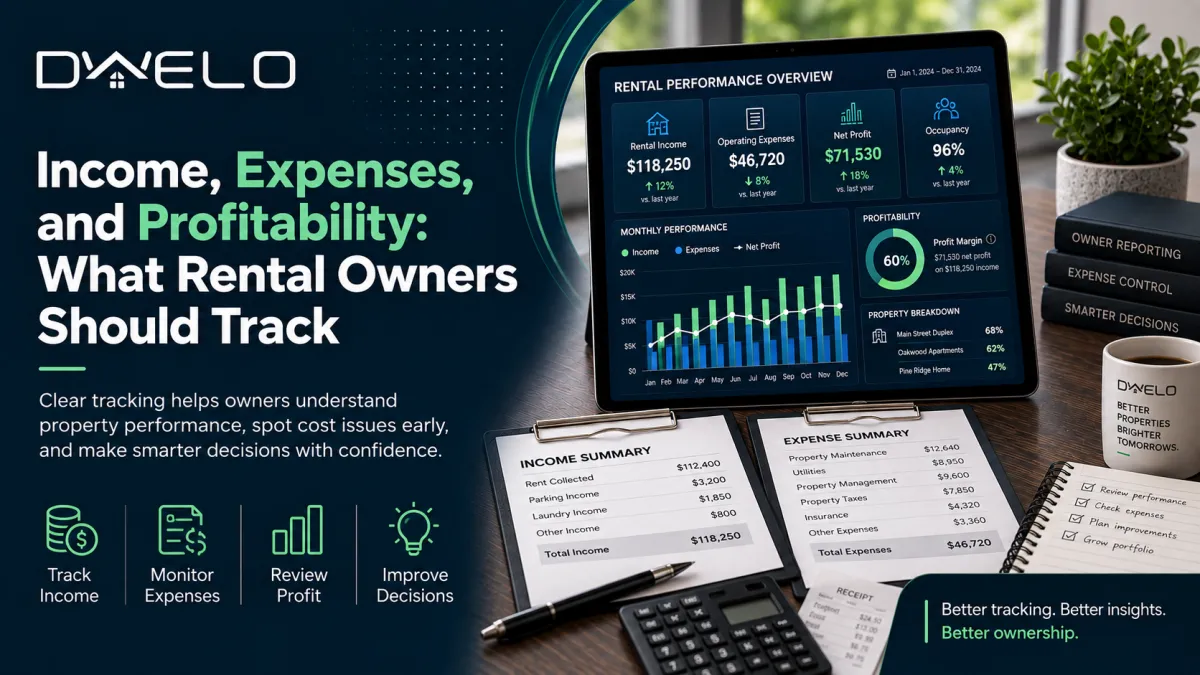
Income, Expenses, and Profitability: What Rental Owners Should Track
Knowing your numbers is the foundation of smart rental property ownership. Learn exactly what income, expenses, and profitability metrics South Carolina owners should track.
Most rental property owners know their monthly rent. Fewer know their monthly net income. And fewer still can tell you, with any precision, what your property's actual profitability has been over the past twelve months after every expense category has been accounted for, every vacancy day has been factored in, and every maintenance cost has been properly attributed.
That gap between knowing the rent and knowing the return is where most rental property financial management breaks down. And it breaks down not because owners don't care about the numbers, but because nobody has clearly mapped out which numbers matter, what each one means, and how they connect to form a complete picture of investment performance.
Tracking rental property income, expenses, and profitability is not an accounting exercise for its own sake. It is the financial intelligence that drives every meaningful decision a property owner makes: whether to raise rent, whether to invest in a repair or defer it, whether the property is performing well enough to hold, or whether capital should be redeployed. Without this intelligence, those decisions are made on assumption and approximation. With it, they are made on fact.
This blog builds the complete financial tracking framework that South Carolina rental property owners need, organized by income, expenses, and profitability metrics, and explains what each component reveals about the health of the investment.
Part 1: Income — What to Track Beyond the Rent Check
Rental income is the obvious starting point, but a complete income picture involves more than the monthly rent figure. Owners who track only gross rent are missing income streams that compound meaningfully over time, and are missing the context that makes the rent figure itself interpretable.
Gross Scheduled Rent
This is the total rent the property is contracted to generate over a given period: the amount specified in the lease, multiplied by the number of months. It is the theoretical income ceiling: what the property would produce if it were fully occupied and every payment arrived on time.
Gross scheduled rent is the baseline against which every other income metric is measured. On its own, it tells an owner what the property should generate. Every subsequent metric explains the gap between "should" and "did."
Collected Rent
This is the rent that was actually received, which may differ from scheduled rent due to late payments still outstanding at the period's end, partial payments, or payment adjustments. Tracking collected rent separately from scheduled rent reveals whether a property's income is arriving reliably or whether there is consistent slippage between what is owed and what is received.
A persistent gap between scheduled and collected rent is one of the earliest indicators of a collection process problem the same problem that Dwelo's rent collection services are designed to eliminate through systematic, automated payment management.
Vacancy Loss
Vacancy loss is the income that was scheduled but not earned because the unit was unoccupied. Tracking it as a distinct line item rather than simply noting that rent was lower in a given month makes the cost of vacancy visible and attributable.
For a property renting at $1,800 per month, a 30-day vacancy represents a $1,800 vacancy loss. A 45-day vacancy represents $2,700. Tracked cumulatively over a year, vacancy loss is often the single largest variable affecting actual versus potential income and the one most directly influenced by the quality of property marketing and tenant retention.
Additional Income
Rental properties generate income beyond base rent in several categories that owners frequently fail to track separately: late fees collected, pet fees or pet deposits that are non-refundable, parking fees for properties with dedicated parking, storage fees, and lease renewal fees if applicable. These amounts are individually modest but cumulatively meaningful, and tracking them separately gives owners a complete picture of what the property generates in total, not just what the lease specifies as monthly rent.
Part 2: Expenses — The Categories That Matter Most
Expense tracking is where most self-managing owners have the largest gaps. The tendency is to track large, obvious expenses a major repair, a full-month management fee and to undercount or lose track of smaller recurring costs that accumulate significantly over a year. A complete expense tracking framework covers every category with discipline.
Property Management Fees
Management fees are the most predictable recurring expense for professionally managed properties: a percentage of collected rent, charged monthly, specified in the management agreement. They should appear as a consistent, separately itemized line item in every reporting period. Tracking them over time confirms the fee is being calculated correctly and provides a cumulative annual figure that feeds into profitability calculations and tax preparation.
Maintenance and Repair Costs
This is the expense category with the highest variability and the highest information value. Maintenance costs should be tracked not just as a total but by category plumbing, HVAC, electrical, appliance, cosmetic, and exterior because the distribution of costs across categories reveals patterns that inform both maintenance strategy and capital planning.
A property whose maintenance costs are consistently concentrated in plumbing, for example, is communicating something about its infrastructure that an aggregated total would obscure. That signal, visible in categorized expense tracking, is what supports proactive capital decisions rather than perpetual reactive repair cycles. Dwelo's property maintenance and repairs documentation captures every maintenance expense at the category level, feeding directly into the financial reporting that makes this analysis possible.
Capital Expenditures
Capital expenditures are significant one-time investments in property improvements or major system replacements and are distinct from routine maintenance and should be tracked separately. The distinction matters for several reasons: capital expenditures are treated differently from operating expenses for tax purposes, they affect the property's basis for depreciation calculations, and they need to be evaluated separately from operating costs when assessing the property's ongoing expense run rate.
Tracking capital expenditures separately prevents them from distorting the routine maintenance expense picture. A year in which a $12,000 roof replacement occurs looks very different from a year of normal maintenance, and conflating the two produces a misleading expense profile for both years.
Insurance
Property insurance is a fixed annual cost that should be tracked precisely and reviewed periodically. Premium changes from year to year are a direct expense impact that owners sometimes absorb without noticing because they've set up automatic payment. Tracking it explicitly keeps the cost visible and prompts periodic coverage review to ensure the policy limits remain appropriate as the property's value changes.
Property Taxes
Property taxes are an annual fixed cost that, like insurance, is easy to lose track of when paid automatically or through escrow. Tracking them as a distinct annual expense and monitoring for assessment changes that affect the tax liability without requiring owner action keeps this cost visible and properly attributed in annual profitability calculations.
Utilities Paid by Owner
For properties where the owner covers any utilities water and sewer in some multi-tenant arrangements, trash collection, common-area electricity those costs should be tracked as operating expenses with the same discipline as maintenance. Utility costs are subject to rate increases that compound over time and deserve the same periodic review as any other recurring expense.
Vacancy-Period Carrying Costs
During vacancy periods, the property continues to generate costs without generating income. Insurance, taxes, and any owner-covered utilities continue. Turnover preparation costs cleaning, painting, and repairs are incurred before the next tenant takes possession. Tracking these costs as a distinct category during vacancy periods reveals the full economic cost of turnover, making the value of tenant retention and the cost of preventable vacancy precisely calculable rather than vaguely understood.
Part 3: Profitability Metrics; The Numbers That Reveal Performance
Individual income and expense figures tell part of the story. The metrics derived from combining them are what reveal whether a property is genuinely performing, and how to evaluate it against alternatives.
Gross Operating Income
Gross operating income is collected rent plus all additional income, representing total actual income received before expenses. It is the starting point for all profitability calculations and the figure from which every expense category is subtracted.
Net Operating Income
Net operating income (NOI) is gross operating income minus all operating expenses, including management fees, maintenance, insurance, taxes, and utilities, but before mortgage debt service. NOI is the single most important profitability metric for a rental property because it represents what the asset generates from its operations, independent of how it is financed.
NOI is the figure that allows owners to evaluate a property's performance against market benchmarks, including the capitalization rate calculation that determines whether the property's return is appropriate relative to its current value. Dwelo's financial reporting services present NOI as a standard monthly and year-to-date figure, giving owners the metric that makes performance evaluation meaningful rather than approximate.
Cash Flow After Debt Service
For owners with a mortgage on the property, cash flow after debt service NOI minus the monthly mortgage payment is the figure that represents actual money in hand. This is the profitability metric that most directly answers the owner's practical question: "What did I actually make this month?"
Tracking it separately from NOI is important because debt service is a financing cost, not an operating one. Understanding both figures what the property generates operationally and what it nets after financing is essential for owners evaluating refinancing decisions, comparing leveraged versus unleveraged returns, or assessing the impact of a rate change on overall portfolio performance.
Cash-on-Cash Return
Cash-on-cash return expresses annual cash flow after debt service as a percentage of the total cash invested in the property, the down payment plus closing costs plus any initial capital improvements. It is the metric that answers: "What return am I earning on the cash I actually put into this investment?"
Tracking cash-on-cash return over time reveals whether the investment's return on deployed capital is improving, stable, or declining, and provides the basis for comparing the property's performance against other investment options available to the owner.
Expense Ratio
The expense ratio, total operating expenses divided by gross operating income, expresses what percentage of income is consumed by operating costs. A rising expense ratio over time is an early warning signal: even if nominal income is increasing, an increasing proportion of that income going to expenses means net profitability is being compressed.
Tracking the expense ratio annually is one of the most effective early-warning mechanisms available for identifying properties where maintenance cost escalation, insurance increases, or rising vacancy are beginning to erode returns before the impact becomes dramatic.
Real-World Scenarios: Financial Tracking That Changed Owner Decisions
Scenario 1: The Vacancy Loss That Reframed the Marketing Investment
A Johns Island property owner had never tracked vacancy loss as a separate line item; when the unit was empty, they simply noted the absence of income without quantifying it. After transitioning to Dwelo's full-service property management in South Carolina and beginning to receive itemized monthly statements, the owner saw for the first time that cumulative vacancy loss across three tenancy transitions in 24 months had totaled over $8,400. That figure, made visible by structured tracking, reframed the value of professional marketing and tenant retention from an expense into a measurably justified investment. The owner had been evaluating marketing costs in isolation; seeing vacancy loss quantified put those costs in their correct context.
Scenario 2: The Maintenance Expense Ratio That Flagged a Portfolio Outlier
A Columbia investor managing three properties through Dwelo reviewed annual expense ratios across the portfolio and identified that one property's expense ratio was running 14 percentage points higher than the other two, a gap invisible in the nominal numbers but apparent when expenses were expressed as a proportion of income. Drilling into the categorized maintenance data revealed that HVAC-related costs at the outlier property accounted for the majority of the variance. A targeted inspection identified an aging system operating inefficiently. The owner made a planned capital replacement decision based on the financial data, converting a recurring operating cost problem into a one-time capital expenditure that improved the expense ratio in subsequent years.
Scenario 3: The Cash-on-Cash Calculation That Prompted a Refinance Review
A Summerville property owner who had held a rental for seven years had never calculated their cash-on-cash return since the original acquisition analysis. After beginning to track the full financial picture through Dwelo's reporting, the owner worked with their accountant to calculate current cash-on-cash return using the actual NOI figures from the past 12 months. The calculation revealed that rising property insurance costs and a mortgage rate higher than current market rates had compressed the cash-on-cash return meaningfully from the original underwriting. That clarity prompted a refinance evaluation, which produced a rate reduction that materially improved cash flow after debt service. The decision was only possible because the financial tracking created the inputs the calculation required.
Key Financial Metrics Every South Carolina Rental Owner Should Track
Metric | What It Reveals |
|---|---|
Gross Scheduled Rent | Income potential at full occupancy |
Collected Rent | Actual collection reliability |
Vacancy Loss | Cost of unoccupied periods |
Operating Expenses by Category | Cost structure and emerging trends |
Net Operating Income | True operational performance |
Cash Flow After Debt Service | Actual monthly return after financing |
Cash-on-Cash Return | Return on deployed capital |
Expense Ratio | Efficiency of income conversion |
The Numbers Are Only Useful if They're Being Tracked
Every one of these metrics is available to every rental property owner, but only if the underlying data is being captured, categorized, and reported consistently. An owner whose income arrives in a bank account and whose expenses are scattered across invoices, automatic payments, and memory has the raw ingredients for this analysis but no way to assemble them reliably.
Professional financial reporting assembles the picture automatically, from transaction data that is captured correctly at the point of each event. Dwelo's financial reporting services provide South Carolina property owners with the monthly and year-to-date figures that make every metric in this framework calculable without any owner-side assembly effort, so the intelligence is available at the moment decisions need to be made, not reconstructed weeks later from incomplete records.
Dwelo Property Management: your partners in real estate success.
Real estate agents with South Carolina investor clients who are making financial decisions without complete tracking can connect their clients with a reporting infrastructure that changes that immediately through our agent referral program.
Ready to know your real numbers and make better decisions because of them? Schedule a free consultation with Dwelo and let's build a financial tracking framework that matches the scale of your investment.
Dwelo Property Management provides comprehensive, full-service rental property management across Charleston, Mount Pleasant, North Charleston, Summerville, Goose Creek, Daniel Island, Johns Island, James Island, West Ashley, Isle of Palms, and the South Carolina Lowcountry.


