
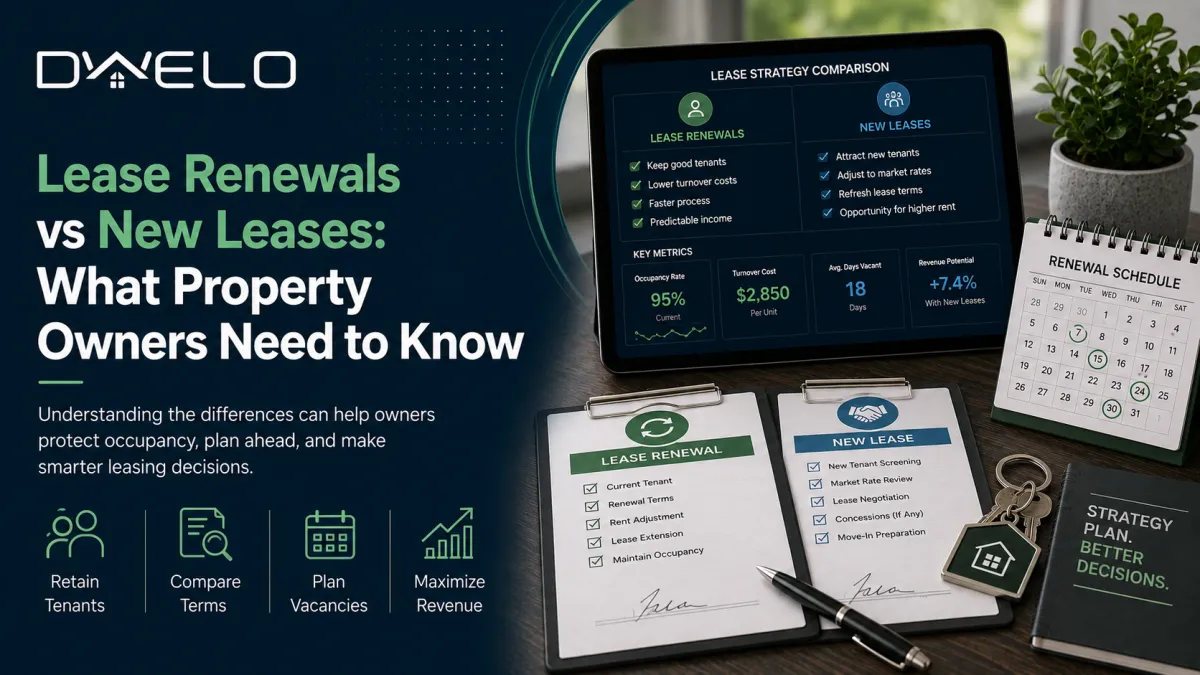
Lease Renewals vs New Leases: What Property Owners Need to Know
Renew or re-lease? It's one of the most important decisions rental property owners face. Learn how to evaluate lease renewals vs new leases for your South Carolina rental.
Sixty to ninety days before a lease expires, every rental property owner faces the same decision: pursue a renewal with the current tenant, or prepare the unit for a new one. For many owners, particularly those self-managing or working with a less proactive management company, this decision arrives without enough lead time, without enough information, and without a clear framework for evaluating it well.
The result is one of two common mistakes. The first is renewing automatically, without evaluating whether the current rent reflects the market or whether the tenancy has been genuinely strong enough to warrant prioritizing retention. The second is defaulting to turnover, assuming that a new tenant at a higher rent is always the better outcome, without accounting for the full cost of the vacancy, the re-leasing process, and the uncertainty that comes with an unknown occupant.
Understanding lease renewals vs new leases for rental property isn't about finding a universal answer that applies to every situation. It's about building the analytical framework to evaluate each situation on its actual merits, the tenant's history, the market conditions, the property's condition, and the owner's investment goals, and making a decision that serves the investment rather than just the path of least resistance.
This blog breaks down that framework, examines the full financial picture on both sides of the decision, and explains how professional property management supports owners in making the right call at exactly the right time.
The True Cost of Tenant Turnover
The most important starting point for the renewal versus new lease decision is an honest accounting of what turnover actually costs. Most owners who self-manage underestimate this figure significantly, because the costs are distributed across multiple categories and arrive at different points in the turnover cycle rather than as a single invoice.
Vacancy Loss
From the day a tenant vacates to the day a new tenant's rent payment begins, the property is generating zero income while carrying costs continue. In South Carolina rental markets, average time-to-lease for a well-marketed property typically ranges from two to six weeks depending on market conditions, seasonality, and property type. For a property renting at $1,800 per month, a 30-day vacancy represents $1,800 in lost income. A 45-day vacancy represents $2,700.
This figure alone often exceeds the value of a full year's worth of a modest rent increase, meaning that a decision to turn over a reliable tenant in pursuit of a $100 per month rent increase may not break even for over a year, once vacancy loss is factored in.
Turnover Preparation Costs
When a tenant vacates, the property almost always requires preparation before re-listing. At minimum, professional cleaning, carpet cleaning or replacement, and touch-up painting are standard between tenancies. If the departing tenant caused damage beyond normal wear and tear, repair costs are additional, and while the security deposit offsets some of this, it rarely covers the full cost of significant damage.
Turnover preparation costs in South Carolina rentals typically range from a few hundred dollars for a well-maintained unit to several thousand for properties with meaningful wear or damage. These costs are incurred fresh with every new tenancy and are entirely avoided when an existing tenancy is renewed.
Re-Marketing and Leasing Costs
Relisting a property means professional photography, listing distribution, advertising, showing coordination, applicant communication, and screening, all before a lease is signed. Under professional management, these activities are handled systematically. But they carry both direct costs and time costs that renewal eliminates.
The Uncertainty Premium
This is the cost that rarely appears on any spreadsheet but is entirely real: the risk that a new tenant, however well-screened, will not perform as reliably as the known, established tenant whose history is already documented. A tenant who has paid on time for 18 months, maintained the property responsibly, and communicated professionally is a known quantity. A new tenant is a probability estimate based on a screening profile. That uncertainty carries a cost in both risk and management attention, particularly in the early months of a new tenancy.
When all four categories are added together, the total economic cost of a single turnover event for a mid-range South Carolina rental frequently falls between $3,000 and $6,000 or more. That is the baseline against which any renewal decision must be evaluated. Dwelo's financial reporting for property owners gives owners the accurate income and expense tracking needed to perform this calculation honestly rather than estimating it loosely.
When Renewal Is the Clear Right Decision
Not every renewal decision requires deep analysis. There are tenant and market profiles where renewing, even at a rate below the current market ceiling, is clearly the superior financial outcome.
The tenant with an excellent track record: A tenant who has paid on time every month, submitted maintenance requests appropriately, maintained the property in good condition, and communicated professionally over 12 or more months represents something genuinely valuable: a proven, low-risk occupant whose continued presence eliminates the turnover cost. For this tenant, a modest rent increase to reflect market movement, rather than the maximum achievable rent, is often the better owner outcome when turnover costs are factored in.
The property in a seasonal or slower market: In coastal South Carolina markets, the timing of a vacancy matters significantly. A lease expiring in November or December, when tenant demand is lower and leasing timelines extend, carries more vacancy risk than one expiring in March or April at the start of peak leasing season. For leases expiring in slower months, the value of renewal is amplified by the market timing risk of turnover.
The property requires minimal preparation: Some tenants leave units in excellent condition, which is to say, they generate minimal turnover cost even if they do vacate. But others would generate significant preparation costs, and for those tenancies, the economic case for a well-priced renewal is even stronger, since turnover savings are higher.
The stable, long-term portfolio: Owners whose investment strategy prioritizes stable, predictable income over maximum short-term rent optimization consistently benefit from prioritizing renewal. A portfolio with high average tenancy length generates lower management friction, lower maintenance wear from turnover preparation, and more predictable annual financial performance.
When Pursuing a New Lease Is the Right Decision
Renewal is not always the superior choice. There are situations where pursuing a new tenancy, with all the costs that entails, is the correct strategic decision for the investment.
The underperforming tenancy: A tenant who has paid late consistently, generated friction through maintenance complaints or lease violations, or damaged the property beyond normal wear and tear is not a tenant whose renewal serves the investment. The short-term cost of turnover is worth absorbing to exit a tenancy that creates ongoing risk, financial uncertainty, or management burden. Dwelo's lease administration services maintain the documentation of tenancy performance that makes this evaluation objective rather than subjective; late payment records, maintenance histories, and communication logs create a clear picture of whether a tenancy has been genuinely strong or merely tolerable.
The property is significantly below market rent: When a property has been rented at below-market rates for an extended period, the gap between the current rent and achievable market rent may be large enough that the mathematics favor turnover, particularly if the departing tenant would leave the unit in good condition, minimizing preparation costs. A property renting for $1,400 per month in a market that now supports $1,750 represents a $350 monthly income gap that the right new tenancy would recover. Across 12 months, that's $4,200, enough to absorb a typical turnover cost and still represent a net gain.
The capital improvement opportunity: A tenant vacancy is the only moment when a property owner can make significant interior improvements, kitchen updates, flooring replacement, and bathroom renovation without disrupting an occupied tenancy. If the property would benefit from improvements that would both increase its market value and support a meaningfully higher rental rate, a planned turnover can be the right vehicle for executing that work.
The strategic portfolio shift: Sometimes the decision is not about this tenant or this market moment at all. An owner who plans to sell the property, convert it to a different use, or otherwise change its role in the portfolio may make decisions about lease renewal or non-renewal based on those longer-horizon factors rather than the short-term income calculation alone.
How the Renewal Process Should Actually Work
Whether the decision is to renew or to turn the unit, the renewal process itself has a professional standard that many owners don't follow, and that departure from standard creates its own risk.
Renewal outreach should begin 90 days before lease expiration, not 30. Beginning early gives the tenant adequate time to make their decision, gives the management team time to process paperwork and address any renewal conditions, and gives the owner time to begin marketing preparation if the tenant ultimately declines to renew.
The renewal offer should be specific: a proposed rent for the new term, the proposed lease duration, and any changes to existing lease terms that the owner wants to incorporate. A vague "would you like to renew?" conversation is not a renewal offer; it is a delay that compresses the available timeline and reduces the owner's options.
If the tenant accepts, renewal documentation should be executed promptly and in writing. A verbal renewal agreement is not a lease extension; it is an ambiguous arrangement that creates legal uncertainty for both parties. Every renewal should produce a signed, dated document that clearly establishes the new term, rate, and any modified conditions.
If the tenant declines, the management team should immediately activate the marketing preparation sequence: scheduling property preparation, professional photography, listing creation, and platform distribution in a timeline calibrated to minimize vacancy between the departure date and the new tenancy start.
Dwelo's tenant placement and screening process is structured to move efficiently from renewal decision to new tenant placement, so owners who decide to re-lease don't absorb unnecessary vacancy days from a slow start to the marketing process.
Real-World Scenarios: The Renewal Decision in Practice
Scenario 1: The Renewal That Was Worth More Than the Rent Increase
A Mount Pleasant property owner with a tenant approaching the end of a 12-month lease was considering pushing to market rent, approximately $150 per month above the current rate. The tenant had an excellent payment history and had maintained the property well. After reviewing the full financial analysis with Dwelo, the owner offered a renewal at a $75 per month increase, splitting the difference between retention value and market optimization. The tenant accepted. The owner avoided an estimated $4,200 in turnover costs, maintained a reliable occupancy, and added $900 in annual income over the prior rate. The decision to retain rather than maximize returned more money than pursuing maximum market rent would have.
Scenario 2: The Non-Renewal That Cleared the Path for a Better Outcome
A Columbia landlord had a tenant with a pattern of late payments, never more than a week late, but consistently so for nine of the twelve months of the tenancy. Under Dwelo's management, this pattern was documented clearly in the payment records. At renewal time, the financial and risk profile of the tenancy was evaluated honestly: the consistent lateness created ongoing management friction and signaled a tenant whose financial reliability was not what the owner needed. The decision was made not to renew. After a 22-day vacancy, a well-screened replacement tenant was placed at a rate $125 per month above the prior lease. The turnover was worth absorbing to exit a tenancy that had been a persistent source of uncertainty.
Scenario 3: The Out-of-State Owner Who Stopped Guessing
A Greenville property owner based in another state had historically made renewal decisions based on a simple question: does the tenant want to stay? If yes, renew. If no, re-lease. After transitioning to Dwelo's full-service property management in South Carolina, the renewal evaluation became a documented, data-supported process: tenancy performance history, current market rent analysis, cost of turnover estimate, and a clear recommendation from the management team. The owner's decisions became grounded in actual investment analysis rather than the path of least resistance, and the portfolio's financial performance improved accordingly.
Key Considerations for Every Renewal Decision
Tenancy Performance Record
Has the tenant paid on time? Maintained the property responsibly? Communicated professionally? The documented performance history is the single most important input in the renewal evaluation.
Current Market Rent
What would the property lease for today if offered to the market? The gap between current rent and market rent determines how much income is at stake in the decision, and whether a turnover might be worth its cost.
Full Turnover Cost Estimate
Vacancy loss, preparation costs, re-leasing costs, and the uncertainty premium of a new tenant together represent the economic cost of choosing not to renew. This figure must be part of the analysis.
Market Timing
When does the lease expire, and what are the market conditions at that time? A lease expiring during peak leasing season carries lower vacancy risk than one expiring in a slow period.
Owner's Investment Horizon
What are the owner's goals for the property over the next one to three years? Short-term income maximization, long-term stability, and planned capital improvement each point toward different renewal strategies.
The Decision Deserves More Than a Last-Minute Conversation
The lease renewal decision is one of the most consequential recurring choices in rental property ownership, and it is too frequently made under time pressure, without adequate information, and without a clear analytical framework. The difference between a well-considered renewal decision and a reactive one can be measured in thousands of dollars per tenancy cycle.
Professional property management provides the systematic structure that makes this decision consistently well-informed: proactive outreach timelines, documented tenancy performance data, current market analysis, and experienced guidance from a team that has navigated this decision across hundreds of South Carolina tenancies.
Real estate agents whose South Carolina investor clients are making renewal decisions without this level of support can connect their clients with a management partner who brings genuine rigor to the process through our agent referral program.
Ready to make lease renewal decisions that actually serve your investment? Schedule a free consultation with Dwelo and let's talk about how systematic lease management changes the long-term trajectory of your rental portfolio.
Dwelo Property Management provides comprehensive, full-service rental property management across South Carolina, including Charleston, Mount Pleasant, Isle of Palms, Columbia, Greenville, Spartanburg, and surrounding communities.


