
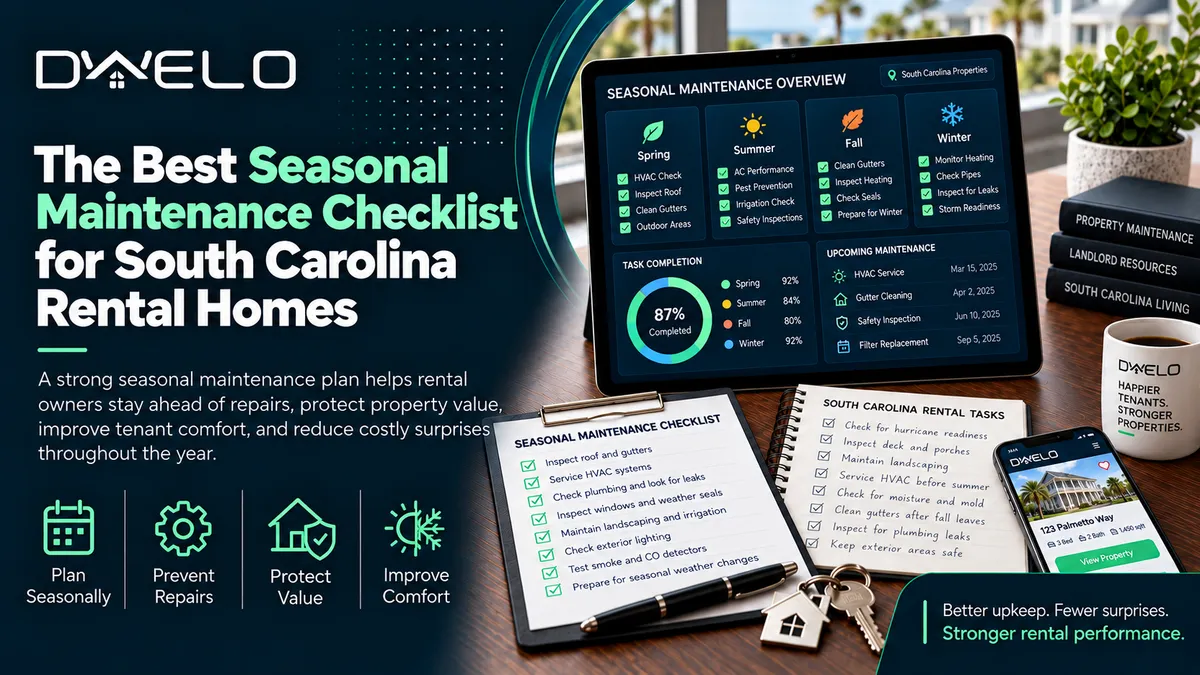
The Best Seasonal Maintenance Checklist for South Carolina Rental Homes
A season-by-season maintenance checklist for South Carolina rental homes, covering hurricane prep, humidity, HVAC, and pests, plus who handles each task.
The Best Seasonal Maintenance Checklist for South Carolina Rental Homes
Most maintenance checklists online were written for a climate that has little in common with the Lowcountry. They tell you to winterize pipes in October and shovel walks in January. They say nothing about 90 percent humidity, hurricane season, termite swarms, or salt air eating through exterior hardware.
A seasonal maintenance checklist for South Carolina rental homes has to start from the state’s real stressors. This one is organized by season, divided by who handles each task, and adjusted for coastal and inland properties, so nothing depends on anyone’s memory.
Why a Seasonal Maintenance Checklist for South Carolina Rental Homes Has to Be Local
South Carolina’s hazards cluster by season. Spring brings pollen, termite swarms, and the first hard run of the air conditioner. Summer brings heat, humidity, and the start of hurricane season on June 1. Fall brings storm-season cleanup and the main inspection window. Winter is mild, but freeze events do reach exposed plumbing, especially in the Upstate.
Humidity is the constant. It accelerates mold, wood rot, and HVAC strain all year, which is why moisture-related items appear in every season below.
How to Use This Checklist: Who Owns Each Task
Maintenance fails when everyone assumes someone else handles it. Each item below carries a tag:
[M] Manager or licensed vendor
[T] Tenant, as written into the lease
Tenant tasks only hold up if the lease names them. Dwelo’s lease administration services spell out these responsibilities up front, so expectations are documented before move-in.
Spring (March–May): Reset After Winter, Prepare for Heat
☐ [M] Service the HVAC system: coils, refrigerant, electrical connections, thermostat calibration
☐ [M] Flush the AC condensate drain line; clogs here cause humid-season water damage
☐ [M] Schedule the annual termite inspection, since swarm season is spring
☐ [M] Inspect roof, flashing, and gutters for winter and storm damage
☐ [M] Check exterior caulking, window seals, and door weatherstripping
☐ [T] Replace HVAC filters, then every 30–60 days through summer
Summer (June–August): Protect Against Heat, Moisture, and Storms
☐ [M] Confirm roof, shutters, and exterior fixtures are secure before storm season peaks
☐ [M] Photograph the property’s condition and file dated images in case of a storm claim
☐ [M] Clear drainage paths and trim vegetation away from the structure
☐ [T] Replace HVAC filters on schedule; run bathroom fans during showers
☐ [T] Report musty smells, leaks, or sweating ducts immediately
☐ [M] Respond to any AC failure same-day; extreme heat makes it a safety issue
Fall (September–November): Inspect, Document, Prepare
☐ [M] Complete the full annual interior and exterior inspection, with photos
☐ [M] Clean gutters after peak storm season and check for water intrusion
☐ [M] Flush the water heater and inspect the anode rod and pressure relief valve
☐ [M] Test smoke and carbon monoxide detectors; replace batteries
☐ [M] Clean dryer vents, which are both an efficiency and fire-safety item
☐ [M] Have fireplaces and chimneys inspected before winter use
Winter (December–February): Protect Plumbing, Plan the Year
☐ [M] Insulate exposed pipes in crawl spaces, garages, and exterior walls
☐ [T] Know the water shutoff location; follow freeze-warning instructions from management
☐ [M] Verify heating function in every zone
☐ [M] Check for drafts, moisture, and mold in closed-up areas
☐ [M] Review the past year’s repair costs and plan spring capital items
Coastal vs. Inland Adjustments
Coastal (Charleston, Mount Pleasant, Isle of Palms): inspect exterior metal hardware and railings for salt corrosion every season, confirm storm-securing procedures, and ask your insurance agent about flood coverage, since standard property policies generally exclude it.
Inland and Upstate (Columbia, Greenville, Spartanburg): prioritize pipe freeze protection, tree limbs near roofs, and HVAC load during long summer heat runs.
Illustrative Scenarios: Checklists in Practice
These are representative examples of situations the checklist is designed to catch.
Mount Pleasant: The Clogged Condensate Line. A spring HVAC service includes flushing the condensate line. Skipped, the line backs up in July and water stains the ceiling. The checklist item costs minutes; the repair costs a drywall job and a tenant complaint.
Isle of Palms: The Pre-Storm Photo Record. Before the peak of hurricane season, the property is photographed and exterior items are secured. After a tropical system, the dated images support the insurance claim and settle questions about pre-existing conditions.
Greenville: The Crawl Space Freeze. A fall inspection finds uninsulated supply lines. They are wrapped before the first hard freeze, and the pipe burst that hit a neighboring home never happens.
Key Benefits of Working From a Seasonal Checklist
Fewer Emergencies
Most urgent calls trace to items a scheduled inspection would have caught.
Clear Accountability
Tagged tasks mean neither manager nor tenant assumes the other has it covered.
Lower Lifetime Repair Costs
Small, scheduled fixes cost less than failures that arrive on their own timeline.
Stronger Documentation
Dated inspections and photos support insurance claims and deposit decisions.
Better Tenant Experience
A well-kept home generates fewer complaints and more renewals.
A Checklist Only Works If Someone Runs It
Knowing what to do each season is the easy part. Scheduling the vendors, entering occupied units with proper notice, documenting results, and tracking costs is the work. That is what Dwelo’s property maintenance and repairs team handles as part of full-service property management in South Carolina, so every item gets scheduled, completed, and recorded.
Dwelo Property Management — your partners in real estate success.
Real estate agents whose South Carolina investor clients are managing maintenance season by season on their own can connect them with a team that runs the schedule through our agent referral program.
Ready to put this checklist on autopilot? Schedule a free consultation with Dwelo and let’s build a maintenance calendar for your property.
Dwelo Property Management provides comprehensive, full-service rental property management across Charleston, Mount Pleasant, North Charleston, Summerville, Goose Creek, Daniel Island, Johns Island, James Island, West Ashley, Isle of Palms, and the South Carolina Lowcountry.


