
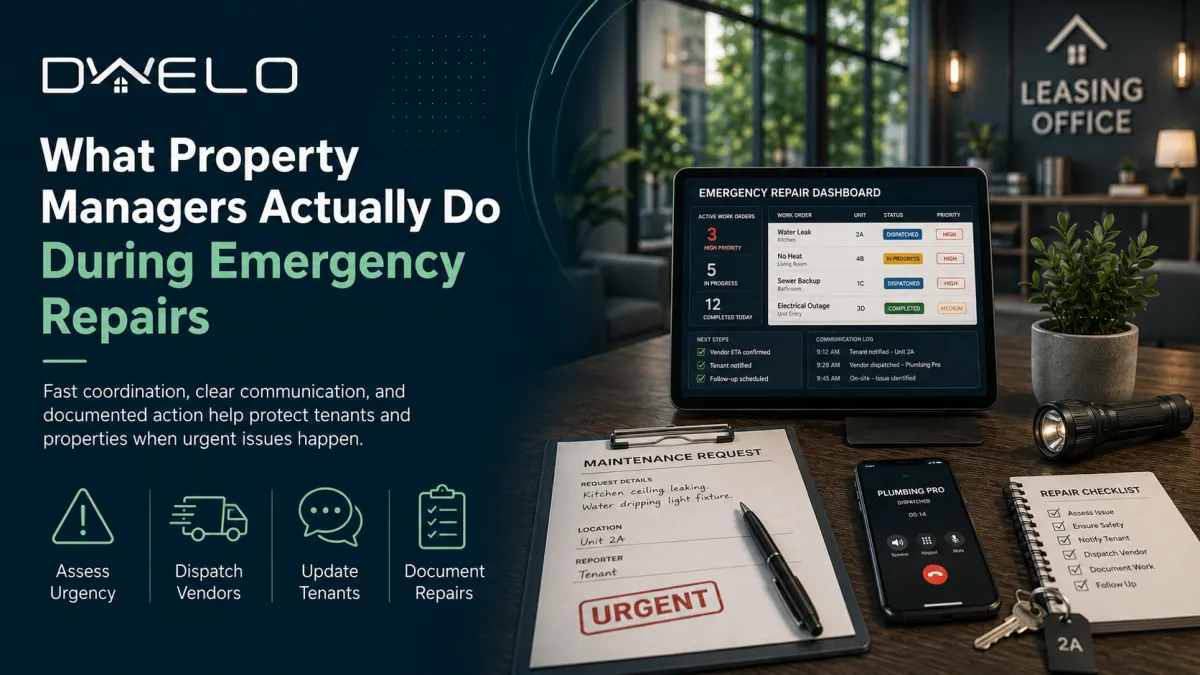
What Property Managers Actually Do During Emergency Repairs
Ever wondered what happens behind the scenes when a rental property emergency strikes? Learn exactly how Dwelo manages emergency repairs for South Carolina property owners.
It's 11:30 PM on a Wednesday in July. A tenant in a Charleston rental property discovers water pouring through the kitchen ceiling from a burst pipe in the unit above. They call the emergency maintenance line. And then, from the property owner's perspective, sleeping soundly in another part of the state, nothing visible happens. Except that by 7 AM the next morning, the water has been shut off, a plumber has made the repair, a water extraction company has begun drying the affected area, and the owner has received a summary of what occurred and what it cost.
This is professional emergency repair management. For most property owners, the inside of that process is invisible by design; the situation was handled before it required their involvement. But understanding what actually happens during a property manager emergency repair response is valuable, both because it clarifies what owners are paying for and because it explains why the quality of that response varies so significantly between management companies.
This blog pulls back the curtain on the full emergency maintenance process, what triggers it, who does what and in what sequence, and how the outcome is documented and communicated to the owner.
What Qualifies as a Maintenance Emergency
The first function of an emergency response system is triage: determining what constitutes a genuine emergency requiring immediate action versus an urgent but non-emergency request that can be addressed the next business day.
Professional property management companies establish clear criteria for this distinction, because the category determines the response protocol. A genuine maintenance emergency is one where delay would cause material harm to the property, to the tenant's health or safety, or both. The most common categories in South Carolina rentals include:
Active water intrusion or flooding: A burst pipe, an overflowing appliance, a roof penetration during a storm, or a sewage backup all create immediate water damage that compounds by the hour. Every minute of unmitigated water intrusion expands the affected area, increases drying time, and raises the total remediation cost. Water emergencies are almost always the highest-priority category.
Complete HVAC failure in extreme temperatures: In South Carolina's summer heat, where heat index values routinely exceed 100 degrees along the coast and inland, a complete air conditioning failure is not an inconvenience. It is a habitability and safety issue, particularly for elderly tenants, families with young children, or anyone with a health condition affected by heat. After-hours HVAC response in July is a core emergency management function in this climate.
Electrical hazards: Exposed wiring, burning smells without an identifiable source, flickering that suggests a circuit fault, or a total electrical failure all require immediate professional assessment. Electrical emergencies carry both safety and liability dimensions that make delay unjustifiable.
Security breaches: A broken exterior door lock, a damaged or missing window that compromises the unit, or any other breach of the property's security perimeter requires same-day response, both for the tenant's immediate safety and to preserve the owner's habitability compliance.
Gas leaks: Any report of a gas smell requires immediate action: tenant evacuation instructions, utility notification, and emergency contractor response. This is the one category where the initial response is not a contractor call; it is directing the tenant to leave the property and contact the gas utility and emergency services.
Situations that are urgent but do not meet the emergency threshold a malfunctioning appliance that still leaves the unit functional, a plumbing fixture that is dripping but not actively flooding, a pest sighting that requires treatment but not immediate intervention are addressed as high-priority next-business-day items rather than after-hours emergencies.
This triage discipline matters for two reasons. First, it ensures that genuine emergencies receive the full urgency they require, with no delay while a call center determines whether the situation is serious. Second, it protects owners from unnecessary after-hours contractor call-out fees for situations that don't require them.
The Emergency Response Sequence: Step by Step
Once a situation is classified as an emergency, the response sequence begins immediately. Here is what that sequence looks like in a professionally managed South Carolina property.
Step 1: Tenant Acknowledgment and Immediate Guidance
Within minutes of the emergency report, the tenant receives acknowledgment and initial guidance. For a water emergency, this means instructions to locate and shut off the nearest water supply valve if safe to do so, move valuables away from the affected area, and avoid contact with standing water that may have electrical exposure. For an HVAC failure, it means confirmation that a technician is being dispatched and guidance on immediate steps to manage temperature in the unit.
This first contact does two things simultaneously: it stops the tenant's anxiety from escalating and, in many water situations, it limits the damage that occurs before a contractor arrives. A tenant who knows where the shutoff valve is and uses it in the first five minutes of a burst pipe event saves thousands of dollars of additional water damage compared to one who doesn't know what to do and waits for a plumber.
Dwelo's tenant relations services are built on the understanding that tenant communication during an emergency is not a secondary function; it is a core component of the management response that affects both the human experience and the financial outcome.
Step 2: Contractor Dispatch from the Trusted Vendor Network
Simultaneously with tenant communication, the on-call management team contacts the appropriate contractor from Dwelo's established vendor network. This is one of the most consequential distinctions between professional property management and self-management: the ability to reach a qualified, known, trusted contractor after hours without starting from scratch.
A self-managing landlord receiving a burst pipe call at 11 PM is searching Google for emergency plumbers in Charleston, calling numbers that may or may not be answered, and making hiring decisions under pressure with no prior relationship or knowledge of quality. The contractor who arrives may be qualified or may not be. The hourly rate may be reasonable or may be an emergency premium that is difficult to dispute.
A professional property manager with an established vendor network is calling a plumber they have worked with for years, who knows the management company, who has a history of reliable after-hours response, and whose pricing structure is understood in advance. This relationship advantage produces faster arrival times, more reliable quality, and pricing that reflects a professional relationship rather than a one-time emergency call.
Step 3: On-Site Assessment and Scope Determination
When the contractor arrives, the property manager's role shifts to coordination and scope management. The contractor assesses the situation and determines what work is required to stabilize the emergency, not necessarily to complete all repairs, but to stop the active harm and render the unit safe and habitable.
For a water emergency, stabilization means stopping the source and removing standing water. Drying and remediation follow but are typically managed as a subsequent, planned process rather than an emergency one. For an HVAC failure, stabilization means either repairing the immediate fault or deploying temporary cooling measures while a full repair is scheduled.
The property manager receives the contractor's assessment, approves the scope of emergency stabilization work within the authority granted by the management agreement, and ensures the work proceeds without requiring the owner to be awakened for a phone call, unless the scope or cost exceeds the authorization threshold established in advance.
This pre-authorization structure is an important piece of the management agreement that owners should understand clearly. Most professional management agreements specify a per-incident spending authority, a threshold below which the manager can approve emergency repairs without owner consultation. Understanding and setting this threshold appropriately gives the manager the authority to act decisively in genuine emergencies while protecting owners from unexpected major expenditures without notice.
Step 4: Secondary Vendor Coordination if Needed
Some emergencies require coordination across more than one vendor. A burst pipe that has caused significant water intrusion, for example, requires a plumber to repair the source and a water damage restoration company to extract standing water, deploy drying equipment, and monitor moisture levels over the following days.
Coordinating multiple vendors in the aftermath of an emergency scheduling, access, sequencing, and oversight is a meaningful operational undertaking. A self-managing owner handling this remotely, while also managing their own work and family commitments, is managing a project management task they may have no experience with, under time pressure, with vendors they've never met.
Professional property management absorbs this coordination entirely. Dwelo's property maintenance and repair services include multi-vendor coordination as a standard component of emergency response; vendors are scheduled in the correct sequence, access is managed, and progress is monitored without the owner needing to direct any part of the process.
Step 5: Documentation Throughout
Every step of the emergency response is documented from the moment the call is received to the moment the situation is fully resolved. The initial report with a timestamp, the contractor dispatched, the arrival time, the scope of work performed, the materials used, the cost, the follow-up work scheduled, and the property condition at completion; all of it creates the record that protects both the owner and the management company.
This documentation serves multiple functions. It supports the owner's insurance claim if the emergency involves damage covered by the property policy. It creates the expense record that flows directly into the owner's financial reporting without requiring any additional data entry. And it establishes a defensible maintenance record if the tenant raises any question about the response time or quality of the resolution.
Step 6: Owner Communication
Once the emergency is stabilized, or during the response if the situation is difficult enough, the property owner receives a clear summary of what occurred, what was done, the cost incurred, and any follow-up steps planned. This communication is timed to be informative without being disruptive: significant emergencies are escalated immediately, while situations that were successfully stabilized and resolved are summarized in a morning report.
Most owners of professionally managed properties report that their primary emergency experience is receiving an early-morning summary of a situation that had already been fully handled, and that this is precisely what they wanted. The emergency was real. The response was professional. Their involvement wasn't required because the systems in place were designed to handle it without them.
Real-World Scenarios: Emergency Response in Practice
Scenario 1: The Burst Pipe at Midnight
A tenant in a Mount Pleasant rental contacted Dwelo's emergency line after discovering water flowing from a bathroom ceiling at 11:45 PM. The on-call team acknowledged the call within minutes, guided the tenant to the unit's water shutoff valve, and contacted a licensed plumber from Dwelo's vendor network within ten minutes of the initial call. The plumber arrived within the hour, identified a failed supply line connection in the upstairs unit, made the repair, and cleared the site. A water damage restoration company was scheduled for first thing the following morning to assess moisture levels and deploy drying equipment. The owner received a detailed summary by 7 AM, including the plumber's invoice, the restoration company's scheduled arrival, and photos of the affected area. Total damage was contained to the original failure point and a ceiling section that required drywall repair, contained because the response was fast and sequential.
Scenario 2: The HVAC Failure on the Hottest Day of the Year
In late July, a Columbia tenant reported a complete air conditioning failure. The outdoor temperature was 96 degrees with a heat index above 105. The tenant, an elderly resident with a health condition affected by heat, was in immediate discomfort. Dwelo's emergency protocol escalated the situation to the highest priority tier. An HVAC technician from the vendor network was reached within thirty minutes and arrived at the property mid-afternoon. The compressor had failed and required replacement, a same-day parts procurement that the technician was able to complete. The tenant remained in the unit with a portable cooling unit provided while the repair proceeded, and full HVAC function was restored before evening. The owner received a cost summary and an explanation of the equipment failure before the end of the day.
Scenario 3: The Storm Damage That Required Immediate Coordination
A tropical system making landfall near the South Carolina coast caused roof damage at an Isle of Palms property managed by Dwelo. The tenant reported active water intrusion through a compromised section of roofing during the storm. Emergency protocol included immediate tenant guidance, same-day deployment of temporary weatherproofing by a roofing contractor, and coordination of a water damage assessment once the storm passed. The owner, based out of state, received real-time updates as the situation developed and a comprehensive damage and response summary within 24 hours, along with documentation packaged to support an insurance claim. The full-service property management structure meant the owner's entire role was reviewing a summary and approving the restoration scope, not managing a crisis from a distance.
What Emergency Response Reveals About a Property Manager's True Capability
The quality of emergency repair management is one of the most accurate indicators of a property management company's actual operational capability. Almost every company can process a standard lease renewal or distribute a monthly rent payment. Emergency response requires something fundamentally different: a 24-hour availability structure, a trusted contractor network built over years, a documented response protocol that functions under pressure, and the judgment to triage, coordinate, and communicate clearly when the stakes are high.
Owners evaluating property management companies should ask directly: What is the emergency response protocol? Who is available after hours? What is the contractor network, and how are after-hours calls handled? What spending authority does the manager have without owner consultation, and how are emergency expenses communicated?
The answers to these questions reveal whether a company has invested in the infrastructure required to handle genuine emergencies professionally, or whether emergencies will default to the owner's problem when they arise at the worst possible moment.
Emergency Management Is Where Professional Property Management Earns Its Value Most Clearly
It is easy to underestimate the value of professional property management during months when everything runs smoothly. Rent arrives on time, no maintenance issues surface, and the owner's primary interaction with the management company is reviewing a monthly statement.
Emergencies are when that value becomes impossible to miss. A burst pipe at midnight, managed professionally, is a contained maintenance event with a documented resolution and a recoverable cost. The same situation managed by a self-managing owner who doesn't know a plumber, can't reach anyone after hours, and is making decisions from two states away is a property crisis.
For South Carolina property owners whose investment deserves a professional response when it matters most, Dwelo's full-service property management delivers the systems, vendor relationships, and operational discipline that emergencies require, without the owner ever having to manage a crisis at 2 AM.
Real estate agents with investor clients who want to know their properties are protected when things go wrong can learn more about our agent referral program, connecting clients with management that performs when the stakes are highest.
Ready to have a property manager who handles emergencies so you don't have to? Schedule a free consultation with Dwelo and let's talk about what professional emergency response looks like for your investment.
Dwelo Property Management provides comprehensive, full-service rental property management across South Carolina, including Charleston, Mount Pleasant, Isle of Palms, Columbia, Greenville, Spartanburg, and surrounding communities.


