
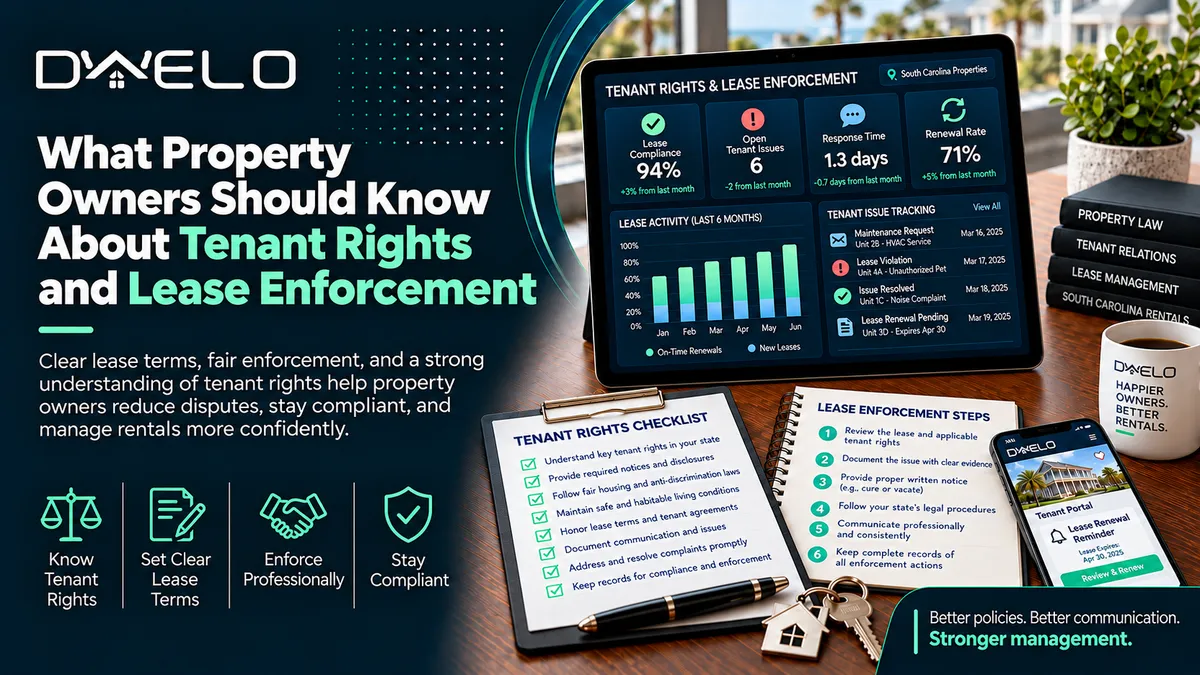
What Property Owners Should Know About Tenant Rights and Lease Enforcement
Enforcing a lease the wrong way can cost more than the violation. Learn the tenant rights South Carolina owners must respect and how to enforce leases lawfully.
Most owners think of lease enforcement as a one-way street: the tenant breaks a term, the owner responds. What gets overlooked is that tenants hold legal rights the owner must respect throughout that response. An owner who is right about the violation can still lose by enforcing it the wrong way.
Understanding tenant rights and lease enforcement together is what keeps a legitimate claim from turning into a liability. This post covers the tenant protections that matter most for South Carolina owners and what lawful enforcement looks like in practice.
Why Tenant Rights and Lease Enforcement Go Hand in Hand
South Carolina’s Residential Landlord and Tenant Act sets rules for both parties. It gives owners clear remedies, but it requires those remedies to follow a defined process. Skipping the process doesn’t speed things up. It usually hands the tenant a defense, and sometimes a claim of their own.
The practical rule is simple: the lease tells you what you can enforce, and the statute tells you how.
Tenant Rights Every Owner Should Know
The Right to Privacy and Proper Entry Notice
Owners cannot enter a rented home whenever they like. For ordinary entries such as inspections, showings, and non-urgent repairs, South Carolina requires at least 24 hours’ notice and entry at reasonable times. The statute carves out emergencies and certain scheduled or tenant-requested services, but the safe habit is written notice that states the date, the time window, and the reason.
Repeated unannounced entry is one of the easiest ways for an owner to create a claim, even with good intentions.
The Right to a Habitable Home
Owners must keep the property in habitable condition: working plumbing, heating and cooling where provided, structural safety, and freedom from hazards. When a tenant gives written notice of a problem, the clock starts. Unaddressed repairs can lead to remedies for the tenant and weaken the owner’s position if rent later goes unpaid.
The Right to Be Free From Self-Help Eviction
South Carolina prohibits self-help eviction. Changing locks, shutting off utilities, removing belongings, or pressuring a tenant to leave is unlawful, even when the tenant is behind on rent. Only a court can remove a tenant, and tenants can sue over attempted self-help.
The Right to Be Free From Retaliation
Owners may not respond to a lawful complaint, a repair request, or a report to a housing authority with a rent increase, reduced services, or a termination notice. When an adverse action follows a complaint closely, it invites a retaliation argument, whatever the owner’s real reason was. Documentation of the independent reason is the defense.
The Right to Fair Housing Protection
Federal and state fair housing law applies to enforcement as well as screening. If one tenant gets a warning and another gets a notice for the same violation, the difference needs a documented, neutral explanation.
The Right to the Security Deposit Process
Owners must return the deposit, or provide an itemized accounting of deductions, within 30 days. Enforcement of lease terms at move-out follows the same deadline.
What Lawful Lease Enforcement Looks Like
1. Start with the lease. Enforce only what the lease says. Vague terms are hard to enforce, which is why precise drafting in Dwelo’s lease administration services matters before any dispute starts.
2. Document the violation. Dates, photos, messages, and payment records. Facts, not impressions.
3. Use the correct notice. South Carolina distinguishes between nonpayment (a 5-day notice to pay or vacate) and other lease violations (a 14-day notice to cure). Using the wrong form, delivering it improperly, or filing early can derail the case.
4. Give a real chance to cure when the law calls for one. A cure period is a legal step, not a courtesy.
5. Go to court, not around it. If the tenant doesn’t comply, the remedy is the magistrate’s court process.
6. Apply the rules evenly. The same violation should produce the same response for every tenant.
Dwelo’s legal compliance support handles each of these steps, from notice selection to documentation, so the owner’s position stays clean.
The Relationship Side of Enforcement
Enforcement isn’t only a legal exercise. A tenant who feels respected, who was given proper notice, a clear explanation, and a fair chance to fix a problem, is more likely to resolve it and stay. Dwelo’s tenant relations services treat enforcement as a conversation first and a legal process second, because the best outcome is usually a corrected problem and a tenant who renews.
Illustrative Scenarios
These are representative examples of how situations like these tend to play out, not specific client case studies.
Charleston: The Lockout That Backfired. An owner changes the locks after two months of unpaid rent. The tenant files a claim, the owner faces exposure for unlawful ouster, and the legitimate rent claim becomes harder to pursue. A properly served 5-day notice and court filing would have kept the case clean.
Mount Pleasant: The Notice That Followed a Complaint. A tenant reports a mold issue and, two weeks later, receives a non-renewal notice. The owner had a genuine unrelated reason but no documentation. The timing makes a retaliation claim credible. Dated records of the earlier issue would have supported the owner.
Summerville: The Unannounced Inspection. A manager enters to check on a lease concern without notice. The concern may be valid, but the improper entry becomes the story. A written 24-hour notice would have kept the focus on the violation.
Key Takeaways for Owners
Know the Process, Not Just the Rule
Having a valid lease term is only half the case. The method of enforcement decides whether it holds.
Document Before You Act
Records are your best defense against retaliation and discrimination claims.
Never Use Self-Help
Lockouts and utility shutoffs create liability, whatever the tenant owes.
Give Notice for Entry
Written, specific, and at least 24 hours ahead, except in emergencies.
Be Consistent
Uniform enforcement protects fair housing compliance and earns tenant trust.
Enforce the Lease Without Creating New Problems
Good enforcement is calm, documented, and procedurally correct. That takes knowledge of what tenants are entitled to as much as what owners are. Dwelo builds both into every managed property, so owners can stand behind their lease without risking a claim.
Dwelo Property Management — your partners in real estate success.
Real estate agents whose South Carolina investor clients are handling lease violations on their own can connect them with a team that enforces leases lawfully through our agent referral program.
Ready to enforce your lease with confidence? Schedule a free consultation with Dwelo and let’s talk about how we’d protect your investment.
Dwelo Property Management provides comprehensive, full-service rental property management across Charleston, Mount Pleasant, North Charleston, Summerville, Goose Creek, Daniel Island, Johns Island, James Island, West Ashley, Isle of Palms, and the South Carolina Lowcountry.


