
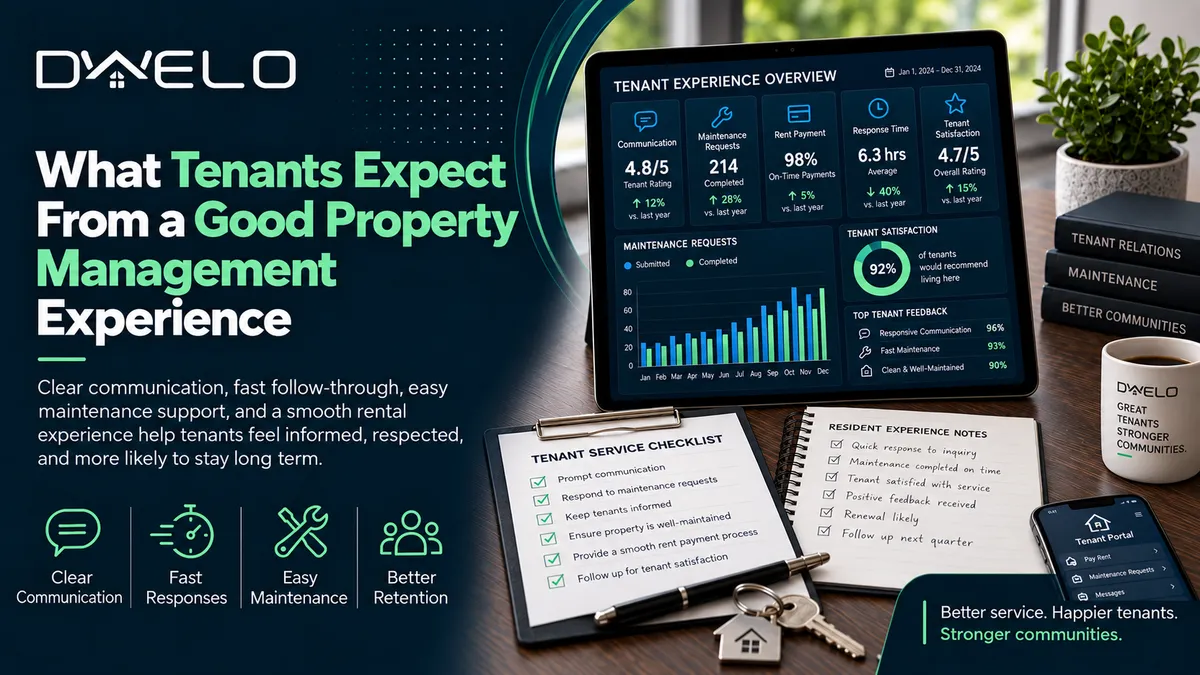
What Tenants Expect From a Good Property Management Experience
Understanding what tenants expect from property management is the key to keeping them. Learn how meeting tenant expectations drives retention across South Carolina rentals.
There is a version of property ownership where the tenant is thought of primarily as a revenue source someone who occupies the unit, pays rent, and ideally causes no problems. In this version, tenant experience is an afterthought. The lease gets signed, the rent comes in, and contact between owner and tenant is minimized unless something breaks.
This model works until it doesn’t. And it stops working at the same predictable moment: renewal time, when a tenant who felt invisible for twelve months quietly declines to stay, takes their reliable payment history with them, and leaves the owner with a vacancy, a turnover bill, and no clear understanding of why they left.
The question that prevents this outcome is one most owners don’t ask often enough: what do tenants actually expect from a good property management experience? Not what owners assume they want, not what the lease requires, but what tenants are genuinely evaluating, consciously or not, throughout the course of their tenancy. For South Carolina rental property owners, the answer to that question is one of the most practically valuable pieces of business intelligence available, because it maps directly onto the management practices that drive retention.
This blog examines what research and operational experience consistently show tenants want organized across the stages of a tenancy and connects each expectation to the management practices that meet it.
Expectation 1: A Professional, Prepared Move-In Experience
The first impression a tenant forms of their management team happens before they submit a single maintenance request or pay a second month’s rent. It happens on move-in day, and the quality of that experience establishes the relational baseline for everything that follows.
What tenants expect at move-in is simpler than most owners realize: they want the unit to be clean, functional, and ready. They want clear information about how to pay rent, how to submit a maintenance request, who to contact for what, and what the process looks like when they need something. They want to feel that they are entering a relationship with a management team that has thought about their experience in advance, not one that is improvising.
What they do not want is to move into a unit that still has issues from the prior tenancy, to receive their lease with missing information, or to have their first week of questions go unanswered while they figure out the basics on their own. That experience, even if everything improves afterward, creates a skepticism about management quality that takes months to reverse.
Dwelo’s lease administration services encompass the full move-in process: executed documentation, a thorough move-in condition report, and clear tenant orientation to the communication channels and management standards they can expect throughout their tenancy. The first week sets the tone. A professional move-in sets it well.
Expectation 2: Maintenance That Is Resolved, Not Just Acknowledged
When tenants are surveyed about what matters most in their rental experience, maintenance responsiveness consistently ranks at or near the top above rental price, above amenities, above location. This is not because tenants are particularly demanding. It is because maintenance is the category of interaction that most directly affects the daily quality of their life in the property.
But tenants don’t only want fast responses. They want resolution. There is a meaningful difference between a management team that acknowledges every maintenance request quickly and one that actually fixes the problem, and tenants know the difference because they live with the outcome.
What tenants expect in a maintenance interaction has three components: they want to know their request was received, they want to know when someone will address it, and they want confirmation when it is complete. Across all three, they want to be treated as the occupant of a home that matters, not a ticket number in a queue.
The most frustrated tenants in property management are not the ones who had maintenance issues. Every rental has maintenance issues. The most frustrated tenants are the ones whose issues were minimized, deprioritized, or left unresolved for weeks without explanation. That frustration experienced once and forgiven, experienced twice and noted, experienced repeatedly and accepted as a pattern is the primary driver of non-renewal decisions that owners rarely see coming.
Dwelo’s property maintenance and repairs process is structured around all three communication beats acknowledgment, scheduling confirmation, and completion follow-up applied consistently to every maintenance request. Tenants do not have to wonder whether their request was received or advocate repeatedly for a repair. The process does that work so the tenant doesn’t have to.
Expectation 3: Clear, Honest Communication Without Having to Chase
Tenants expect to be able to reach their property manager through a clear, reliable channel and to receive honest, informative responses when they do. This expectation is both simpler and more specific than it might appear.
Simple: tenants want to know who to contact and how. They do not want to wonder whether to call, text, or email, or to discover after trying three channels that none of them produced a response. A property management relationship with clear contact information, defined communication channels, and reliable response times meets this expectation at its most basic level.
More specifically: tenants also expect honesty about timeline and process. If a repair is going to take a week because a part needs to be ordered, a tenant who is told that upfront will accept it with minimal frustration. The same tenant who is told “we’ll have someone out soon” and then receives no further communication for eight days will not be frustrated because the delay was longer, but because the communication set an expectation that wasn’t met.
Transparency about what is happening and when, even when the news is not what the tenant was hoping for, builds more trust than vague reassurances that create false expectations. Tenants who feel they receive honest, direct communication from their management team develop confidence in the relationship that translates directly into renewal inclination.
Expectation 4: To Be Treated With Respect as an Adult
This expectation sounds obvious enough that it barely seems worth stating, but it is violated frequently enough in landlord-tenant interactions that it belongs on this list explicitly.
Tenants expect to be communicated with as competent adults who are capable of understanding information and making decisions. They do not expect to be lectured about lease terms they already know. They do not expect condescending responses to legitimate questions. They do not expect to feel dismissed when raising a concern or talked over when offering an explanation.
The power dynamic in a landlord-tenant relationship is genuinely asymmetric: the tenant occupies a home that someone else owns, and that ownership creates a structural authority that can, in less professional management relationships, manifest as dismissiveness or paternalism. Tenants notice this. They compare it to every other service relationship in their lives with their bank, their employer, their healthcare provider, and they form judgments about the management relationship accordingly.
Professional property management treats tenant communications as they would any other professional service interaction: respectfully, clearly, and with the assumption that the tenant is acting in good faith. Dwelo’s tenant relations services are built on this standard not because it is a nicety, but because it is the foundation of the trust that drives long-term tenancy.
Expectation 5: A Property That Is Maintained, Not Just Repaired When Broken
There is a distinction that experienced tenants draw, often without articulating it explicitly, between a property that is actively maintained and one that is only repaired when something breaks. The experience of living in each is meaningfully different.
A property that is actively maintained has functioning light fixtures that are replaced when they burn out, weatherstripping that seals properly, landscaping that is kept in good condition, common areas that are clean, and the general sense that someone is paying attention to the property’s condition on an ongoing basis. A tenant living in this property feels that their home is cared for.
A property that is only reactively repaired has a fundamentally different texture. Things work until they don’t. Small issues accumulate between tenant-initiated reports. The overall condition of the property gradually reflects the absence of proactive attention, and tenants feel that absence as a comment on how much the management team values the quality of their living environment.
This expectation that the property will be maintained proactively, not just fixed reactively, is one of the most powerful drivers of tenant satisfaction and retention, and one of the most differentiating features of professionally managed properties compared to self-managed ones. Dwelo’s property maintenance and repairs approach encompasses proactive inspections and scheduled maintenance alongside reactive repairs so tenants experience a property that is consistently in good condition rather than one that alternates between broken and just-fixed.
Expectation 6: A Fair, Consistent Enforcement of Lease Terms
Tenants do not expect lease terms to be ignored or routinely waived. What they expect is that the rules governing their tenancy are applied the same way every time to them and to every other tenant in the property and that enforcement, when it occurs, is handled professionally rather than personally.
A tenant who is charged a late fee when they pay late has no legitimate grievance if the lease clearly specifies the fee and it is applied consistently. The same tenant who is charged a late fee after it was waived for several months without explanation or after observing that a neighbor’s late payment produced no consequence has a reasonable complaint about inconsistency that generates resentment even if the fee itself is technically valid.
Consistency in lease enforcement is not primarily a legal protection for the owner, though it is that too. It is a component of the tenant’s experience of fairness in the management relationship. Tenants who feel the rules are applied fairly and consistently are tenants who accept enforcement without resentment and maintain the management relationship with confidence. Tenants who feel rules are enforced arbitrarily are tenants who become defensive, less communicative, and more likely to exit at renewal.
Expectation 7: A Renewal Process That Treats Them as Valued
When a lease expiration approaches, tenants pay close attention to how the management team handles the renewal conversation. This interaction, which many owners treat as a purely administrative transaction, is actually one of the highest-signal moments in the management relationship from the tenant’s perspective.
A renewal offer that arrives well in advance of the expiration date, that is clearly explained, that invites questions, and that treats the tenant as someone whose continued presence is genuinely valued communicates that the management team sees the relationship as worth maintaining. A renewal notice that arrives two weeks before expiration, with no preceding communication, communicates that the tenancy is a commodity; the management team neither noticed nor planned for the approaching date.
Tenants make mental notes of these signals. A tenant who felt the renewal was handled professionally, with advance notice, clear terms, and an open invitation to discuss, enters the renewal decision with goodwill. A tenant who felt the renewal was a last-minute administrative obligation enters the same decision wondering whether they really want to stay.
Real-World Scenarios: Expectations Met and Missed
Scenario 1: The Move-In That Set the Right Foundation
A Daniel Island tenant moving into a Dwelo-managed property received their lease documentation three days before move-in, a detailed move-in inspection checklist on the day of possession, and a welcome communication that outlined the maintenance request process, the payment platform, and the direct contact information for the management team. The tenant noted that the unit had been freshly cleaned, a burned-out light fixture in the kitchen had been replaced before their arrival, and the landscaping was in good condition. Three months later, when asked whether they were satisfied with the management experience, they cited the move-in specifically, not any subsequent interaction. First impressions in property management are durable.
Scenario 2: The Maintenance Experience That Made the Difference
A West Ashley tenant submitted a maintenance request for a persistent bathroom exhaust fan issue, not an emergency, but a daily annoyance. Under a prior management arrangement, a similar request had gone unaddressed for three weeks before being resolved with no communication in between. Under Dwelo’s management, the request was acknowledged the same day, scheduled within 48 hours, and followed up with a completion confirmation. The tenant, who had privately been weighing whether to renew, mentioned in conversation with the management team that the contrast with their prior experience was significant. Dwelo’s full-service property management in South Carolina treats this kind of interaction not as a maintenance event but as a retention opportunity, because that is exactly what it is.
Scenario 3: The Renewal That Felt Like a Partnership
A Johns Island tenant in the eleventh month of their lease received a renewal outreach from Dwelo 90 days before their expiration date. The communication explained the proposed rent adjustment with brief market context, outlined the renewal term options clearly, and explicitly invited any questions or concerns. The tenant had one question about a minor lease modification they wanted to discuss. The question was answered within a business day, the modification was addressed in the renewal addendum, and the lease was executed three weeks before expiration. The tenant’s comment: “It felt like they actually wanted us to stay.” They renewed for two years.
Key Tenant Expectations — Summary
Expectation | What Owners and Managers Must Deliver |
|---|---|
Professional move-in experience | Clean unit, clear documentation, immediate orientation |
Resolved maintenance | Acknowledgment, scheduling, completion follow-up |
Honest communication | Clear channels, reliable response, transparent timelines |
Respectful treatment | Professional, adult-to-adult engagement at every touchpoint |
Proactive property upkeep | Maintained condition, not just reactive repair |
Consistent enforcement | Uniform application of lease terms, no arbitrary variation |
A valued renewal process | Advance notice, clear terms, invitation to engage |
Understanding What Tenants Want Is How Owners Keep Them
The tenant expectations mapped in this blog are not demanding. They are the same expectations anyone has of a professional service relationship: responsiveness, clarity, respect, consistency, and the sense that the other party is engaged and prepared. Meeting these expectations does not require extraordinary effort, it requires a management system that executes the basics consistently, across every interaction, for every tenant, throughout every tenancy.
That consistency is what professional property management provides. Not the occasional exceptional response to an unusual situation, but the reliable delivery of the standard every tenant is evaluating, every month, in every ordinary interaction with the management team.
Dwelo Property Management — your partners in real estate success.
Real estate agents with South Carolina investor clients whose tenants are leaving at renewal can share this framework as a lens for understanding why and connect their clients with a management approach that closes the gaps through our agent referral program.
Ready to build a management experience that makes your tenants want to stay? Schedule a free consultation with Dwelo and let’s talk about what meeting tenant expectations looks like across your rental investment.
Dwelo Property Management provides comprehensive, full-service rental property management across Charleston, Mount Pleasant, North Charleston, Summerville, Goose Creek, Daniel Island, Johns Island, James Island, West Ashley, Isle of Palms, and the South Carolina Lowcountry.


