
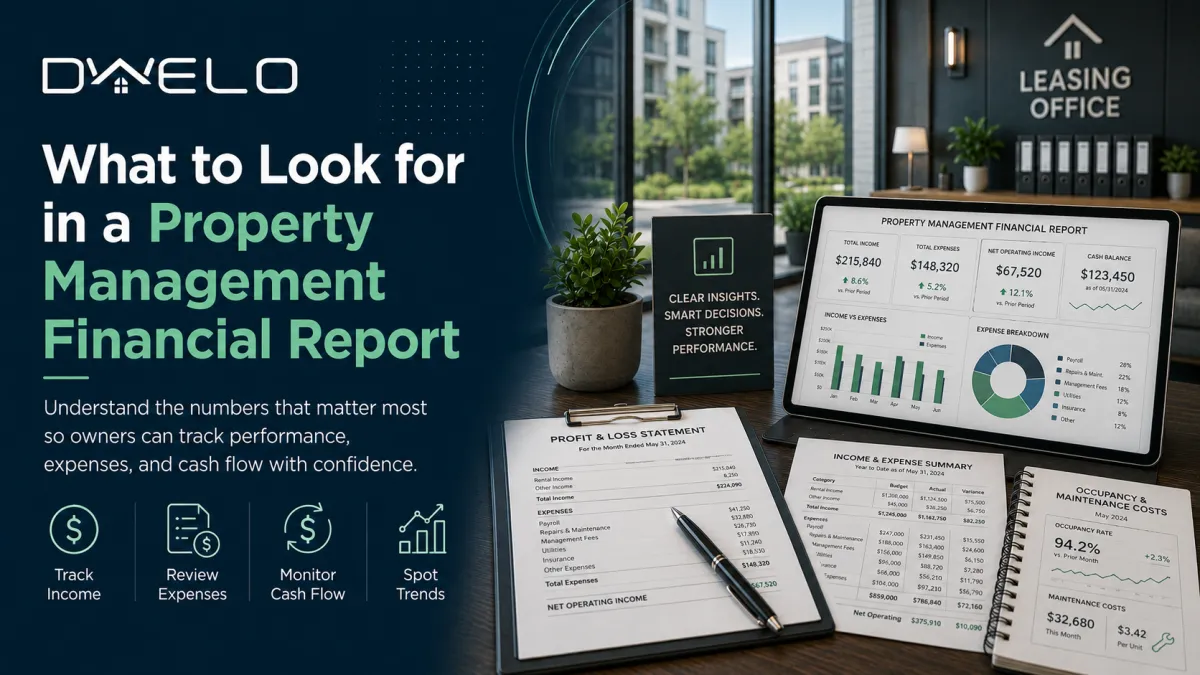
What to Look for in a Property Management Financial Report
Do you know how to read your property management financial report? Discover what every section means and what signals should prompt action for South Carolina rental owners.
A monthly owner statement lands in your inbox. You open it, scan to the distribution figure at the bottom, confirm the number matches roughly what you were expecting, and close it. If this is how most of your financial reviews go, you are not alone, and you are also leaving significant value on the table.
The distribution figure is the result. Understanding your property management financial report means understanding everything that produced that result: how rental income is flowing, where expenses are concentrating, whether anything has shifted from the previous month, and what the year-to-date trajectory of your investment actually looks like. For South Carolina rental property owners, developing the ability to read a financial report critically, not just confirm a number, is one of the most practical investment skills available.
This guide walks through every component of a well-structured property management financial report, explains what each section should contain, and identifies the signals that should prompt closer attention or a direct conversation with your property manager.
The Anatomy of a Property Management Financial Report
A professional monthly owner statement is not a single number or even a summary. It is a layered document with several distinct sections, each serving a specific function. Understanding what belongs in each section, and what it means when something is missing, unclear, or inconsistent, is the foundation of reading your report with confidence.
Section 1: Rental Income
The income section of a financial report should clearly identify every source of income received for the property during the reporting period. For most residential rentals, this is primarily monthly rent, but a well-structured report will also itemize additional income sources separately, including late fees collected, pet fees, parking charges, or any lease addendum fees that apply to the tenancy.
What to look for: Confirm that the rent amount matches the current lease terms. If you've approved a rent increase for a renewal, verify that the new amount is reflected. If a partial payment was received, it should appear as such rather than being rounded or approximated.
The signal to investigate: If the income figure is lower than the lease rate without a clear explanation in the report, ask immediately. Common explanations, such as a prorated period, a late payment still pending, or an approved concession, should be stated explicitly. An unexplained shortfall is not a formatting issue. It is information that requires a conversation.
Dwelo's rent collection services feed directly into owner reporting; every payment is logged by date, amount, and status, so income figures in owner statements are specific, traceable, and never approximated.
Section 2: Expenses
The expense section is where the quality of a financial report is most clearly demonstrated, and where the gap between a professional management company and a mediocre one is most visible. A well-constructed expense section is fully itemized. Every expenditure for the reporting period appears as its own line item with a description of what the expense covers, the vendor or contractor involved, and the amount.
Categories that should appear as distinct line items include: property maintenance and repairs, management fees, landscaping, inspection fees, leasing fees if applicable, insurance if paid through the management account, and any other operational expenditure.
What to look for: Descriptions should be specific enough to be meaningful. "Plumbing repair, replaced bathroom supply valve, ABC Plumbing, $185" is appropriate. "Maintenance, $185" is not. If you cannot tell from the description what was done, who did it, and approximately why it cost what it did, the reporting is insufficient.
The signal to investigate: A maintenance expense that appears significantly higher than comparable prior months, a vendor name that appears repeatedly across multiple line items in the same reporting period, or a charge labeled as "miscellaneous" or "other" without further detail; any of these warrants a direct request for the underlying invoice. Professional property management does not hide behind vague categories. Every expense should be traceable to a specific, documented transaction.
Dwelo's property maintenance and repairs documentation is structured specifically to support owner reporting, work orders, vendor invoices, and completion records, creating the paper trail that makes every maintenance line item in an owner statement verifiable.
Section 3: Management Fees
Management fees should appear as their own clearly labeled line item, separate from maintenance and operational expenses. The fee should match the percentage or flat rate specified in your management agreement, applied to the correct income base.
What to look for: Verify that the fee calculation is consistent with your agreement. If the agreement specifies a percentage of collected rent, confirm that the fee is calculated on actual rent collected, not on scheduled rent if a payment was missed or partial.
The signal to investigate: A management fee that has changed without prior notice or written agreement amendment is a material discrepancy that requires immediate clarification. Fee transparency is a baseline standard of professional property management.
Section 4: Net Owner Distribution
After income is received and all expenses and fees are deducted, the net distribution is what remains — the amount transferred to the owner for the reporting period. This figure should be clearly labeled, and the statement should include the date the distribution was processed and the method by which it was transferred.
What to look for: Confirm that the arithmetic is consistent, that the income minus expenses minus fees actually produces the distribution figure shown. While professional accounting systems handle this automatically, reviewing the math is a reasonable and appropriate habit.
The signal to investigate: If the distribution is meaningfully lower than expected and the income and expense sections don't clearly account for the difference, that gap requires explanation before the reporting period closes. Distribution amounts should never be a surprise if the underlying report is complete.
Section 5: Year-to-Date Totals
A monthly statement that exists in isolation, without cumulative context, provides only a partial picture of investment performance. Professional reporting includes year-to-date totals for each major category: total income collected, total expenses by category, total management fees, and total distributions. These cumulative figures are what allow owners to identify trends, evaluate seasonal patterns, and assess whether performance is tracking against the projections established at the start of the year.
What to look for: Compare the year-to-date expense total against any budget or projection you established at the start of the year. If total maintenance expenses are running significantly ahead of projection by mid-year, that pattern is worth understanding; it may signal a developing property issue that warrants proactive attention rather than continued reactive response.
The signal to investigate: A year-to-date distribution that is materially lower than your income projections, when income is tracking normally, means expenses are running higher than anticipated. Understanding which expense category is responsible for that variance is the analysis that leads to actionable decisions.
Dwelo's financial reporting services for property owners include year-to-date totals on every monthly statement as a standard component, not as an optional add-on, because cumulative context is essential to genuine financial visibility.
What Good Reporting Looks Like Versus What Adequate Reporting Looks Like
There is a meaningful difference between a financial report that complies with the minimum expectations of property management and one that genuinely serves an owner's ability to understand and manage their investment.
Adequate reporting tells you what the net distribution is. Good reporting tells you why it is what it is, what changed from last month, and what the year-to-date trajectory of your investment looks like.
Adequate reporting lists maintenance as a single aggregated figure. Good reporting itemizes every expense with enough specificity to trace it to a work order and an invoice.
Adequate reporting delivers a statement on a schedule. Good reporting delivers a statement that is accurate, complete, and structured so that an owner with reasonable investment literacy can review it in fifteen minutes and come away with a clear, confident picture of how their property performed.
The difference matters not just for peace of mind, but for practical decision-making. An owner who understands their property's financial performance month to month can make informed decisions about rent adjustments, capital improvements, lease renewal terms, and portfolio expansion. An owner who is reviewing a number rather than a report is making those same decisions with significantly less information.
Real-World Scenarios: What Financial Reports Revealed in Practice
Scenario 1: The Maintenance Pattern That Signaled a Bigger Problem
A Columbia property owner reviewing monthly statements with Dwelo noticed that HVAC-related maintenance charges had appeared across three consecutive months, each charge modest, but the pattern unmistakable in the itemized expense history. The pattern prompted a conversation with the Dwelo team, which led to a technician assessment of the unit. The system was found to be operating with a failing compressor that, left unaddressed, would have required emergency replacement at significantly higher cost during peak summer demand. The owner authorized a planned replacement at a scheduled time and price, a direct financial benefit that only became visible because the reporting was specific enough to surface the trend.
Scenario 2: The Fee Discrepancy That Was Caught Early
A Charleston property owner conducting a routine review of a monthly owner statement noticed that the management fee for the period appeared slightly higher than the percentage specified in the management agreement, applied against the rent figure shown. The discrepancy was modest in absolute terms but was inconsistent with the contract. After raising it with the prior management company, no satisfactory explanation was provided. The owner transitioned to Dwelo's full-service property management in South Carolina, where management fees are itemized clearly, calculated transparently, and verifiable against the agreement without ambiguity.
Scenario 3: The Year-to-Date Review That Changed a Budget Decision
A Greenville investor who owned two rentals reviewed year-to-date totals at the midpoint of the year and found that maintenance expenses on one property were running nearly 40 percent ahead of the prior year's pace, while the other property's expenses were consistent. That variance, visible only because of year-to-date cumulative reporting, led to a targeted property assessment that identified aging plumbing infrastructure as the source of recurring repair frequency. The owner made a planned capital investment to address the root cause before the year-end, reducing the maintenance run rate for the following year and improving the property's net performance materially.
What Questions Your Financial Report Should Answer Without You Having to Ask
A well-structured property management financial report should answer the following questions automatically, without the owner needing to chase supplementary information:
How much rent was collected this month, and does it match the lease rate? Were any fees applied or collected, and what were they for? What specific maintenance or repair work was performed, who performed it, and what did it cost? What is the management fee for this period, and is it consistent with the management agreement? What is the net distribution, when was it processed, and by what method? How do this month's income and expenses compare to the same period last year? Where does year-to-date performance stand relative to the beginning of the year?
If your current financial reporting cannot answer all of these questions from a single monthly document, the reporting you are receiving is not meeting the standard that professional property management should deliver.
Your Financial Report Is Your Investment's Scoreboard
A rental property is a business. Every business needs a scoreboard, a clear, accurate, timely record of how it is performing and what the numbers behind the result actually mean. A monthly owner statement that delivers only the final score, without the underlying statistics, is a scoreboard that tells you whether you won but not how, why, or what to do differently.
The owners who manage their investments most effectively are those who have learned to read their financial reports as the operational intelligence they are, not as a confirmation of a number, but as a window into the performance, condition, and trajectory of the asset they've built.
Dwelo's commitment to financial transparency means every owner statement is built to support that kind of informed engagement. Itemized, specific, cumulative, and delivered on a reliable schedule, because the quality of the information you receive is directly connected to the quality of the decisions you can make with it.
Real estate agents with South Carolina investor clients who deserve better financial visibility into their properties are welcome to explore our agent referral program, connecting clients with management that makes their investment performance genuinely legible.
Ready to receive financial reports that actually tell you how your investment is performing? Schedule a free consultation with Dwelo and let's talk about the difference that professional financial reporting makes.
Dwelo Property Management provides comprehensive, full-service rental property management across South Carolina, including Charleston, Mount Pleasant, Isle of Palms, Columbia, Greenville, Spartanburg, and surrounding communities.


