
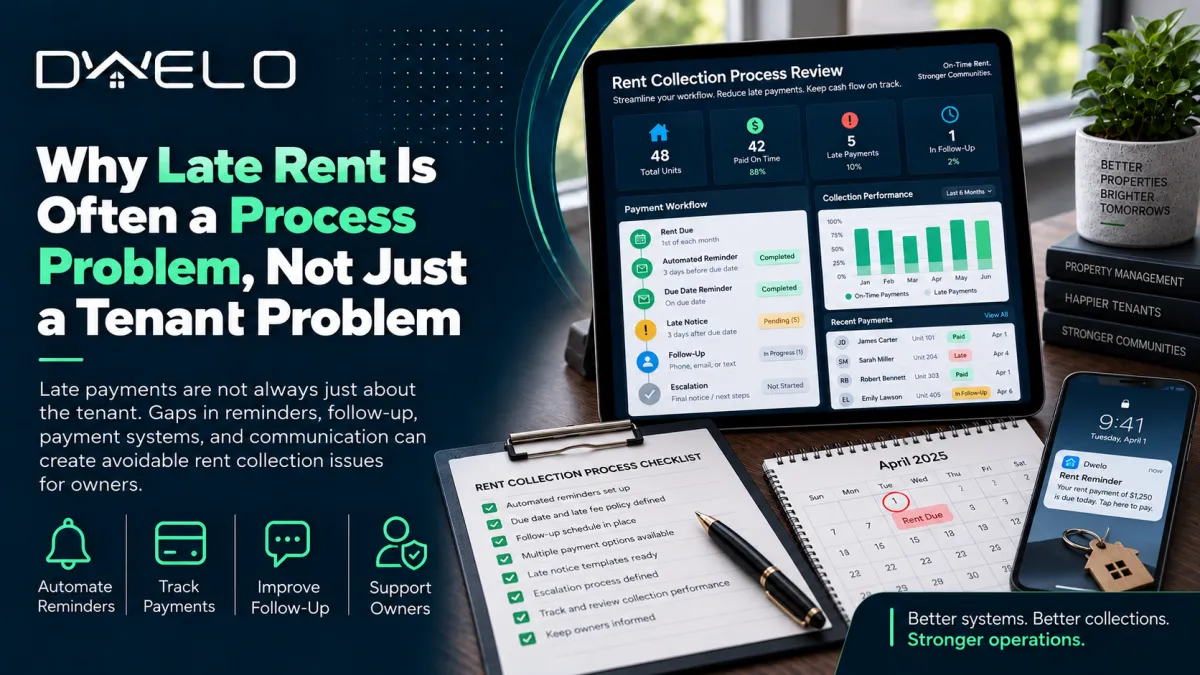
Why Late Rent Is Often a Process Problem, Not Just a Tenant Problem
Chronic late rent usually signals a broken collection process, not just a bad tenant. Learn how Dwelo's rent collection system keeps South Carolina owners paid on time.
When rent arrives late, the instinct is to focus on the tenant. They're disorganized. They're irresponsible. They don't respect the lease terms. These conclusions feel natural, and sometimes they're accurate. But experienced property managers know something that most self-managing landlords don't: chronic late payment patterns are more frequently a symptom of a broken collection process than a reflection of tenant character.
This distinction matters enormously, because it determines what the solution is. If late rent is purely a tenant problem, the only remedy is finding better tenants. If late rent is partly or primarily a process problem, then fixing the process produces better outcomes with the tenants already in place and creates a foundation that virtually eliminates preventable lateness regardless of who is occupying the unit.
For South Carolina rental property owners who are tired of following up every month, absorbing inconsistent payment timing, or having the same late-fee conversation repeatedly, understanding where process fails is the first step toward building a collection system that works without making every payment cycle a management exercise.
What a Broken Rent Collection Process Looks Like
Before identifying the specific process failures that produce late rent, it helps to recognize what a broken collection environment looks like in practice. The patterns are consistent and recognizable across self-managed properties throughout South Carolina.
The owner has no formal payment system. Tenants pay by check, cash, Venmo, Zelle, or whatever method is most convenient for them inconsistently, from cycle to cycle. The owner manually records each payment when it arrives and follows up when something seems missing. Late fees exist in the lease but are applied irregularly, sometimes waived when the conversation feels awkward, sometimes charged and then reversed when the tenant pushes back.
Payment timing is unpredictable. The owner's mortgage payment hits on the fifth, but rent from two of three properties routinely doesn't clear until the seventh or eighth, creating a recurring cash flow gap that the owner absorbs each month without addressing the root cause. The third property pays reliably on the first because that tenant set up an automatic bank transfer on their own initiative, not because the owner's system required it.
None of the tenants are bad people. None of them have malicious intent. The late payment pattern is not the product of dishonesty; it is the product of a collection environment that doesn't require or systematically enable on-time payment. The process is failing, and the tenants are operating within whatever structure the process provides.
The Process Failures That Produce Late Payment
Failure 1: No Clear, Enforced Payment Channel
When tenants can pay through multiple different methods check, cash, bank transfer, payment app — with no single designated system, the collection process has no central record, no automatic enforcement mechanism, and no consistent documentation. The owner is managing a different transaction type every month, and the tenant has no friction-reducing reason to pay on any particular schedule.
A designated, consistent payment channel, ideally an online system where tenants create an account, see their balance, and initiate or schedule payment, reduces the cognitive load of the payment act for the tenant and centralizes the record for the owner. Payment becomes a single, repeatable action rather than a monthly decision about method and timing.
Dwelo's rent collection services operate through a consistent online payment platform for every managed property — one channel, one record, automatic documentation for every transaction from initiation to clearance.
Failure 2: Lease Terms That Are Vague or Never Reinforced
A lease that specifies a due date and a late fee but never reinforces those terms in practice is a lease that teaches tenants the terms are negotiable. If the first late payment is waived, the second late payment is more likely. If the third is also waived, the due date has effectively become whatever day the tenant finds convenient.
The fault in this pattern is not the tenant's willingness to push boundaries, that is predictable human behavior. The fault is the process that allowed the boundary to move. A collection system where late fees apply automatically, without owner discretion or intervention, removes the human negotiation from the equation entirely. The lease terms enforce themselves, consistently, because the system executes them rather than leaving them to an individual judgment call in the moment.
Dwelo's lease administration services draft late fee provisions with the precision that makes automatic enforcement possible: specific amount, specific grace period, specific application trigger. No ambiguity means no dispute about whether the fee applies.
Failure 3: No Automatic Payment Option for Tenants
This is the process failure that has the most direct impact on payment timing, and it is entirely within the owner's control to address. A tenant who must actively initiate a rent payment every month writing a check, logging into a bank, pulling out a money order is dependent on their own memory and availability every single month, twelve times a year. Life intervenes. A particularly demanding week at work, a health issue, travel, a family situation any of these can shift the payment timing by a few days without the tenant intending to pay late.
A tenant who has set up automatic recurring payment is not dependent on memory or availability. The payment processes on the scheduled date whether the tenant is having a difficult week or not. The structural protection that automatic payment provides for the tenant's payment record and for the owner's cash flow reliability is one of the most effective late payment prevention tools available.
The owner's role in this is to make automatic payment the easiest and most obvious option: a platform that surfaces it clearly during tenant onboarding, confirmation that it's set up correctly before the first payment date, and consistent use of the same system throughout the tenancy. When the path of least resistance for the tenant leads directly to on-time automatic payment, most preventable lateness disappears without any further management intervention.
Failure 4: Screening That Prioritized Speed Over Reliability
Some late payment patterns do originate with the tenant — but the process failure in those cases typically occurred before the tenancy began. When tenant screening is rushed to fill a vacancy quickly, or when screening criteria are applied inconsistently, the result is sometimes a tenant whose financial history suggests payment reliability is going to be a recurring issue.
Payment history is the most predictive screening factor for future payment behavior. A tenant with a pattern of late payments in prior tenancies identifiable through a thorough background and rental history check is statistically more likely to continue that pattern in a new tenancy than to change it. An owner who skips or shortcuts screening and then experiences late payment throughout the tenancy has, in a meaningful sense, inherited the consequences of that process decision.
Dwelo's tenant placement and screening process treats payment history as a primary evaluation criterion, not an afterthought. The time invested in thorough upfront screening is the most cost-effective late payment prevention available, because it addresses the source rather than the symptom.
Failure 5: No Consistent Follow-Through on Non-Payment
When a payment is missed and the response is inconsistent sometimes a quick text, sometimes a formal notice, sometimes nothing until the owner notices the bank balance hasn't moved the collection environment communicates that the consequences of non-payment are unpredictable. Unpredictable consequences are weaker deterrents than consistent ones, because the tenant's mental model of what will happen if they pay late is uncertain.
A defined, documented non-payment response protocol: first missed payment triggers an automated notice on a specific day, second missed payment triggers a formal legal notice; no owner discretion in the sequence creates a collection environment where the consequences of non-payment are known, certain, and unavoidable. That certainty is itself a deterrent. Most tenants who are capable of paying on time will do so in an environment where the response to lateness is prompt and consistent.
When the Process Is Fixed, What Changes
The transformation that a properly structured rent collection process produces is not gradual; it is often immediate and dramatic. Owners who transition from informal, inconsistent collection to a systematic process frequently report that payment timing improves in the very first cycle, without any change in the tenant population.
This is the clearest evidence that the process, not the tenant, was driving the problem. The same tenants who were paying on the seventh or eighth of the month begin paying on the first, not because their financial habits changed, but because the collection structure now makes on-time payment the easiest, most automatic, most expected outcome.
Real-World Scenarios: Process Fixes That Changed Payment Patterns
Scenario 1: The Three-Day Drift That Disappeared Overnight
A Columbia property owner with two rentals had both tenants paying consistently late — never by more than three or four days, but reliably so, every month. The owner had accepted this as a feature of the tenancies rather than a process problem. After transitioning to Dwelo's full-service property management in South Carolina, both tenants were onboarded to the online payment platform with automatic recurring payment setup during move-in orientation. In the first month under the new system, both payments processed on the first. In the six months that followed, neither payment was late. Nothing about the tenants changed; the structure they operated within did.
Scenario 2: The Late Fee That Finally Stuck
A Charleston landlord had a tenant with a documented pattern of paying between five and ten days late most months. The landlord had attempted to charge late fees multiple times but had consistently backed down when the tenant disputed them partly because the lease language was ambiguous about the grace period, and partly because the owner found the conversation uncomfortable. After Dwelo took over management, the lease was renewed with precise late fee language and automatic system enforcement. The first time the tenant paid on day six, the fee applied automatically. No conversation occurred. The tenant paid by day two for every subsequent month of the tenancy. The fee didn't even need to be collected; it just needed to apply predictably once.
Scenario 3: The Screening Gap That Was Caught Before Move-In
A Mount Pleasant property owner had experienced two consecutive tenants with late payment patterns and assumed they were simply unlucky with tenant selection. A Dwelo review of the prior screening process revealed that rental history verification had not been completed for either tenancy; both tenants had been approved based on income documentation alone, without confirming payment behavior with prior landlords. Under Dwelo's screening process, the next applicant's rental history check surfaced a pattern of late payments with a prior landlord that the income documents had not revealed. The application was declined. The tenancy that followed with a thoroughly screened replacement applicant produced 14 consecutive on-time payments.
Key Benefits of a Systematic Rent Collection Process
Predictable Cash Flow
Automatic, on-time payments produce a reliable income rhythm that owners can plan against, eliminating the month-to-month uncertainty that informal collection creates.
Reduced Owner Time Investment
A collection process that runs automatically requires almost no owner attention in months where everything functions correctly, which, in a well-structured system, is most months.
Consistent, Defensible Late Fee Enforcement
System-applied fees are uniform, objective, and non-negotiable, protecting the owner's lease enforcement posture and fair housing compliance simultaneously.
Earlier Identification of Genuine Non-Payment
When the system expects payment on a specific date and flags non-receipt automatically, genuine non-payment is identified immediately rather than after several days of owner-side uncertainty. Earlier identification means earlier formal response and a faster path to resolution.
Lower Long-Term Tenant Quality Risk
A thorough screening process that treats payment history as a primary criterion reduces the incidence of tenancies that produce chronic lateness regardless of process quality, addressing the tenant-side contribution to late payment before the lease is signed.
The Problem You Can Fix Is the One Worth Focusing On
Late rent that comes from a genuinely unreliable tenant is a problem with a limited set of solutions: escalating notices, lease enforcement, and ultimately turnover. But late rent that comes from a process gap is a problem that can be fixed completely, often without changing the tenant population at all.
The owners who experience the most consistent, reliable rent collection are not necessarily the ones with the best tenants. They are the ones with the best systems: clear payment channels, automatic enforcement of lease terms, thorough upfront screening, and consistent non-payment follow-through. Those systems are what Dwelo builds into every managed property from day one.
Dwelo Property Management — your partners in real estate success.
Real estate agents whose South Carolina investor clients are absorbing chronic late rent as an unavoidable cost of property ownership can connect those clients with a management approach that addresses the root cause through our agent referral program.
Ready to build a rent collection process that works every month without chasing anyone? Schedule a free consultation with Dwelo and let's talk about what systematic collection looks like for your investment.
Dwelo Property Management provides comprehensive, full-service rental property management across Charleston, Mount Pleasant, North Charleston, Summerville, Goose Creek, Daniel Island, Johns Island, James Island, West Ashley, Isle of Palms, and the South Carolina Lowcountry.


