
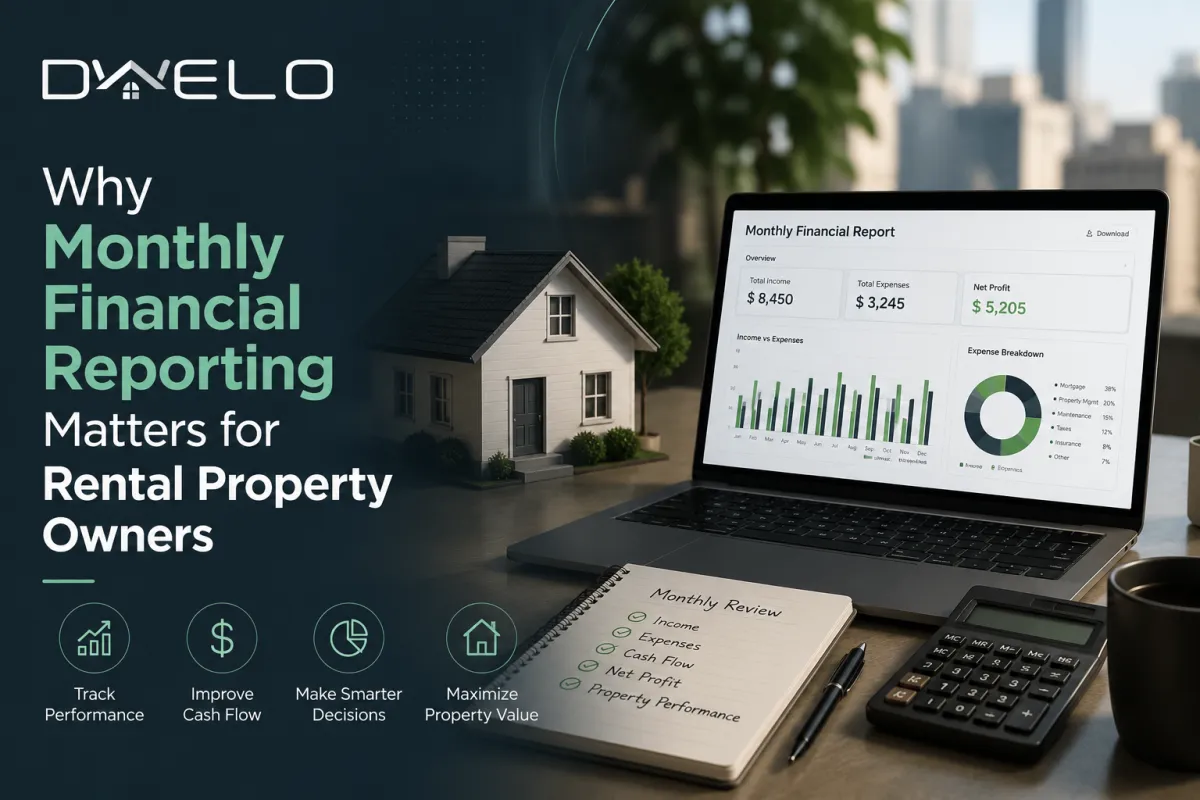
Why Monthly Financial Reporting Matters for Rental Property Owners
Most rental property owners can tell you what their monthly rent is. Far fewer can tell you, with any confidence, what their property actually netted last month after maintenance, management fees, vacancy days, and incidental costs were accounted for. There's a significant difference between gross rent and actual investment performance, and without clear financial reporting, the gap between those two numbers is invisible.
That invisibility is expensive. Owners who don't have structured, accurate, monthly financial data on their properties make decisions based on assumptions, gut feel, and incomplete information. They miss patterns that would flag a problem early. They struggle at tax time. They can't evaluate whether a rent increase is justified, whether a maintenance expense is running higher than it should, or whether a particular property is actually delivering the return they expected when they bought it.
Monthly financial reporting for rental property owners is the mechanism that converts a rental property from a passive asset you hope is performing into an investment you actively understand and can manage intelligently. For South Carolina property owners, whether they own one rental or an entire portfolio, structured monthly reporting is one of the most concrete, practical benefits that professional property management delivers.
This blog explains exactly what monthly financial reporting includes, why each component matters, and what it means for the long-term performance of your investment.
The Real Cost of Operating Without Financial Clarity
Before exploring what good financial reporting looks like, it's worth examining what operating without it actually costs, because the costs are real, even if they're hard to see in the moment.
Invisible Expense Creep
Rental property expenses don't always spike dramatically. They creep. A small maintenance cost here. A modest increase in landscaping there. A repair that was slightly more expensive than expected. Individually, none of these seems alarming. Collectively, over several months, they can quietly compress the net return on a property without the owner ever noticing, until they sit down at year's end and the numbers don't match their expectations.
Monthly reporting surfaces this creep in real time. An owner who reviews a clear expense summary every month sees changes as they happen, not after they've compounded for six months.
Tax Season Stress and Inaccuracy
Rental property owners who don't maintain monthly financial records typically face one of two problems at tax time: either they spend days reconstructing records from bank statements, email threads, and contractor invoices, or they file based on incomplete information and potentially miss legitimate deductions or misreport income.
Accurate monthly statements, maintained consistently throughout the year, make tax preparation straightforward. The data is already organized, categorized, and documented. The owner, or their accountant, has everything needed without any reconstruction effort.
Inability to Evaluate Investment Performance
A rental property is, fundamentally, an investment. And like any investment, it needs to be evaluated periodically against the return it was projected to deliver. Without structured financial data, that evaluation is impossible. Owners cannot determine whether their rent is priced appropriately relative to expenses, whether the property is appreciating in its net value, or whether capital improvements would generate a meaningful return.
This matters especially for owners considering expanding their portfolios. Decisions about acquiring additional properties should be grounded in a clear understanding of how existing properties are actually performing, not an estimate based on gross rent figures alone.
What Monthly Financial Reports Should Include
A professional monthly owner statement is not a single-line summary of rent received minus management fees. It is a comprehensive, itemized record of every financial activity associated with the property during the reporting period. Here is what Dwelo's financial reporting services for property owners deliver each month.
Rental Income Summary
The report begins with a clear accounting of all rent received during the period, including the date each payment was collected, the amount, and any partial payments or payment adjustments. This section documents not just what was received, but what was expected and whether any gap exists.
For owners managing multiple properties through Dwelo's full-service property management in South Carolina, income summaries are provided per property, allowing owners to evaluate each unit individually rather than viewing their portfolio as a single undifferentiated figure.
Maintenance and Repair Expenses
Every maintenance expenditure during the reporting period is itemized with a description of the work performed, the vendor or contractor involved, and the cost. This transparency allows owners to see exactly where maintenance dollars are going and to identify patterns over time.
An owner who notices, across three consecutive monthly statements, that a particular property is incurring consistently elevated plumbing-related expenses has an actionable signal: there may be a systemic issue worth investigating proactively. Without itemized monthly reporting, that pattern remains invisible until it becomes a major repair. Dwelo's property maintenance and repairs documentation feeds directly into owner reporting, creating a seamless link between what was done and what it cost.
Management Fees and Service Charges
All management fees, leasing fees, and any other service charges are itemized clearly and separately in the owner statement. Owners should never have to guess what they're paying for; professional reporting makes every charge explicit and traceable.
Net Owner Distribution
After all income is received and all expenses are deducted, the statement clearly identifies the net distribution amount transferred to the owner for the period, along with the transfer date and method. This is the number that matters most to most owners, and having it presented clearly, alongside the full detail that supports it, provides both certainty and context.
Running Year-to-Date Totals
Monthly statements should not exist in isolation. Each report should include running year-to-date totals for income, expenses by category, and net distributions. These cumulative figures allow owners to track performance trends over time, compare periods, and evaluate whether the property is on track relative to its annual projections.
How Financial Reporting Connects to Every Other Management Function
One of the most valuable aspects of professional financial reporting is that it doesn't exist in isolation. It is the output of every other management function, and its accuracy depends entirely on the quality of those upstream processes.
Rent collection that is systematic and documented feeds clean, accurate income figures into the owner statement. Dwelo's rent collection services ensure that every payment is recorded with precision, late fees are applied and documented consistently, and the data flowing into owner reports is complete and reliable.
Maintenance that is properly coordinated, invoiced, and documented creates the expense records that make reporting meaningful. A maintenance expense that isn't properly recorded is a gap in the financial picture, and gaps undermine the owner's ability to make sound decisions.
Lease administration that tracks active leases, renewal dates, and any rent adjustments provides the framework around which income reporting is structured. When lease terms are documented clearly and renewals are handled professionally, the financial records that follow reflect an accurate picture of what the property is contractually generating.
This interconnection is why professional property management delivers financial reporting that self-managing owners simply can't replicate on their own; the data quality depends on the operational quality of everything that precedes it.
Real-World Scenarios: What Financial Reporting Reveals in Practice
Scenario 1: The Expense Trend That Flagged a Plumbing Problem
A Mount Pleasant property owner reviewing monthly statements with Dwelo noticed that plumbing-related maintenance costs had appeared in three consecutive months, individually modest but cumulatively meaningful. The pattern prompted a targeted inspection, which identified a corroding pipe section in a crawl space. The repair was scheduled proactively and completed before any acute failure occurred. Without monthly itemized reporting, the pattern would have been invisible until water damage made the problem undeniable.
Scenario 2: The Portfolio Owner Who Finally Understood His Returns
A Columbia investor owned three rental properties and had been operating without structured financial reporting for two years. He believed all three properties were performing similarly because gross rents were comparable. After transitioning to Dwelo's management and receiving monthly statements for each property, he discovered that one unit was incurring maintenance costs nearly double those of the others, compressing its net return significantly. With that data in hand, he made a targeted capital improvement decision that addressed the root cause and brought the property's net performance in line with the rest of his portfolio.
Scenario 3: The Out-of-State Owner Who Could Finally Trust the Numbers
An investor based outside South Carolina owned a Charleston rental and had been managing it with minimal financial visibility, receiving occasional updates and a rough annual summary. After partnering with Dwelo, she began receiving a detailed monthly statement every period: income, expenses, fees, distribution, and year-to-date totals. For the first time, she had a genuine understanding of how her investment was performing month to month. That clarity transformed her relationship with the property from anxious oversight to confident ownership.
Key Benefits of Monthly Financial Reporting
Investment Clarity: Owners who understand their numbers make better decisions about rent pricing, capital improvements, portfolio expansion, and long-term investment strategy. Monthly reporting is what makes that understanding possible.
Tax Efficiency: Clean, categorized monthly records make tax preparation faster, more accurate, and more likely to capture every legitimate deduction. The cost of disorganized records, in accountant time, missed deductions, and stress, is real and avoidable.
Early Problem Detection: Expense trends visible in monthly reporting often signal developing issues before they become serious. Early identification leads to proactive resolution and lower total repair costs.
Ownership Confidence: There is a meaningful difference in how it feels to own a rental property when you have clear, professional financial reporting versus when you don't. Confidence in your numbers is confidence in your investment.
Accountability and Transparency: Professional monthly reporting holds property management accountable to owners in a concrete, documented way. Every dollar in, every dollar out, visible, explained, and on record.
Your Investment Deserves More Than a Rough Estimate
A rental property is one of the most significant financial assets that most owners will ever hold. Managing it without accurate monthly financial reporting is the equivalent of running a business without a P&L statement, possible in the short term, but increasingly costly as the investment grows and time passes.
Dwelo's commitment to financial transparency means every property owner receives clear, comprehensive monthly statements that reflect the true performance of their investment, not a simplified summary designed to avoid difficult conversations. That transparency is part of what it means to have a property management partner who treats your investment with the seriousness it deserves.
Real estate agents with South Carolina investor clients who are looking for a management partner they can trust with their clients' assets are welcome to learn more through our agent referral program, a straightforward way to deliver lasting value to your client relationships.
Ready to gain real financial clarity on your rental property? Schedule a free consultation with Dwelo, and let's talk about what professional financial reporting looks like for your investment.
Dwelo Property Management provides comprehensive, full-service rental property management across South Carolina, including Charleston, Mount Pleasant, Isle of Palms, Columbia, Greenville, Spartanburg, and surrounding communities.


